
If you stepped away from regular exercise in your 30s and you're now trying to rebuild in your 40s or beyond, the first thing you need to know is this: picking up where you left off is not a strategy. It's a shortcut to injury and frustration. The biology has shifted, and a smarter approach is available to you if you're willing to start where you actually are, not where you used to be.
Coaches who specialize in the 40-plus demographic hear the same story constantly. Someone who was active in their 20s, drifted away during the career-and-family years, and now wants it back. The desire is real. What's often missing is a framework that respects how the body changes with age while still pushing it to adapt and grow stronger.
Why Your 40s Demand a Different Starting Point
After 40, several physiological shifts are already in motion. Muscle protein synthesis slows down, meaning your body takes longer to build and repair muscle tissue. Connective tissue becomes less elastic. Recovery windows stretch out. None of this means you can't make significant gains. It means you need more precision at the start, not more intensity.
Research consistently shows that adults over 40 who jump back into high-volume training without a structural base are significantly more likely to sustain overuse injuries within the first eight weeks. That stat is not a reason to stay sedentary. It's a reason to build the foundation first.
Returning to exercise also has compelling cognitive benefits. Endless Scrolling Hurts Your Memory. Exercise Fights Back. covers the research showing that regular physical activity actively counteracts the working memory degradation associated with passive screen time, a pattern that tends to accumulate during sedentary periods.
Start With Foundational Human Movements
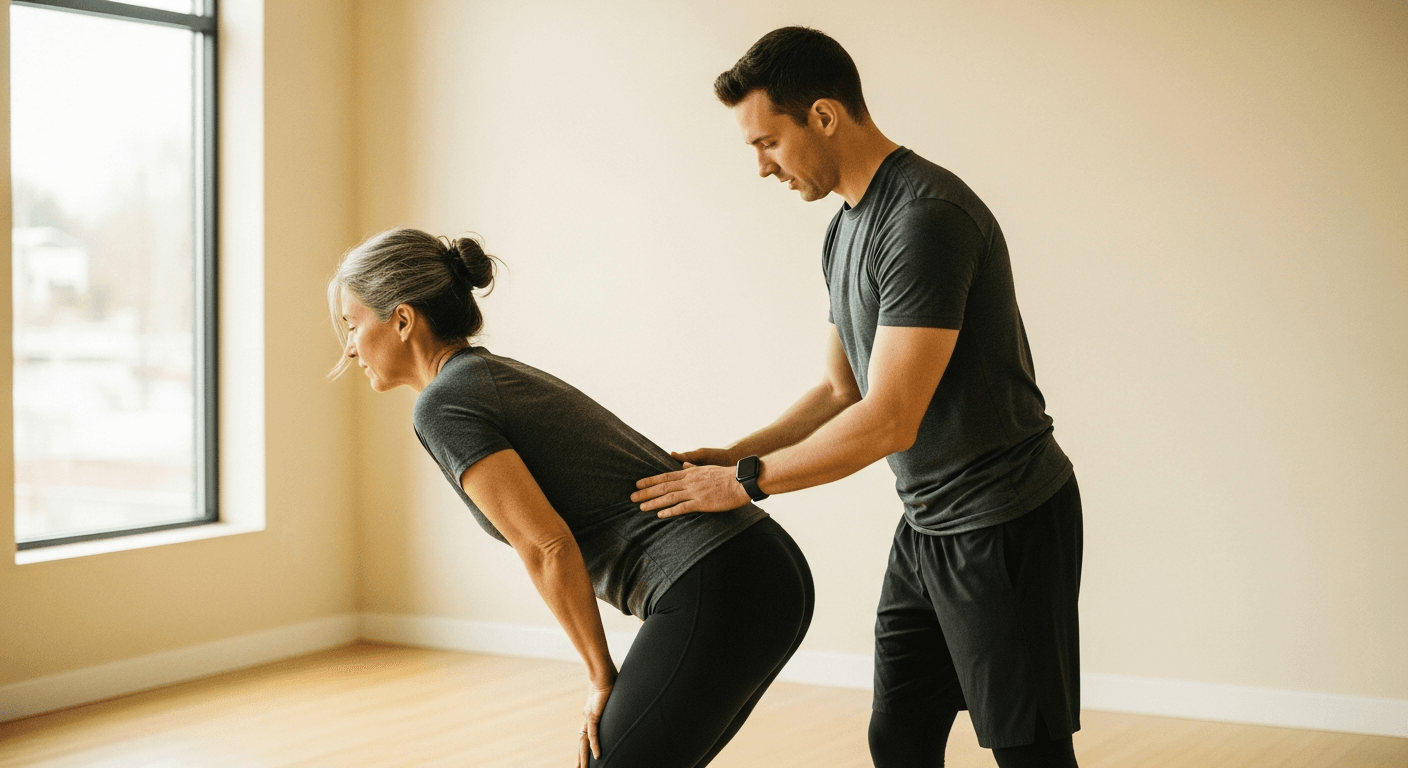
Before you load a barbell, before you sign up for a HIIT class, before you run your first 5K, your body needs to relearn how to move well. Coaches working in this space consistently point to the same handful of patterns as the starting line: walking, hinging at the hip, pushing, and pulling.
These aren't warm-ups. They're the foundation. Walking with intention, especially varied-pace walking on uneven surfaces, rebuilds proprioception and single-leg stability. Hip hinging, the movement pattern behind deadlifts, kettlebell swings, and bending to pick things up, is one of the most protective skills you can develop for your lower back and hamstrings. Pushing and pulling movements rebuild shoulder integrity and the upper-back strength that decades of desk work tends to erode.
Spend the first two to four weeks doing these movements with no added load or minimal load. The goal isn't fatigue. The goal is moving correctly enough that when you do add weight, your joints and connective tissue are ready for it.
Daily Movement Habits Matter as Much as Structured Sessions
One of the most overlooked elements of returning to fitness after a sedentary period is what happens between your scheduled workouts. If you're sitting for eight to ten hours a day and then doing three gym sessions per week, your body is still spending the vast majority of its time in positions that counteract your training.
Coaches working with busy professionals in this demographic recommend building what some call a movement environment. That means varying your posture throughout the workday, standing for portions of calls, taking short walking breaks every 60 to 90 minutes, and doing simple mobility work during transitions in your day. None of these replace structured training. All of them compound its effects.
The evidence behind this is solid. Adults who integrate low-intensity movement throughout their day show meaningfully better outcomes in joint health, metabolic markers, and exercise adherence compared to those who rely solely on scheduled sessions. If you're re-entering fitness, treating movement as a continuous habit rather than an event is one of the highest-leverage shifts you can make.
Recovery quality matters here too. If your sleep is fragmented or undiagnosed issues are disrupting your rest, your training adaptation will suffer. 5 Simple Recovery Habits That Actually Work outlines practical ways to support the tissue repair and hormonal recovery that make your workouts actually pay off.
Progressive Overload Over Volume: What the Research Says
Once you've rebuilt basic movement quality and established daily habits, the next phase is structured strength work. Here, the research is clear and coaches experienced with the 40-plus demographic echo it consistently: prioritize technique and progressive overload over volume.
Current exercise science recommends sets of 8 to 10 repetitions for building functional muscle in adults over 40. This rep range sits in a zone that generates enough mechanical tension to stimulate hypertrophy and strength adaptation without the joint stress and recovery debt that higher-rep, higher-volume approaches tend to produce. Two to three well-designed sessions per week, focused on compound movements executed with good form, will outperform five poorly structured ones every time.
Progressive overload simply means that over time, you're asking slightly more of your body. That could mean adding a small amount of weight, performing one more rep with the same load, or improving the quality and control of a movement. What it doesn't mean is adding more sessions or grinding through fatigue. Volume is a dial you turn up later, once the foundation is solid and recovery is keeping pace.
Nutrition plays a parallel role. Adequate protein intake becomes more critical after 40 because of the reduced efficiency of muscle protein synthesis. If you're unsure where your diet stands, Simple Diet Changes That Actually Move the Needle gives a practical starting point without requiring a total dietary overhaul.
Knowing When to Get Professional Coaching Support
There's a point in any return-to-fitness process where self-directed effort hits its ceiling. That ceiling tends to arrive earlier than people expect when they're over 40, not because of a lack of motivation, but because the margin for technical error is smaller and the cost of a misstep is higher.
Signs that coaching support makes sense include persistent discomfort in joints that doesn't resolve between sessions, feeling stuck in a plateau after six to eight weeks of consistent effort, or simply not knowing whether the program you're following is appropriate for your current condition. If you're wondering whether any of these apply to you, 11 Signs You Actually Need a Personal Trainer offers a concrete framework for making that call.
The barrier to accessing good coaching has dropped significantly in the past several years. Online and mobile coaching formats now make it possible to work with an experienced coach without committing to a specific gym or a fixed schedule. In the US market, remote coaching typically runs between $100 and $300 per month depending on the level of personalization and check-in frequency. That range puts professional guidance within reach for most working adults, at a fraction of the cost of in-person personal training sessions.
If you're weighing different coaching formats, the question of human versus AI-assisted coaching is increasingly relevant. AI vs Human Trainer: What to Choose in 2026 breaks down where each option performs well and where human judgment still has a clear edge, particularly for clients navigating injury history or significant deconditioning.
Building a Realistic 90-Day Framework
Coaches working with returning exercisers in their 40s tend to think in 90-day blocks. Here's how a realistic framework typically looks:
- Weeks 1 to 4: Focus on foundational movement patterns with bodyweight or minimal load. Walk daily. Prioritize sleep and basic recovery. Establish the habit of showing up before adding any real training stress.
- Weeks 5 to 8: Introduce structured strength sessions two to three times per week using compound movements. Keep sets in the 8 to 10 rep range. Add load only when form is consistent and recovery feels adequate.
- Weeks 9 to 12: Begin applying progressive overload systematically. Assess what's working. Consider whether a coach, program adjustment, or nutritional support would accelerate progress from here.
This timeline isn't glamorous. It won't produce viral transformation photos in 30 days. What it does produce is a body that's meaningfully stronger, more resilient, and better prepared for the next phase of training without having acquired a catalog of injuries along the way.
The Longer View
Fitness after 40 isn't about recapturing your 25-year-old self. The coaches who are most effective with this demographic share a consistent message: the goal is building a body that functions well, moves without pain, and supports the life you actually want to live for the decades ahead.
That framing changes how you train. It shifts the measure of success from aesthetics to capacity, from how you look in a given week to how you feel and move over years. It also makes the early investment in foundational work feel less like a delay and more like the actual point.
Start with movement. Build the habit. Add load with intention. Get support when you need it. The path back is straightforward. It just requires you to take it on its own terms.