

Four in five coaches say finding new clients is harder in 2026 than it was just two years ago. That figure, pulled from the Trainerize State of Personal Training report, isn't a blip. It reflects a market where attention is fragmented, competition is global, and the classic "trade hours for dollars" model has a hard ceiling. The coaches growing fastest right now aren't grinding harder at 1:1 sessions. They've restructured how they deliver value entirely.
Key Takeaways
- Group Coaching vs Monthly Subscription: Which Model to Choose When You're Ready to Scale Beyond 1:1 Four in five coaches say finding new clients is harder in 2026 than it was just two years ago.
- The coaches growing fastest right now aren't grinding harder at 1:1 sessions.
- Training a cohort of new runners preparing for their first 10K is a strong group setup.
Two paths dominate the conversation: group coaching and subscription programs. Both can work. Both can fail spectacularly. The difference almost always comes down to fit, not just format.
What Group Coaching Actually Is (And Isn't)
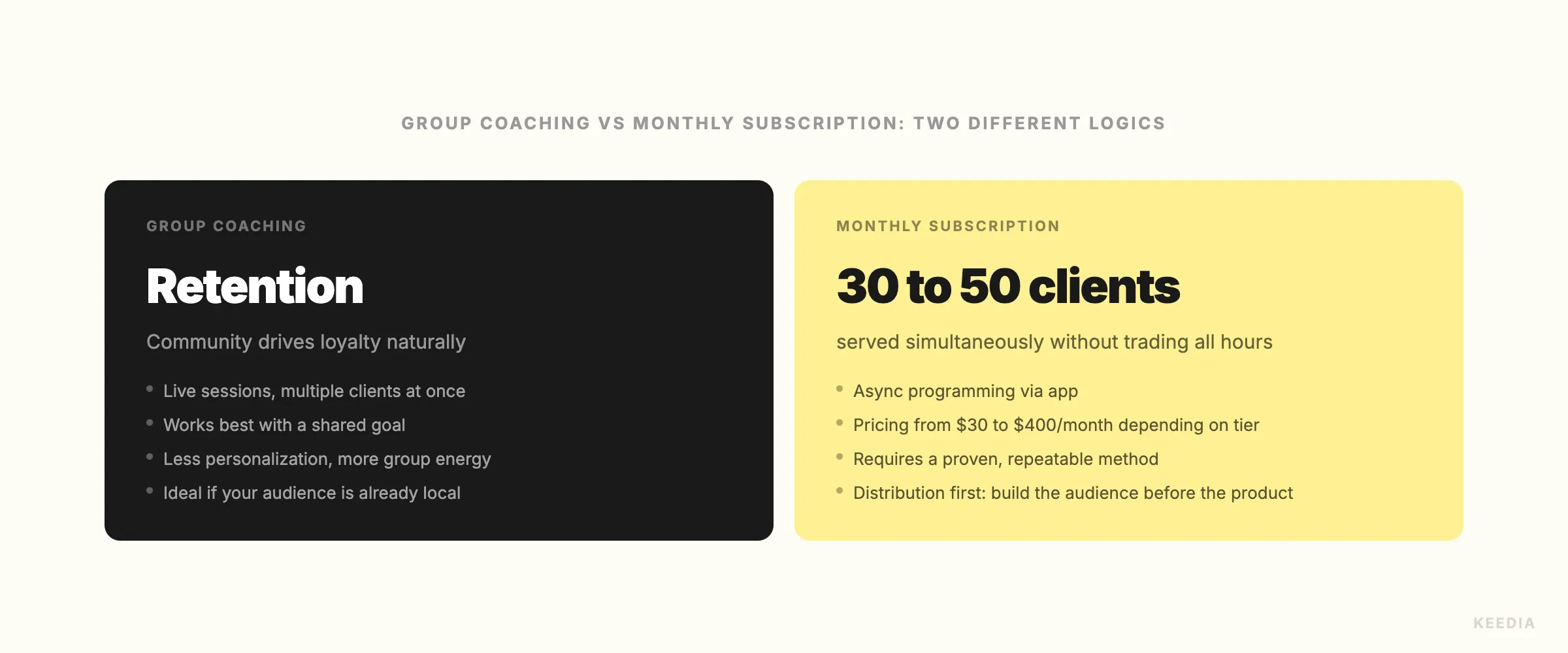
Group coaching means you're leading multiple clients live, at the same time. That could be a Zoom call with six people working through the same program, a weekly accountability session, or a structured training block where everyone moves through the same phases together.
The model works best when your clients share a clear, specific goal. Training a cohort of new runners preparing for their first 10K is a strong group setup. Trying to coach a 55-year-old recovering from a knee injury alongside a 28-year-old training for a powerlifting meet in the same group is not.
Compatibility of fitness level and outcome matters more than most coaches expect. When it's right, the community effect carries real retention weight. Clients don't just stay for the programming. They stay because they've built relationships with the people in the group, and leaving feels like abandoning a team. That kind of social glue is genuinely hard to replicate in 1:1 work.
The trade-off is depth. You can't customize everything. A client who needs specific modifications or a highly individualized plan will hit the limits of the group format quickly. Understanding how you measure progress in that context matters. If you're not tracking the right signals, you'll miss clients who are quietly struggling. How to Actually Measure Client Progress (Beyond Weight and Performance Numbers) is a useful framework for anyone building group accountability structures.

What a Subscription Program Actually Is (And Isn't)
A subscription program is an app-based or platform-based product where clients pay a recurring monthly fee to access pre-built programming, async check-ins, and content you've already created. You're not trading live hours. You're selling access to your system.
Entry-level subscription tiers in the US market typically run $30 to $100 per month. Premium tiers with more check-ins, video feedback, or direct messaging access range from $200 to $400 per month. At scale, a coach with 40 subscribers at $80/month is generating $3,200 monthly with a workload that's a fraction of what 40 individual clients would require.
The prerequisite most coaches skip is this: you need a repeatable, documented method before this model works. If your coaching still lives mostly in your head, if you're customizing everything on the fly, if you couldn't hand your program to someone else and have it make sense, a subscription product will expose every gap. The client experience depends entirely on the quality of what you've already built.
This is also the model where AI tools are having the most meaningful impact in 2026. Automated check-in sequences, adaptive programming suggestions, and async feedback tools all reduce the time cost of serving a larger client base. AI and Personal Training in 2026: What the Tools Actually Do (and What They Don't Replace) breaks down where those tools genuinely help versus where human coaching judgment is still irreplaceable.
The Most Common Failure Mode
Here's what goes wrong most often: a coach builds the product before building the audience.
You spend three months developing a beautifully structured subscription program. You record the video content, set up the app, build the onboarding sequence. You launch it. Sixty days later, you have seven subscribers, three of whom are people you already knew.
A subscription program with no existing community, no email list, and no consistent content presence rarely breaks 10 subscribers in the first 90 days. The delivery model is secondary to distribution. This is true for group coaching too, but the math is more forgiving because you only need 8 to 12 committed people to run a viable group.
Before you build anything, audit your current reach. How many people open your emails? How many people engage when you post? Do you have former clients who have stayed in touch? The answers tell you which model you can realistically fill, and how fast. The industry consolidation happening across fitness platforms right now, detailed in coverage of Playlist and EGYM's $7.5B merger and what it means for the fitness software market, is making distribution harder for independent coaches, not easier. Your existing relationships are your competitive advantage.
Who Thrives in Each Model
Group coaching tends to work well for coaches who:
- Have a niche with a natural cohort structure (new moms returning to training, athletes in a specific sport, adults over 50 focused on mobility and strength)
- Enjoy live facilitation and community building as part of their identity as a coach
- Have a client base with overlapping availability for scheduled sessions
- Want to keep a live, relational element in their work without burning out on individual sessions
Subscription programs tend to work well for coaches who:
- Have already proven their method works across multiple individual clients with consistent results
- Have an existing audience, even a modest one, that already trusts their approach
- Are comfortable with asynchronous communication and don't need the energy of live sessions to stay motivated
- Want to serve clients across multiple time zones without scheduling constraints
Why Hybrid Wins in 2026
The data from the Trainerize report points clearly toward hybrid models as the most profitable and retentive approach this year. The structure that keeps showing up in high-performing coaching businesses looks like this: one or two live sessions per month, async programming delivered through an app, weekly check-ins, and a community channel where clients interact with each other between touchpoints.
Clients stay in these models not because the programming is exceptional. Programming is widely available at this point. They stay because of the relationship. The live touchpoints, even minimal ones, signal that a real person is invested in their progress. The community creates accountability that doesn't require your direct involvement every day.
Recovery, sleep quality, and lifestyle factors matter more to long-term client retention than training variables alone. Coaches building subscription or hybrid programs that address the full picture, including how clients are sleeping, recovering, and managing stress, tend to see better results and lower churn. The complete guide to active recovery and training without breaking down is the kind of content that integrates well into a subscription program's educational layer.
The coaches stalling in 2026 are mostly trying to solve a distribution problem with a product decision. Picking the right model matters, but it matters less than building the audience, the trust, and the proof of concept before you invest months into building the infrastructure. Start with whichever format you can fill with real people in the next 60 days. Then scale it.
Frequently Asked Questions
How do you find the right personal trainer?
Check their certifications, ask for client testimonials, and evaluate their ability to personalize a program rather than apply a generic template.
How long does it take to see results with a coach?
Most people notice initial changes within 4 to 8 weeks with consistent training. Visible, lasting results typically come between 3 and 6 months.
Is online coaching as effective as in-person?
For many goals, online coaching is equally effective when it includes personalized programming, regular check-ins, and proper form guidance. The best approach in 2026 is often a hybrid model.
Related articles
- How to choose a personal trainer in 2026
- How to Choose the Right Personal Trainer in 2026 (Without Getting Burned)
- Hybrid Coaching: How to Transition from In-Person to a Mixed Model