
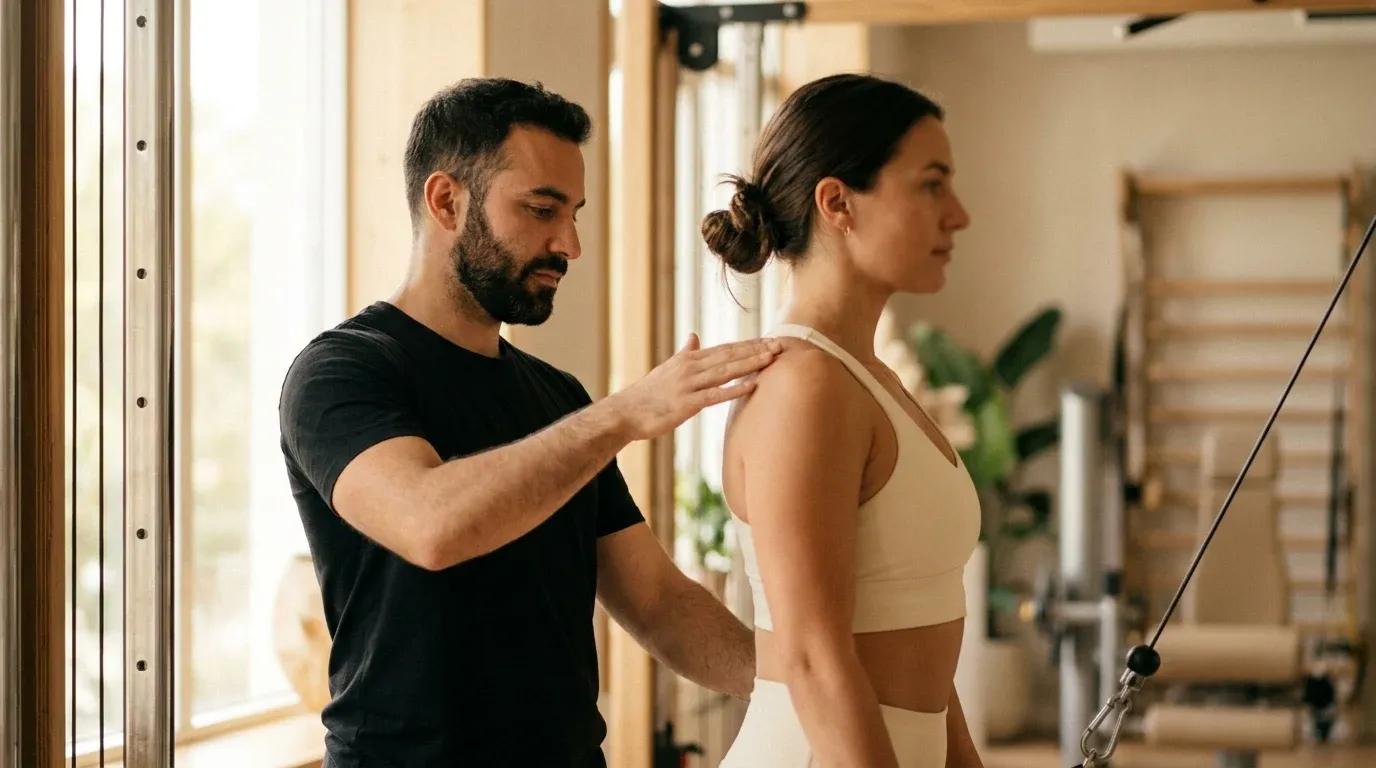
Most people hire a personal trainer for a visible result. They want to lose twenty pounds, add muscle, or finally stop feeling wrecked after a flight of stairs. Those goals are legitimate. But if you ask longtime clients what they actually got from working with a coach, the answer is rarely what they expected. The biggest shift isn't physical. It's perceptual.
They learned, often for the first time, how to read their own body with any real accuracy.
The Metric No One Talks About
There's a persistent assumption in fitness culture that the point of a trainer is to push you harder than you'd push yourself. And while that's sometimes true, it misses something more durable. Coaches who leave a lasting impression don't just load more weight onto the bar. They teach you to notice things: the difference between productive discomfort and pain that signals a problem, the feeling of a muscle actually working versus compensating, the distinction between genuine fatigue and the urge to quit because something feels unfamiliar.
Research on exercise adherence consistently points to a concept called interoceptive awareness. That's your ability to accurately perceive internal body signals. People with higher interoceptive accuracy tend to train more consistently, manage recovery better, and are less likely to overtrain or chronically underdo it. Most fitness content ignores this entirely.
A good trainer builds it deliberately. Every cue they give you. "Feel that in your glutes, not your lower back." "Notice how your breathing changes at the top of that rep." "What does a seven out of ten effort actually feel like for you right now?" These aren't throwaway coaching lines. They're calibration. Over time, you stop needing someone to tell you what's happening in your body, because you've developed the vocabulary and the attention to figure it out yourself.
Why This Changes How You Train Between Sessions
Here's the practical payoff. Clients who develop bodily awareness through coaching don't fall apart between sessions. They don't mindlessly skip workouts or push through pain that should make them rest. They make better decisions on their own because they have better information, not from a wearable or an app, but from their own body.
This is why how often you train with a personal trainer matters less than what you do with the hours between sessions. A coach who sees you twice a week is influencing roughly two percent of your waking hours. The other ninety-eight percent are yours. If the only thing those two sessions do is tell you what to lift, your progress is capped at the sessions themselves. If those sessions teach you how to interpret effort, fatigue, and recovery, your entire relationship with training changes.
Clients who've internalized body signals also tend to modulate intensity intelligently. They know when to go harder because they genuinely have more to give. They know when to pull back because the signals are real, not just inconvenient. That's a skill that compounds quietly over months and years.
The First Four Sessions Set Everything
Before you read another guide on certifications and session rates, here's what actually shapes your long-term experience with a trainer: the first four sessions. Not the intake form. Not their Instagram. The tone of self-awareness gets established almost immediately, and it either builds or erodes from there.
In those early sessions, pay attention to how your trainer communicates. Do they describe exercises in terms of what you should feel, or only in terms of what you should do? Do they ask for your feedback, or do they just move you from station to station? Do they explain why a movement matters for your body specifically, or do they run you through a template?
These aren't soft, secondary considerations. They're the difference between a coaching relationship that makes you more self-sufficient and one that makes you dependent. Dependency isn't always financial, though it can be. It's psychological. Clients who never develop body literacy need a trainer to tell them when they're tired, when they're working hard enough, and when they're ready to progress. That's an expensive and fragile way to stay fit.
If you haven't started yet and you're still evaluating coaches, the framing in how to find a personal trainer you can actually trust is worth your time. But even a technically qualified coach can fail you here if they're not oriented toward building your awareness rather than their own indispensability.
What Good Cueing Actually Sounds Like
Coaching cues fall into two broad categories: external cues and internal cues. External cues direct your attention outward. "Push the floor away." "Drive your elbows toward your hips." Internal cues direct your attention inward. "Feel your lats engage." "Notice the tension in your core." Both have their place, but internal cues are what build the interoceptive muscle over time.
Good trainers mix both, and they shift emphasis as you progress. Early on, external cues help you get the pattern right without overthinking it. As the movement becomes familiar, internal cues help you connect with what's actually happening in the tissue. That progression isn't accidental in skilled coaching. It's deliberate.
You can also notice the quality of a trainer's feedback. Vague feedback like "good job" or "keep going" teaches you nothing. Specific feedback like "your right hip dropped on that last rep. Did you feel it?" does something different. It prompts you to locate a sensation you may have missed. That's the moment learning happens.
Soreness, Fatigue, and the Cost of Misreading Them
One of the most common mistakes untrained exercisers make is confusing muscle soreness with a sign that a workout worked. Delayed onset muscle soreness, or DOMS, is a real physiological response. But it correlates poorly with training quality. You can have an effective session with minimal soreness. You can also wreck yourself chasing soreness and end up undertrained because you needed more recovery days than your program allowed.
A good trainer teaches you this distinction early and revisits it often. They help you understand that fatigue has layers: peripheral fatigue in the muscles themselves, central nervous system fatigue that accumulates over training blocks, and perceptual fatigue that's as much psychological as physiological. Learning to read which kind you're dealing with on a given day changes how you train that day, and over a training year, those daily decisions add up to enormous differences in results.
This is also relevant if you're training in a format where the coach isn't physically present. In-home personal training can be highly effective, but it works best when the client already has a baseline of body awareness. If you're starting from scratch, prioritize sessions that develop that awareness first, regardless of where they happen.
Age, Context, and Why This Matters More Over Time
The stakes around body literacy increase as you get older. Recovery takes longer. The signals are sometimes subtler. The consequences of misreading them, either pushing through real pain or treating normal training discomfort as injury, become more significant. This is especially true for people returning to training after a long gap, or training seriously for the first time in their forties or beyond.
Research consistently shows that older adults who develop strong interoceptive awareness maintain more consistent training habits than those who rely purely on external motivation or rigid programs. If you're in that cohort, the coach you choose matters in a very specific way. You want someone who builds your ability to self-regulate, not just someone who designs good programs. Those are different skills, and not every trainer has both.
The considerations around choosing a trainer for building muscle after 40 go beyond programming knowledge. Ask yourself whether this person is teaching you something every session, or just running you through something.
The Quiet Compounding Effect
Body literacy doesn't show up on a before-and-after photo. It doesn't track neatly in a fitness app. But it's probably the most durable thing a good coaching relationship can give you. It means that when your trainer is on vacation, you don't fall apart. It means that when you travel or your schedule breaks down, you can make a reasonable decision about what your body needs that day. It means that a decade from now, you're still training in some form, because you never fully lost the thread of what it feels like.
The people who stay fit for life aren't the ones who found the perfect program. They're the ones who learned to listen. A good trainer accelerates that education more than almost any other investment in your fitness life. That's worth knowing before you hire one, and worth demanding once you do.