
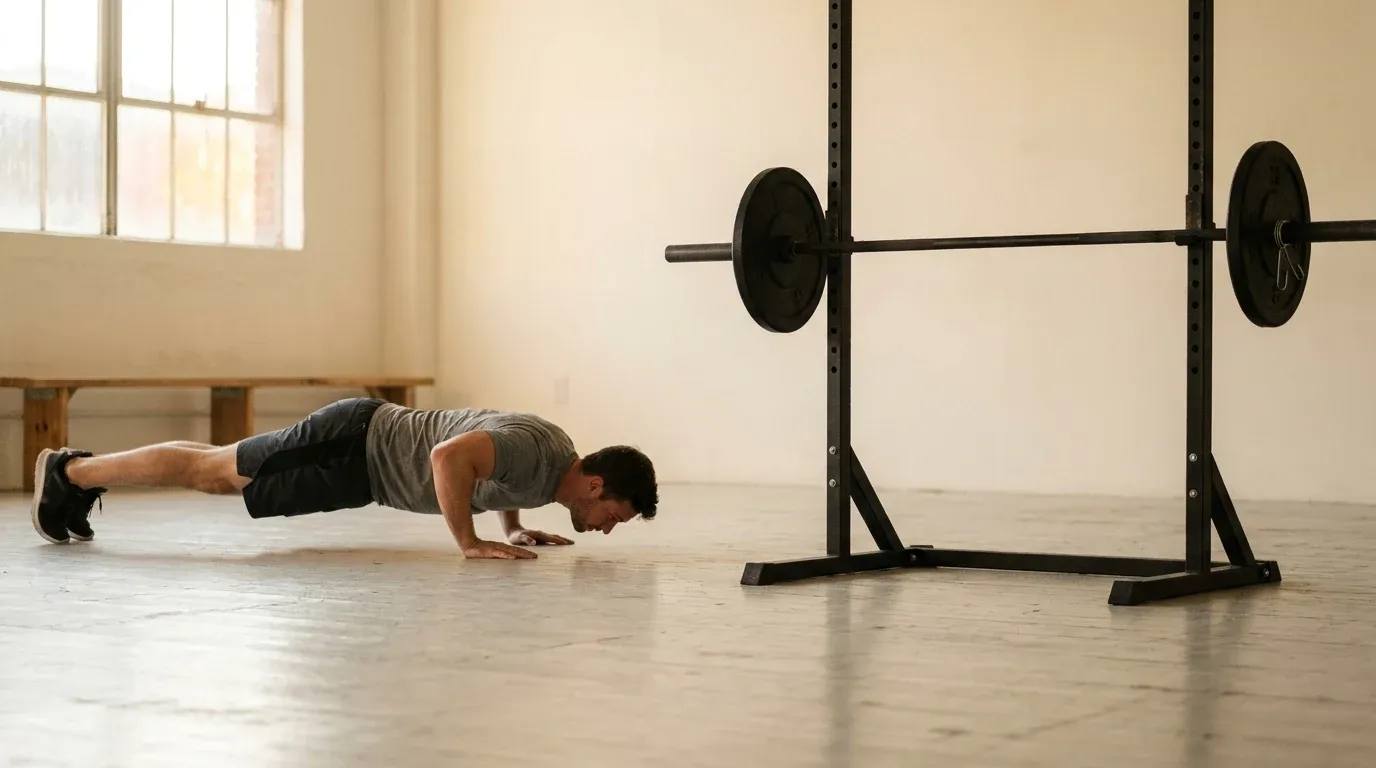
The assumption has been around for decades: if you're serious about building muscle and strength, you need a barbell. A squat rack. A gym membership. Bodyweight training, the thinking goes, is fine for beginners or for staying active on the road, but it can't produce the same results as real resistance training. New research is directly challenging that idea.
A study published in the Journal of Human Kinetics compared outcomes between participants following structured bodyweight programs and those training with free weights over an extended period. When total volume and progressive overload were matched between groups, muscle hypertrophy and strength gains were statistically comparable. The equipment wasn't the deciding factor. The structure was.
What the Research Actually Found
The study tracked two groups of trained adults over several weeks. One group trained exclusively with free weights. The other used bodyweight exercises only. Both groups followed progressive programs designed to increase difficulty over time. Neither group had a significant edge when researchers measured muscle thickness and functional strength at the end of the trial.
That's a notable finding, but it comes with an important condition. The bodyweight group didn't just do push-ups until they got bored. They followed a structured protocol that systematically increased the challenge, using lever progressions, tempo manipulation, and rep scheme adjustments to keep the stimulus demanding. When that structure was in place, the body responded in essentially the same way.
This aligns with what exercise science has been pointing toward for years. Muscle tissue doesn't know whether the resistance it's working against comes from a dumbbell or your own bodyweight. What it responds to is mechanical tension, metabolic stress, and progressive overload over time. Those variables can be created with or without a gym.
The Real Variable: Progressive Overload
Here's where most people go wrong with bodyweight training. They pick a set of exercises, get comfortable with them, and repeat the same routine for months. That's not training. That's maintenance at best.
Progressive overload means consistently increasing the demand placed on your muscles. With weights, that's straightforward: add a plate, increase the dumbbell, move up a kettlebell size. With bodyweight, you have to be more deliberate. But the options are genuinely extensive.
- Leverage progressions: Moving from a standard push-up to an archer push-up to a one-arm push-up dramatically increases the load on the working muscles.
- Tempo manipulation: Slowing the eccentric phase of a movement, say a five-second descent on a squat, increases time under tension and muscle damage without adding external weight.
- Range of motion increases: Deficit push-ups and deep pistol squats extend the range your muscles work through, amplifying the stimulus.
- Volume increases: Adding sets or total reps over time follows the same logic as adding load with weights.
- Skill-based progressions: Movements like the pseudo planche or front lever introduce significant strength demands that rival barbell lifts for the upper body.
The key insight from the research is that these tools work, provided you apply them with the same rigor you'd bring to a barbell program. Casual bodyweight training produces casual results. Structured bodyweight training produces results that hold up under scientific scrutiny.
This matters for how you think about program design broadly. Whether you're lifting weights or working with your own bodyweight, the principle behind building your program around compound versus isolation movements still applies. Multi-joint exercises that recruit large amounts of muscle tissue should form the foundation. Accessory work fills in the gaps.
Where Weights Still Have an Edge
The research doesn't suggest bodyweight training is superior. It suggests it's comparable under the right conditions. There are still areas where external load has clear advantages.
Lower body training is the most obvious limitation. The squat, deadlift, and their variations allow you to load the legs with hundreds of pounds. Pistol squats and single-leg deadlifts are challenging, but they have a ceiling for advanced athletes. If your primary goal is maximum lower body hypertrophy or peak strength, a barbell gives you access to loads that bodyweight simply can't replicate at the top end.
Tracking and repeatability is another advantage of weights. When you put 185 pounds on a bar, you know exactly what you lifted. Bodyweight progressions involve more variables and require more attention to execution to ensure you're genuinely progressing rather than just changing the movement pattern.
For those over 40, there's also the question of how you structure your training as recovery becomes a more significant factor. Understanding what structured coaching looks like after 40 can help you navigate both bodyweight and weight-based approaches without accumulating unnecessary joint stress.
Practical Implications for Home Trainers and Frequent Travelers
If you train at home or travel regularly, this research is genuinely useful. It removes the excuse that you can't make meaningful progress without gym access, but it also raises the standard for what your training needs to look like.
A well-designed home bodyweight program should include:
- A push progression: Moving through a hierarchy from standard push-ups toward more demanding variations like pike push-ups, decline push-ups, and eventually archer or one-arm variations.
- A pull progression: A pull-up bar is the one piece of equipment worth having. If you don't have one, door-frame alternatives exist. Work toward weighted pull-ups or advanced grip variations over time.
- A lower body push: Squats progressing to Bulgarian split squats to pistol squats, with tempo and pause variations throughout.
- A hinge: Single-leg Romanian deadlifts and Nordic hamstring curls are effective bodyweight options for posterior chain work.
- Core and anti-rotation work: Hollow body holds, ab wheel rollouts, and side plank progressions build genuine trunk strength.
The critical habit is logging your sessions. Record what you did, how many reps, what tempo, and how difficult it felt. That data lets you make intentional decisions about when and how to progress. Without it, you're guessing, and guessing leads to stagnation.
If you want a concrete structure for building this out over several months, planning your training block strategically gives you a framework to apply progressive overload across a full season, whether you're working in a gym or a hotel room.
Nutrition Still Matters Equally
Equipment choice has no bearing on what happens at the table. Muscle growth, regardless of training modality, requires adequate protein intake, appropriate caloric support, and recovery-oriented habits. Research consistently points to 1.6 to 2.2 grams of protein per kilogram of bodyweight as the range that supports hypertrophy in trained individuals.
For those using plant-based protein sources, the evidence for alternatives to whey has strengthened considerably. Recent review findings on pea protein and muscle growth suggest it's a viable option for supporting the same adaptations, provided total protein targets are met.
Sleep and recovery are similarly non-negotiable. You can train with perfect programming and optimal nutrition, but without adequate sleep, the adaptations simply don't consolidate the way they should.
The Bottom Line
The barbell is a great tool. So is your own bodyweight. What the recent research makes clear is that neither one is inherently superior when the training is properly structured. The variable that determines your results isn't what's in your hands or attached to a rack. It's whether you're applying consistent, progressive overload over time.
If you've been dismissing bodyweight training as a fallback option or a lesser alternative, it's worth reconsidering. A well-designed bodyweight program, built around compound movements and managed with the same discipline you'd bring to any barbell cycle, can produce the muscle and strength gains you're after. The gym is optional. The structure isn't.