
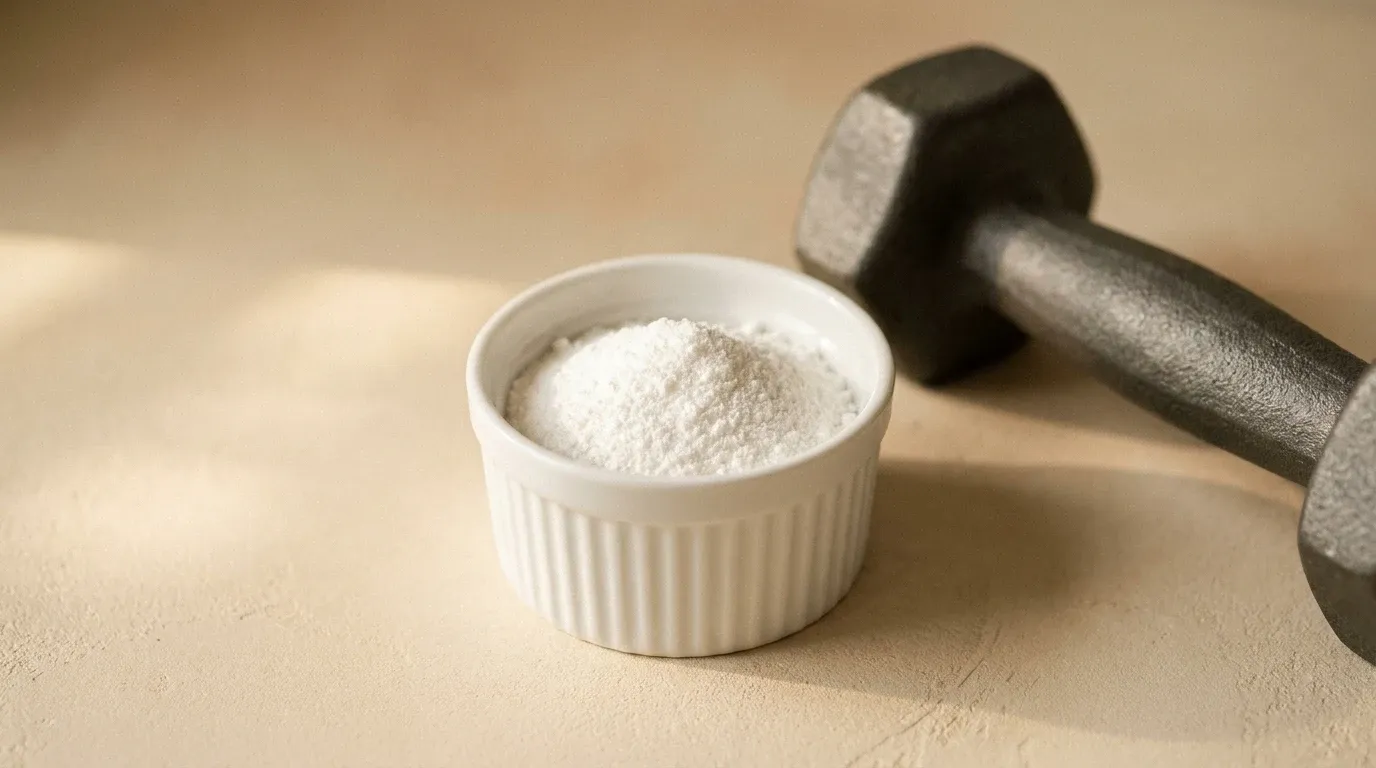
A study out of Texas A&M made headlines for a straightforward reason: participants gained muscle and strength on creatine supplementation alone, without touching a weight or completing any structured exercise program. If you've been skeptical of supplement claims, that finding is worth paying attention to. But stopping there would miss the more important part of the story.
Because when those same researchers looked at what happened when creatine was combined with resistance training and a calorie-reduced diet, the results weren't just better. They were significantly better. Understanding the difference between those two outcomes tells you more about how creatine actually works than any single headline can.
What the Texas A&M Study Actually Found
The 12-week trial enrolled middle-aged adults and split them into groups based on supplementation and exercise status. The creatine-only group, no structured training, no changes to their usual activity, gained measurable lean tissue and showed improvements in strength markers over the course of the study.
That's not a trivial finding. Most supplements produce no meaningful physiological change in the absence of training stimulus. Creatine did. The likely mechanism involves creatine's role in phosphocreatine resynthesis, which supports ATP production during high-effort muscle contractions, but also appears to influence satellite cell activity and myosin heavy chain expression even at rest in certain populations.
The gains in the no-exercise group were real. They were also modest. Researchers were clear that these were not the kind of numbers that would transform a sedentary person's body composition in any dramatic way.
When You Add Training and a Calorie Deficit, Everything Changes
The group that combined creatine supplementation with resistance training and a modest caloric reduction didn't just outperform the creatine-only group. They showed substantially greater strength gains, more lean tissue preservation and growth, and measurable reductions in body fat over the same 12-week window.
This is the creatine story most people in strength sports already understand intuitively, but rarely see laid out so cleanly in a controlled trial. The supplement isn't doing the work. It's amplifying the work you're already doing.
The calorie deficit component matters here too. Maintaining or building muscle mass during a cut is one of the harder physiological challenges in body recomposition. Creatine's ability to support training volume and intensity, while the body is in a mild energy deficit, appears to be a meaningful advantage. If you're currently navigating weight loss alongside a training program, the protocol used in this trial is directly applicable to your situation.
For a broader look at how strength training stacks up against other training modalities in terms of long-term health outcomes, Cardio vs. Strength: What Actually Protects Your Heart covers the evidence across both camps in detail.
Why Middle-Aged Adults Are the Right Population for This Research
The study didn't use college athletes or young lifters. It used middle-aged adults, a population where muscle loss is already a clinical concern. After the age of 30, adults lose roughly 3 to 5 percent of muscle mass per decade in the absence of resistance training. That rate accelerates after 60. Sarcopenia, the progressive loss of skeletal muscle, is directly linked to increased fall risk, metabolic dysfunction, and reduced quality of life.
The fact that creatine produced any measurable benefit in sedentary middle-aged participants is significant from a public health standpoint. Not everyone can train. Not everyone has access to a gym. Some people are recovering from injury or surgery and cannot yet follow a structured resistance program.
For those individuals, the idea that creatine might slow muscle loss or preserve baseline strength during a period of low activity isn't a shortcut narrative. It's a legitimate clinical consideration.
This is also relevant for anyone returning to training after a layoff. If you're rebuilding after an injury or illness, creatine may help you hold on to more of your baseline strength while your capacity to train is still limited. Once you're cleared to train again, the amplification effect kicks in, and that's where the real returns start compounding.
How to Think About Creatine Dosing and Format
Creatine monohydrate remains the most studied and most cost-effective form of creatine available. A standard daily dose of 3 to 5 grams is sufficient for saturation in most adults, with or without a loading phase. The loading phase, typically 20 grams per day split into four doses for 5 to 7 days, speeds up saturation but doesn't change the long-term muscle creatine content you'll reach.
Timing matters less than consistency. Taking creatine at roughly the same time each day, whether pre-workout, post-workout, or with a meal, is more important than trying to optimize a precise window.
It's also worth knowing that not all supplement formats deliver the same bioavailability. The form creatine is delivered in, and what it's combined with, can affect absorption. Supplement Format Matters as Much as the Ingredient Inside breaks down how delivery format affects what your body actually absorbs across several common supplements, including creatine.
What This Means If You're Already Training Consistently
If you're already following a structured resistance program, the Texas A&M findings reinforce something you may already suspect: creatine is probably worth adding if you haven't already. The marginal cost is low, the evidence base is strong, and the upside is real.
What the study also tells you is that creatine won't paper over gaps in your training. The largest gains went to the group doing the most work. Supplementation is leverage, not a foundation. If your training has stalled and you're looking for a reset, the issue is likely in the program itself, not the supplement stack.
If you're hitting a wall with strength progression specifically, How to Break a Strength Plateau, Per New ACSM Research outlines what updated resistance training guidelines suggest for people who've plateaued after consistent months of training.
A Note on GLP-1 Users and Muscle Preservation
One population where the solo-creatine findings carry particular weight is people currently using GLP-1 receptor agonists for weight management. These medications are effective at producing significant caloric deficit and fat loss, but they also carry a well-documented risk of lean muscle loss, particularly in users who aren't engaged in structured resistance training.
For someone on a GLP-1 who is not yet exercising regularly or is medically limited in what they can do, creatine supplementation could theoretically offer some protective effect against muscle loss. The evidence isn't specific to this drug class yet, but the mechanism is plausible and consistent with what the Texas A&M trial demonstrated.
If you're on a GLP-1 and thinking about how to structure your nutrition to minimize muscle loss, On GLP-1s? Here's How to Eat to Keep Your Muscle covers the dietary side of that equation in depth.
The Practical Takeaway
Creatine built muscle and strength in people who didn't exercise. That's true, and it matters. It matters especially for older adults, people in recovery, or anyone whose training capacity is temporarily limited.
But the study also showed, clearly and in the same data set, that the people who trained and supplemented got dramatically better results than the people who supplemented alone. The supplement worked. Training worked harder.
Here's what the research is actually telling you: creatine is a genuine performance tool with a meaningful effect size, even in the absence of training. It is not, under any reading of this data, a substitute for exercise. It's an amplifier. The more quality input you give it to work with, the more it returns.
If you're not sure where to start with a structured program, or you're returning from a break and thinking about getting professional support, it's worth being selective about who guides you. 5 Questions to Ask a Trainer Before You Hire Them outlines what to look for before committing to a coaching relationship, so you don't waste time or money on a poor fit.
Start training. Add creatine. Repeat consistently. That's the full story.