
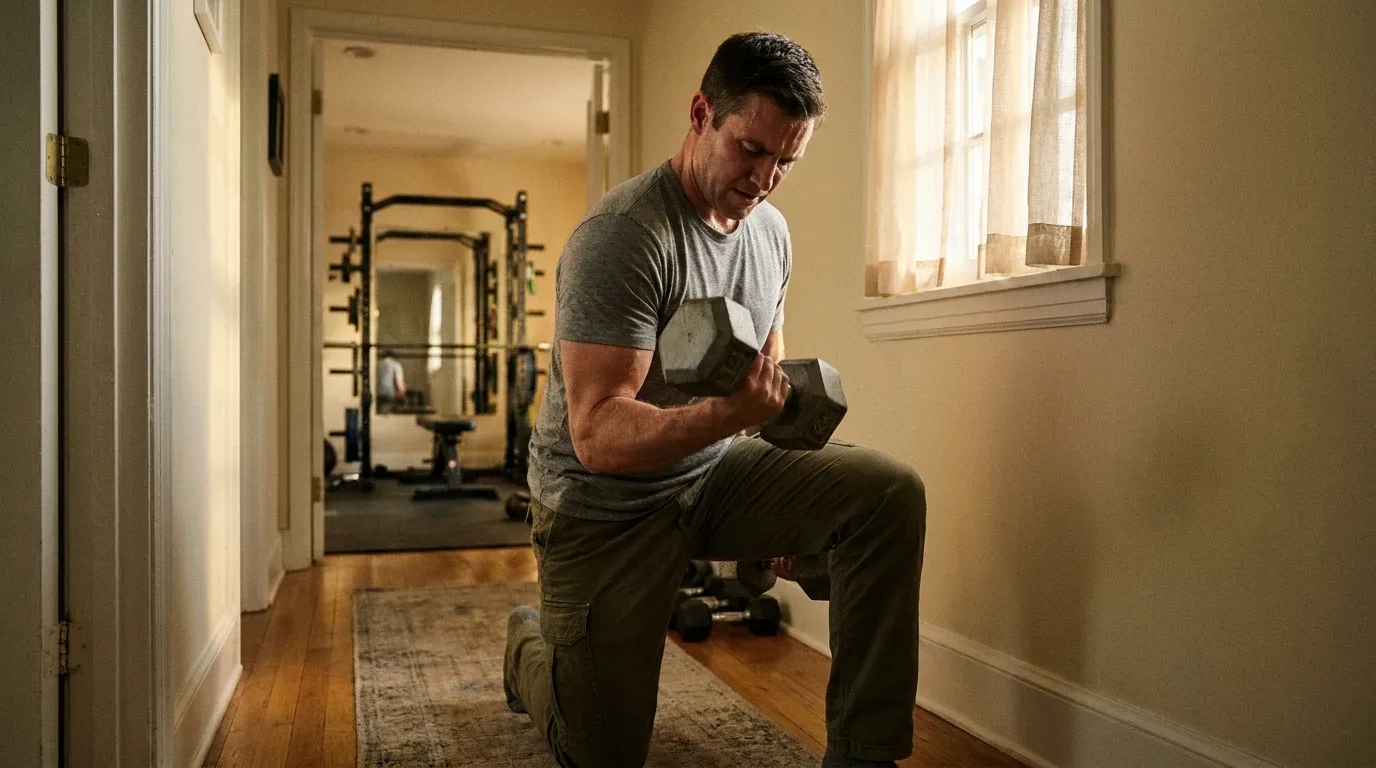
The idea that you need a full hour in the gym to build meaningful muscle has been a fixture of fitness culture for decades. Block out the time, warm up properly, grind through your sets, cool down. Anything less, the thinking goes, and you're leaving gains on the table. New research is pushing back hard on that assumption.
A growing body of evidence now shows that breaking your training into short bouts distributed across the day, a practice increasingly called "exercise snacking," produces strength and muscle outcomes comparable to a single traditional session. That's not a minor footnote. It reframes how most people should think about fitting resistance training into a realistic life.
What the Research Actually Shows
The core finding comes from studies comparing participants who completed multiple short bouts of resistance exercise spread across the day against those who performed the same total volume in one continuous session. When weekly training volume was held equal, strength gains and muscle hypertrophy were broadly equivalent between groups.
What makes this particularly relevant is that the short-bout groups weren't doing easier work. They were performing the same exercises, the same sets, the same level of effort. The only variable was timing. And timing, it turns out, matters far less than previously assumed.
This aligns with what a large-scale analysis of over 110,000 Americans found about exercise patterns across a lifetime. As covered in What 110,000 Americans Teach Us About Aging and Exercise, the frequency and consistency of physical activity predicted health outcomes more reliably than any single-session format. The pattern of behavior over time is what drives adaptation.
Why This Matters for Busy People
The practical implications here are significant. A substantial portion of adults who want to train simply can't carve out 60 uninterrupted minutes on a regular basis. Work schedules, childcare, commutes, and fatigue make that block of time a persistent obstacle. For many people, it becomes all-or-nothing thinking: if they can't do the full session, they skip it entirely.
Exercise snacking removes that barrier. If you can do three 10-to-15-minute blocks across your day, one before work, one at lunch, one in the evening, you're accumulating the same training stimulus without needing a gym membership, a commute, or a continuous window of free time.
This is especially relevant if you're trying to build consistent habits around strength training for the first time. Your First Session With a Coach: What to Expect outlines how structured guidance can help you design a routine that fits your actual schedule rather than an idealized one.
The research isn't suggesting that elite athletes abandon periodized programming. It's making a targeted point for the majority of people who train recreationally and struggle with time as their primary constraint.
Effort and Volume Are the Real Variables
Here's where the nuance matters. Exercise snacking doesn't work because short workouts are magic. It works when two conditions are met: the effort within each bout is genuine, and the total weekly volume adds up to something meaningful.
If your three 10-minute blocks consist of a few low-intensity sets followed by stretching, you're not replicating a proper training session. You're just moving. The stimulus for muscle adaptation requires you to work close to your capacity. Proximity to muscular failure, progressive overload over time, and sufficient weekly sets per muscle group are still the governing principles.
The question of how hard to push in any given session is one that trips up a lot of people. How Hard Should You Actually Train at the Gym? breaks down what the evidence says about effort thresholds and how to calibrate intensity without burning out or undertraining.
As a general benchmark, most research on hypertrophy points to roughly 10 to 20 sets per muscle group per week as an effective range for intermediate trainees. Whether you accumulate those sets in one session or across six doesn't appear to change the outcome. The muscle doesn't know what time of day it is.
Exercise Snacking Already Had a Strong Track Record
It's worth noting that exercise snacking isn't a new concept for cardiovascular and metabolic health. Studies have consistently shown that short bouts of walking, cycling, or stair climbing distributed throughout the day improve blood pressure, insulin sensitivity, and VO2 max to a degree comparable with continuous moderate-intensity exercise.
What's new is the extension of that finding into the domain of resistance training and muscle-specific adaptation. The cardiovascular case was already compelling. The strength case is now being built with similar rigor, and the results are holding up across different populations, age groups, and exercise modalities.
This matters particularly for people managing metabolic health alongside a training goal. Strength training itself improves glucose regulation and insulin sensitivity, and distributing that activity across the day may compound those effects. For context on how lifestyle factors interact with blood sugar, How Stress Quietly Spikes Your Blood Sugar explains how daily habits, including exercise timing, influence glucose control in ways most people don't track.
How to Structure Exercise Snacking for Strength
If you want to apply this practically, the approach is straightforward. Choose compound movements that deliver high value per set: squats, Romanian deadlifts, push-ups or dumbbell presses, rows, lunges. These recruit multiple muscle groups and let you accumulate meaningful volume quickly.
A sample structure might look like this:
- Morning (10-15 minutes): Lower body focus. Three to four sets of goblet squats or split squats with moderate to heavy load.
- Midday (10-15 minutes): Upper body push. Three to four sets of dumbbell press or push-up variations at high effort.
- Evening (10-15 minutes): Upper body pull and hinge. Three to four sets of dumbbell rows and Romanian deadlifts.
Across five to six days a week, that structure can deliver 15 to 20 sets per muscle group, which sits squarely within the hypertrophy-effective range. You're training the full body, hitting the required volume, and spending under 45 total minutes per day doing it.
Progressive overload still applies. Increase the weight or reps across weeks, not randomly, but systematically. The session being short doesn't exempt you from the principle that muscles adapt to increased demand over time.
What You Don't Need to Worry About
A few common concerns about exercise snacking don't hold up under scrutiny. The first is that short sessions don't allow for adequate warm-up. In practice, a few lighter warm-up sets at the start of each bout takes two minutes. That's not a meaningful barrier.
The second concern is recovery. Won't training multiple times a day overtax your muscles? Not if you're managing volume sensibly. The research on muscle protein synthesis shows that spreading protein-stimulating signals across the day may actually be a slight advantage, not a disadvantage. Your muscles don't accumulate fatigue from a 12-minute session the way they would from a two-hour one.
The third is consistency. Can you realistically do three bouts a day? Possibly not every day. But the same is true of a 60-minute session. What exercise snacking offers is more entry points. If you miss a morning block, you still have two more opportunities that day. That flexibility tends to increase adherence over time, not decrease it.
If you're also navigating questions about recovery and rest, Rest vs. Movement: How to Read Your Recovery Signals provides a practical framework for deciding when to push and when to back off, which applies to any training structure, not just exercise snacking.
The Takeaway
The evidence is clear enough to act on. You don't need an uninterrupted hour to build strength. You need sufficient effort, sufficient volume spread across the week, and sufficient consistency over months. Session length is a logistical preference, not a physiological requirement.
If 60-minute blocks work for your schedule, keep doing them. But if that format is what's been standing between you and consistent training, the short-session approach is a fully legitimate alternative, backed by research and grounded in the same principles that drive any effective strength program.
For a broader look at time-efficient training options when traditional lifting isn't accessible, No Time to Lift? What Science Says You Can Do Instead covers additional evidence-based approaches worth considering.