
If you've been lifting consistently for years, you've probably assumed your bones are in good shape. After all, resistance training puts stress on the skeleton, and stress drives adaptation. That logic isn't wrong. But a growing body of research suggests it's incomplete. And if you're over 35, that gap in your training could have consequences you won't feel until it's too late.
A recent study examining bone-formation markers across different types of physical activity found that high-intensity sports involving explosive movements and rapid changes of direction. sports like football and handball. raised those markers by up to 46%. Walking, jogging, and traditional weight training showed measurably lower responses. The implication is clear: not all exercise stimulates your skeleton equally, and lifting alone may not be enough to protect your bones long-term.
What Bone-Formation Markers Actually Tell You
Bone isn't static tissue. It's constantly being broken down and rebuilt through a process called remodeling. Bone-formation markers are biological signals. proteins and enzymes found in the blood. that indicate how actively your body is laying down new bone material. Higher marker levels generally point to more robust bone-building activity.
The study tracked these markers across populations engaged in different training styles. Athletes participating in explosive, multidirectional sports consistently showed the highest elevation in bone-formation markers. Those who walked or jogged regularly showed modest improvements. Traditional weight trainers landed somewhere in the middle, better than sedentary individuals, but significantly below the explosive-sport group.
That 46% figure is not a rounding error. It represents a meaningful physiological difference in how aggressively your body is investing in skeletal strength.
Why Explosive, Multidirectional Movement Hits Different
The mechanism behind this comes down to mechanical loading. Your bones respond to the type, speed, and variety of forces placed on them. Slow, controlled lifting applies predictable, linear stress. That's valuable, but your skeleton adapts to it over time and stops responding as aggressively.
Explosive movements. sprints, jumps, rapid pivots. apply fast, high-magnitude forces from multiple angles. That novelty and intensity are exactly what bone cells respond to most strongly. The osteoblasts (cells responsible for building bone) ramp up activity when the mechanical signal is sudden, varied, and high-impact.
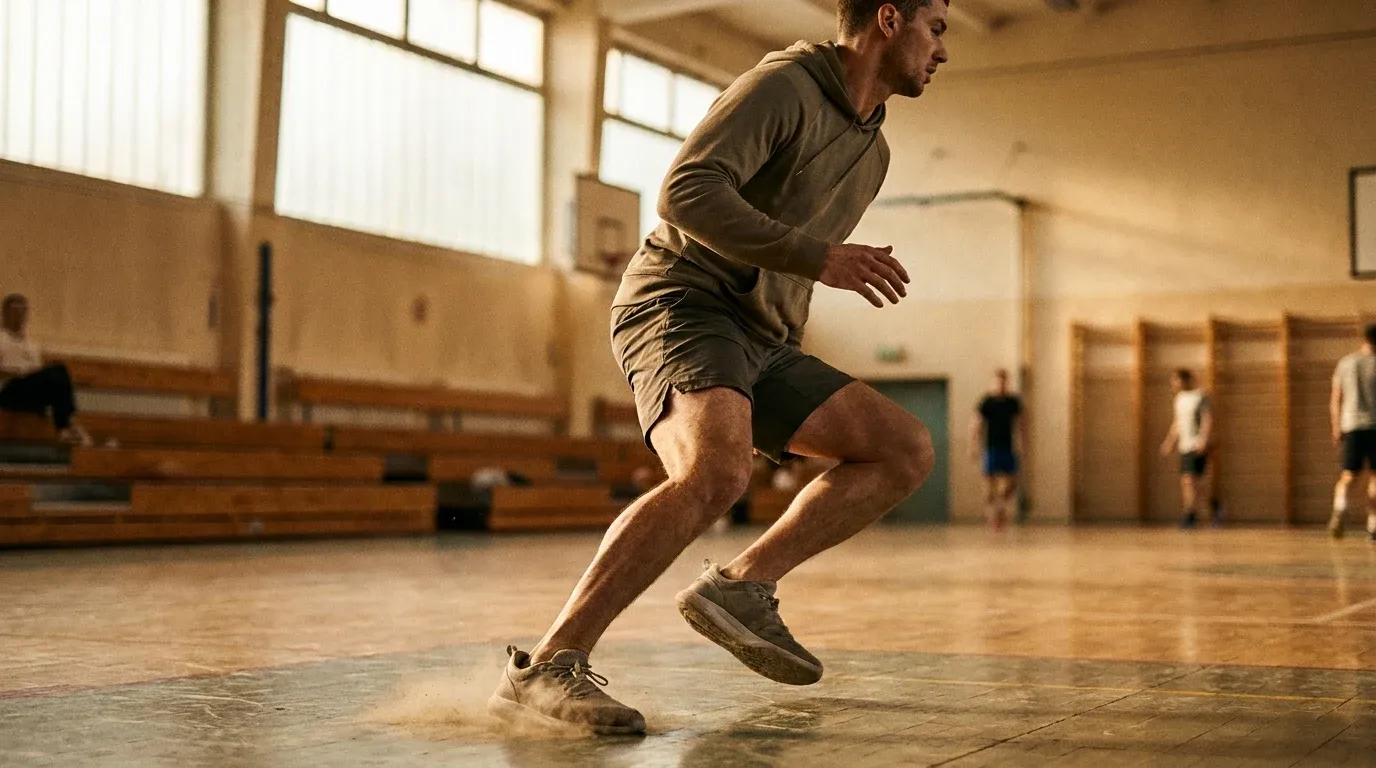
Multidirectional sports like football, basketball, handball, and squash also involve ground-reaction forces that are significantly higher than those produced during most gym-based training. Every hard cut, sprint start, or jump landing sends a mechanical signal up through the skeleton that lifting from a fixed position simply doesn't replicate.
This is consistent with decades of research showing that athletes in impact and court sports tend to have higher bone mineral density than swimmers or cyclists, whose training loads, despite being physically demanding, are low-impact or non-weight-bearing.
Where Weight Training Falls Short
To be clear, resistance training is not bad for your bones. It's beneficial, particularly compared to inactivity. Lifting increases bone density at the specific sites being loaded. squats and deadlifts benefit the hips and spine, for instance. But it has two structural limitations when it comes to bone health.
First, it's largely linear. The forces applied during most lifts move in predictable planes. Your skeleton adapts to that pattern, and adaptation in bone, like in muscle, requires novelty and progressive challenge beyond what a steady program typically delivers over years of repetition.
Second, the speed of force application matters. Bone cells are more sensitive to rapid loading than to slow, sustained pressure. A heavy squat delivers significant load, but it's applied deliberately and over a longer time window than, say, landing from a box jump or planting a foot to cut hard during a sprint. That rate-of-loading difference is a key reason explosive sports outperform traditional lifting in stimulating bone formation.
If you've been training for more than a few years, it's also worth asking whether your program is actually progressive for bone stimulus. If you've been doing the same movements at similar weights for a long time, your skeleton has likely adapted and is no longer receiving a strong growth signal. The article on eccentric training and the gains you might be leaving behind touches on a related issue. the tendency to underestimate how much training variability matters for continued adaptation.
The Age Factor You Can't Ignore
Bone density peaks in your late twenties to early thirties. After that, it begins a slow decline that accelerates with age, particularly after menopause for women, but also progressively in men. By the time most people are in their mid-forties, they're already losing bone faster than they're building it, unless they're doing something specific to counter that trend.
Osteoporosis affects an estimated 200 million people worldwide. In the US alone, around 10 million people have the condition, and another 44 million have low bone density, putting them at elevated fracture risk. Fractures in older adults. especially hip fractures. carry serious morbidity and mortality risk. The window to build and maintain a strong skeletal reserve is not unlimited.
For lifters over 35, this research is a direct challenge to the assumption that training is covering all the bases. You may be building muscle, managing body composition, and protecting cardiovascular health. But if your training doesn't include the kind of high-impact, explosive, multidirectional stimulus that research identifies as most effective for bone formation, you're leaving a gap.
This isn't unique to bone health either. Research on how exercise variety connects to long-term mortality risk points in the same direction. doing the same thing every week, even if that thing is productive, doesn't deliver the full-spectrum benefits of a more varied training approach.
What to Add to Your Training Without Overhauling It
You don't need to quit the gym or sign up for a recreational football league (although the latter isn't a bad idea). The goal is to introduce the type of mechanical stimulus your bones are responding to in explosive-sport athletes. Here's what that looks like in practical terms.
- Plyometrics: Box jumps, depth jumps, broad jumps, and jump squats apply high ground-reaction forces rapidly. Even two or three sets two to three times per week can meaningfully increase the bone stimulus you're generating. Start conservatively if you're not used to impact training, and prioritize landing mechanics.
- Sprint intervals: Short, maximal or near-maximal sprints. 20 to 40 meters. involve rapid foot-strike forces and full-body acceleration that lift slowly, linearly, and don't replicate. Even once a week adds a qualitatively different skeletal stimulus.
- Court sports or recreational team sports: Basketball, squash, tennis, handball, and similar activities naturally combine explosive acceleration, deceleration, and multidirectional cutting. If you have access and enjoy it, one or two sessions per week could do more for your bone health than adding another lifting session.
- Loaded jumps and medicine ball work: Jumping with light loads, medicine ball slams, and rotational throws combine external loading with rapid force application. They bridge the gap between traditional lifting and pure plyometrics and are easy to add to an existing gym session.
If joint health or injury history is a factor, it's worth discussing impact training with a sports medicine professional before scaling up quickly. The goal is progressive exposure, not sudden high-volume impact work on unprepared joints.
Recovery Still Matters
Adding more intense, high-impact work to your training demands that recovery keeps pace. Bone remodeling. like muscle growth. happens during rest, not during the session itself. If you're stacking explosive training on top of an already-demanding lifting schedule without accounting for recovery, you're limiting the adaptation you're trying to drive.
Sleep, nutrition, and stress management all affect bone metabolism. Adequate protein supports the collagen matrix that gives bone its structural integrity. Calcium and vitamin D are foundational. If you want a broader look at the evidence on what actually supports recovery at a physiological level, the guide on the science-backed pillars of recovery is a solid reference.
Nutrition also plays a role that's easy to underestimate. Chronic poor diet choices. excess sugar, insufficient micronutrients. can interfere with bone metabolism over time. If you're not sure your diet is supporting your training adaptations, it's worth getting your fundamentals right before adding training load.
The Takeaway for Lifters
Lifting is not enough on its own. That's not a critique of resistance training. it remains one of the most evidence-supported forms of exercise for longevity, metabolic health, and functional capacity. But when it comes to bone health specifically, the research is pointing toward a gap that explosive, multidirectional training fills better than any amount of additional sets or heavier loads.
If you're over 35, the time to close that gap is now, not when a bone density scan tells you there's a problem. Add sprints. Add jumps. Play a sport if you enjoy it. Your skeleton will respond to stimuli that your current program probably isn't delivering, and the evidence suggests it's worth the effort.