
Most people measure fitness by how much they can lift or how fast they can run. Those numbers matter, but research published in November 2026 suggests they're only part of the picture. Balance and agility assessments, the kind that rarely show up in mainstream gym programs, are turning out to be surprisingly strong predictors of how long you'll live.
The findings are worth paying attention to, especially if your current routine is built entirely around barbells or cardio machines. There's a dimension of physical fitness you're probably skipping, and skipping it may cost you years.
What the Research Actually Found
The November 2026 study, which tracked thousands of adults across age groups, found that individuals who scored higher on balance and agility assessments had measurably longer lifespans, even after controlling for cardiovascular fitness and muscular strength. In other words, two people with identical cardio profiles could have very different longevity outcomes depending on how well they balance.
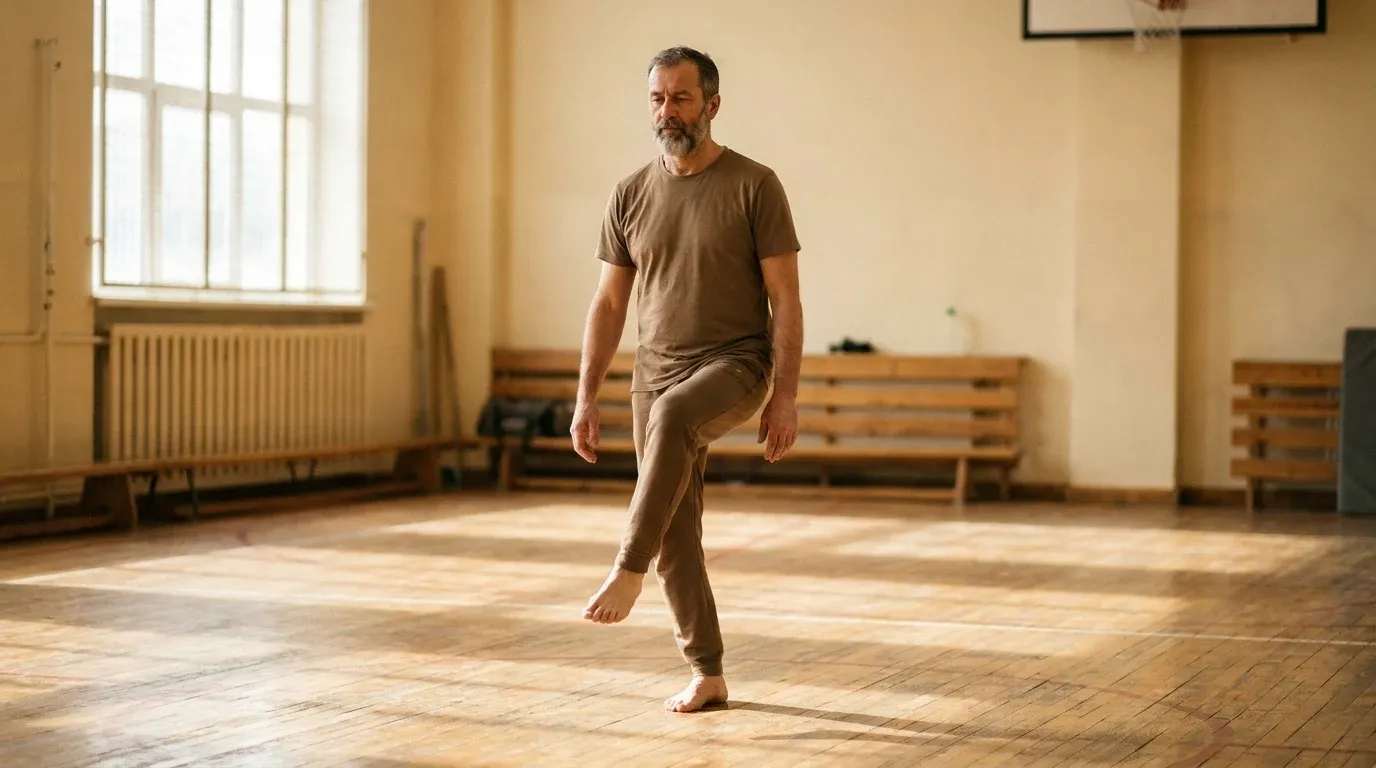
One test stood out in particular: the single-leg stand. Participants who could hold a one-legged stance for 30 seconds or more showed a significantly lower risk of early mortality than those who couldn't. The association held up across different ages and body types, and it wasn't explained away by other health markers.
That's a striking result. A 30-second balance test, something you can do barefoot in your living room right now, carries real predictive power for how long you're likely to be around.
This aligns with a growing body of evidence. What 110,000 Americans Teach Us About Aging and Exercise showed that physical resilience across multiple dimensions, not just aerobic capacity, was consistently linked to healthier aging outcomes. Balance fits squarely into that picture.
Why Balance Predicts Lifespan
It's tempting to dismiss a balance test as a parlor trick. But the ability to hold a one-leg stand reflects a cluster of physiological systems all working together: proprioception, vestibular function, neuromuscular coordination, hip and ankle stability, and core control. When those systems start to degrade, the downstream consequences are serious.
Falls are the leading cause of injury-related death in adults over 65 in the US. Poor balance doesn't just make you more likely to fall. It's also an indicator that your nervous system and musculoskeletal system are losing their precision, which affects everything from how well you recover from illness to how efficiently you move through daily life.
Balance also declines faster than strength or aerobic capacity with age, and it responds well to training. That combination makes it both an important warning signal and a trainable asset, which is exactly what you want in a longevity marker.
The Gap in Most Gym Programs
Standard strength programs are built around compound lifts: squats, deadlifts, presses, rows. That's a solid foundation, and nobody's suggesting you drop it. But lifting heavy in a stable, bilateral pattern doesn't challenge your balance the way life actually does. You're almost always moving in controlled, symmetric conditions when you train that way.
Running and cycling have their own gaps. They build cardiovascular capacity and some lower-body endurance, but they don't develop the lateral stability, single-leg coordination, or reactive agility that show up in real-world movement demands.
The result is a large population of people who are strong and fit by traditional metrics but who would struggle to pass a basic balance screen. And according to the latest research, that gap has measurable longevity consequences.
If you're wondering how hard you should be pushing in your current workouts, how hard you actually train at the gym matters less than whether you're training the right things in the first place.
The Tests Worth Knowing About
Beyond the single-leg stand, several other assessments have emerged as meaningful longevity markers in recent research:
- The sitting-rising test: Can you get up from the floor without using your hands, knees, or forearms? Each assist point deducted correlates with a higher mortality risk. It tests mobility, coordination, and body control simultaneously.
- The tandem walk: Walking heel-to-toe in a straight line for 10 steps without losing balance. Simple, but it reveals a lot about dynamic balance and vestibular function.
- Timed agility drills: Lateral shuffle tests and T-tests that measure how quickly you can change direction. Slower scores correlate with higher injury risk and reduced functional capacity in older age.
- Single-leg squat quality: Not just whether you can do it, but how well. Knee caving, trunk lean, and ankle instability all show up here and all carry implications for long-term joint health.
None of these require a lab. Most can be self-administered or assessed by a trainer in a single session. If you've never worked with a coach before, your first session with a coach is often where these kinds of functional gaps get identified and addressed.
How to Build Balance Into Your Program
You don't need to overhaul everything. The goal is to add a layer of challenge that your current program probably isn't providing. Here's where to start:
- Practice the one-leg stand daily. Start with eyes open, progress to eyes closed. Work toward 30 seconds on each side without wobbling. Do it while brushing your teeth if that's what it takes to build the habit.
- Swap bilateral exercises for unilateral variations. Replace some barbell squats with Bulgarian split squats or single-leg Romanian deadlifts. You'll still build strength, but you'll also force each limb to work independently, which exposes and addresses asymmetries.
- Add unstable surface training strategically. Bosu balls and balance boards get mocked in serious lifting circles, but used deliberately, they build proprioceptive awareness that carries over to real-world stability.
- Include lateral and rotational movement patterns. Most gym programs move in straight lines. Lateral band walks, rotational medicine ball work, and lateral bounds train the planes of motion your body actually encounters during everyday activities.
- Try yoga or dedicated mobility work once a week. These practices build the kind of controlled, body-aware movement that complements strength training and directly addresses balance deficits.
If your schedule is tight and you're already wondering how to fit more in, the evidence on time-efficient training alternatives suggests that short, targeted sessions focused on balance and coordination can deliver meaningful returns without requiring extra hours in the gym.
It's Not Just About Not Falling
There's a broader point here that's easy to miss. Balance and agility work isn't just fall prevention for people in their 70s. It's a form of physical intelligence that shapes how your body performs across your entire life.
When your neuromuscular system is sharp, you move more efficiently, recover from exertion faster, and handle unexpected physical demands without injury. That has obvious implications for athletic performance, but it also affects how much energy you have on a daily basis and how well your body holds up under the accumulated stress of decades of living.
Speaking of accumulated stress, it's worth noting that physical fitness doesn't exist in isolation. Research consistently shows that poor sleep and chronic stress independently accelerate physical decline. If you're training hard but sleeping erratically, the gains are compromised. Irregular sleep and its links to death risk represent a parallel threat to longevity that runs alongside physical fitness.
The emerging picture of longevity is multidimensional. Strength matters. Cardio matters. But balance, coordination, and functional agility are sitting at the same table, and the research is making that harder to ignore.
The Bottom Line
You don't have to be an athlete or a yogi to benefit from this. You just have to be willing to test yourself honestly and add the work your program is currently missing. Stand on one leg. Get off the floor without using your hands. Walk a straight line with your eyes closed. If any of those feel difficult, that's not a reason to feel bad. That's a training signal.
The research is pointing toward a version of fitness that most programs aren't building. It turns out that living longer might have less to do with how much you can squat and more to do with whether you can hold your balance when the ground shifts under you.
That's a relatively easy thing to start training. And the best time to start is now, while the gap is still small enough to close.