
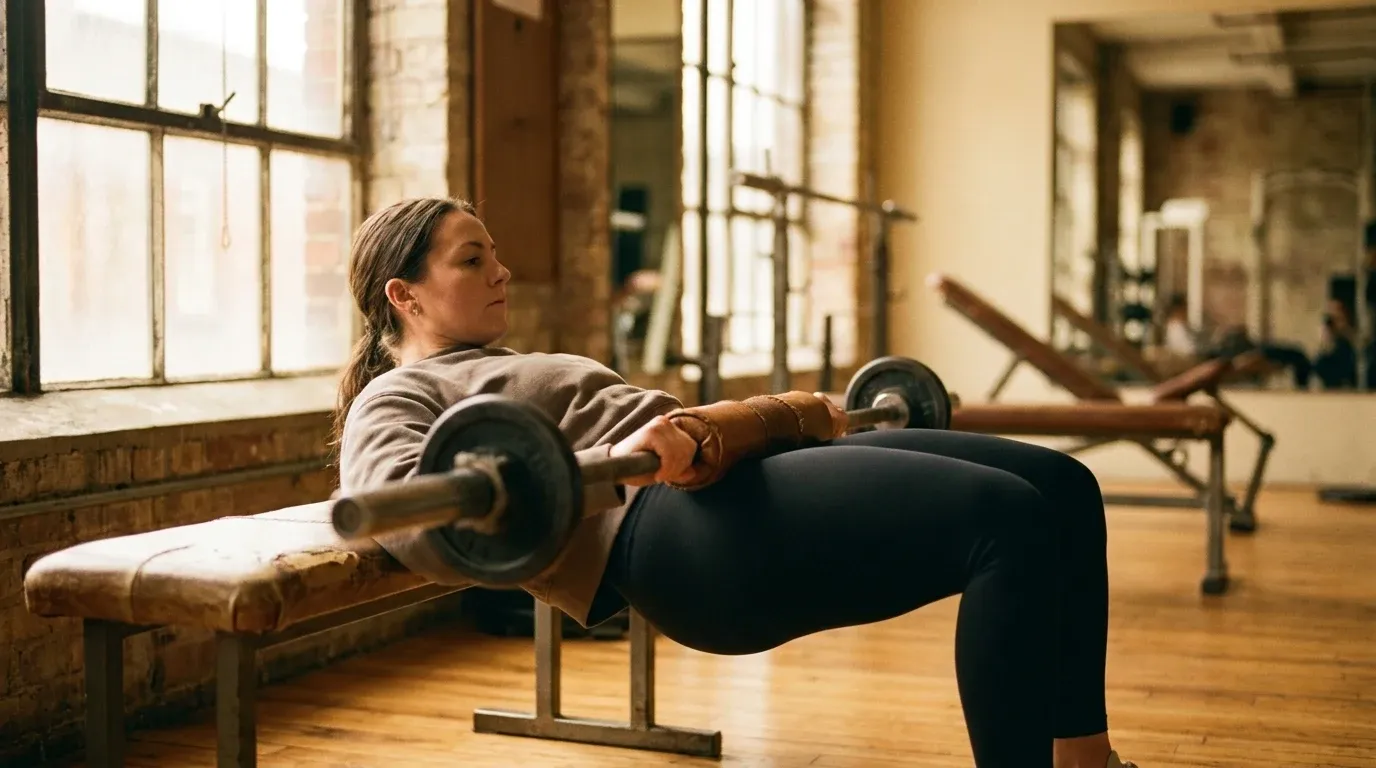
You're squatting twice a week, lunging on leg day, and wondering why your glutes still aren't responding the way you expected. The issue probably isn't effort. It's mechanics. Specifically, it's the relationship between hip position, load angle, and muscle tension that most training programs never address directly.
Exercise science has become increasingly precise about what it takes to maximally recruit the gluteus maximus. And the data consistently points to one uncomfortable truth: the exercises most lifters rely on are not the best tools for the job.
Why the Glutes Are Harder to Train Than They Look
The gluteus maximus is the largest muscle in the body, but size doesn't mean it's easy to target. It has a complex fiber architecture and contributes to both hip extension and external rotation. Whether it's maximally recruited depends heavily on the position of the hip joint and the direction of the load.
Research using electromyography (EMG) consistently shows that glute activation varies by a factor of two to three across different exercises, even when subjective effort feels identical. This means the sensation of working hard tells you very little about whether the glutes are actually doing the work.
Most lifters also operate under the assumption that compound exercises are always superior for muscle development. For overall lower body strength, that logic holds. For glute-specific hypertrophy, it breaks down quickly once you look at the biomechanics.
The Problem with Squats and Lunges as Primary Glute Exercises
Squats and lunges are excellent movements. They build quad strength, improve knee stability, and develop general lower body power. The problem isn't the exercises themselves. It's using them as your primary glute builders when the mechanics don't support that goal.
During a back squat, the glutes are most active at the bottom of the movement when the hip is flexed. But this is also the position where the muscle is at its longest length and the external load, relative to the hip joint, is near its lowest mechanical advantage. As you stand up and the glutes shorten, the load shifts increasingly to the quads. The glutes finish the movement, but they don't dominate it.
Lunges have a similar limitation. Unless you're performing a deep, forward-leaning variation with deliberate hip extension emphasis, the glute contribution is often secondary to the quadriceps. Standard lunge cues like "keep your torso upright" actually reduce the moment arm at the hip, limiting glute recruitment further.
That's not to say you should drop squats. If you're rebuilding your approach to lower body training, a structured reset like the one outlined in Fall Strength Reset: Get Your Program Back on Track in 4 Weeks can help you reintroduce movements with better mechanical intent rather than just defaulting to whatever you were doing before.
Understanding Torque and Moment Arms
To train smarter, you need a working understanding of torque. Torque is simply the rotational force applied at a joint. It's determined by two things: the magnitude of the load and the perpendicular distance between that load and the joint axis, which is called the moment arm.
Longer moment arm equals more torque. More torque means the muscle has to work harder to produce movement. This is why lying down and raising a straight leg requires less glute effort than performing a hip thrust with a loaded barbell, even though the barbell involves more total weight.
For the gluteus maximus specifically, the moment arm is longest when the hip is near neutral, meaning close to full extension. This is exactly the position where hip thrusts place peak load. During the top of a hip thrust, the hips are extended, the glutes are shortened and contracting hard against maximum resistance, and EMG readings are consistently among the highest recorded for any exercise.
Compare that to the bottom of a squat. The hip is flexed, the moment arm for the glute is actually quite small relative to the knee extensors, and the mechanical advantage shifts away from the glutes. The muscle is stretched but not loaded at its mechanically optimal length.
The Exercises That Actually Produce Peak Glute Tension
Based on the biomechanical research, several exercises consistently outperform squats for glute-specific activation. These are not novel or complicated movements. They're simply better matched to the mechanics of the gluteus maximus.
- Barbell hip thrust: Performed through full range with deliberate posterior pelvic tilt at the top, this is the single most validated exercise for peak glute EMG activity. The load angle remains perpendicular to the hip extension axis throughout the movement.
- Romanian deadlift (RDL): Loads the glutes under stretch during hip flexion and requires significant force production during the return to extension. The hip hinge pattern targets the gluteus maximus and hamstrings together with a long effective moment arm.
- Cable pull-through or banded hip hinge: The horizontal load angle of a cable or band means the resistance remains high throughout the entire hip extension range, unlike a barbell where the load becomes more vertical and less challenging as you stand.
- Bulgarian split squat with forward lean: When the torso is inclined forward intentionally, the hip moment arm increases significantly, shifting demand from the quads to the glutes. This is the opposite of most coaching cues for this exercise.
- Single-leg hip thrust: Increases the demand on each glute individually while also introducing stabilization requirements. Useful once bilateral hip thrust mechanics are solid.
The Cue Corrections That Change Everything
Technique cues are where most coaching fails glute training specifically. Standard cues are designed for safety and general movement quality. They're not always designed to maximize activation in a target muscle.
Here are the corrections that matter most:
- Hip thrust: Instead of simply driving hips up, cue a posterior pelvic tilt at the top. Tuck the pelvis under, squeeze the glutes as if trying to bring your pubic bone toward your navel. This eliminates lumbar hyperextension and puts the glute in its fully shortened, maximally contracted position.
- RDL: Push the hips back, not down. The movement is a hip hinge, not a knee bend. The bar should stay close to the legs throughout. Feel the stretch in the glutes and hamstrings, then drive through the hips to return to standing.
- Squat: If you want more glute involvement, use a slightly wider stance and allow some forward lean in the torso. Cue "spread the floor with your feet" to increase external rotation torque, which engages the glutes more effectively.
- Lunge: Let the torso hinge slightly forward during the descent. This increases the hip moment arm and transfers demand from the quads to the glutes. It's counterintuitive but backed by the biomechanics.
It's also worth noting that working with a coach doesn't automatically mean you'll receive biomechanically informed cues. As covered in A Qualified Trainer Isn't Automatically the Right One, credentials don't guarantee that a coach has kept pace with the exercise science literature. Ask specifically whether your trainer can explain moment arms and load angles in the context of glute training.
How to Audit Your Own Program
You don't need a biomechanics degree to evaluate whether your current routine is actually targeting your glutes. Run through these questions for each exercise you're using:
- At what point in the movement is the glute fully shortened? Is the load highest at that point or lowest?
- Is the load angle vertical (barbell) or horizontal (cable, band)? Horizontal loads tend to maintain tension through the full range of hip extension.
- Are you feeling the work primarily in your glutes or in your quads and lower back? Subjective feedback isn't perfect, but persistent misdirection of effort is a signal.
- What's your rep range? Glute hypertrophy research suggests moderate to higher rep ranges (8 to 15 reps) with controlled eccentrics tend to produce better results than low-rep strength work for size-focused goals.
Recovery is also part of this equation. Glute training done correctly creates significant mechanical stress on the muscle tissue. If you're training hard without adequate rest, you're likely undercutting your own results. Overtraining Without Rest Is Quietly Wrecking Your Progress breaks down how insufficient recovery impairs muscle adaptation regardless of how well-designed your programming is.
Putting It Together Without Overcomplicating It
You don't need to overhaul your entire training week. Start by adding one or two hip thrust variations as primary movements, not accessories. Treat them with the same priority you'd give a squat or deadlift. Then audit your existing exercises for load angle and peak tension position, and adjust your cues accordingly.
Track your progress by more than just weight lifted. Changes in body composition, specifically muscle mass relative to fat mass, are a more meaningful signal than the number on the scale. If you want context on how to measure that accurately, Body Composition vs BMI: Which Number Actually Matters? gives you a practical framework for interpreting what you're seeing.
The gap between effort and results in glute training almost always comes down to mechanics, not motivation. Understanding the biomechanics doesn't require a textbook. It requires asking the right question: is this exercise loading the glutes where they're strongest, and does my technique support that? Answer that honestly, and your program will do far more work for you.