
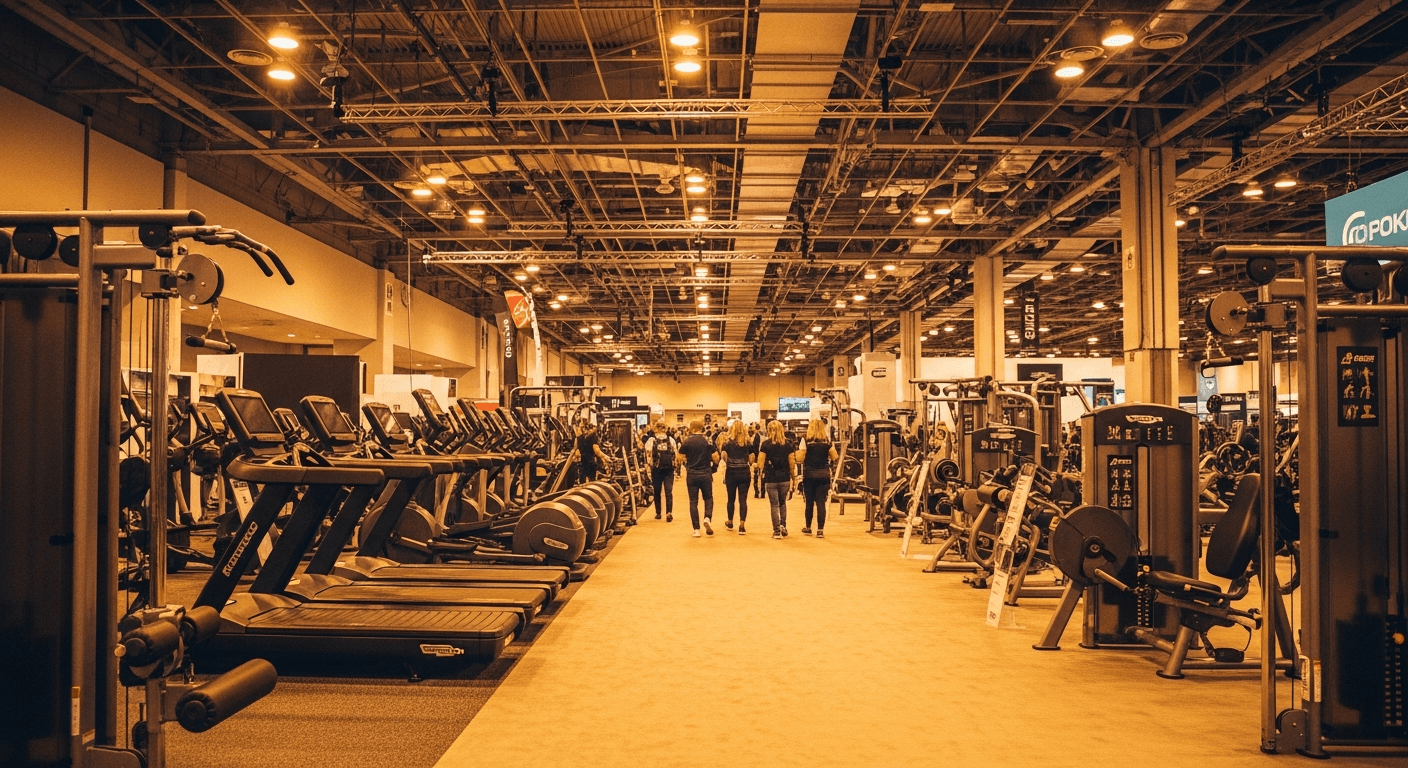
If you want to know where the fitness industry is heading, you watch what 10,300 professionals do when they're in the same room. From March 16 to 18 in San Diego, the Health and Fitness Association Show 2026 delivered the clearest directional signal the industry has produced in years. The message wasn't subtle.
Key Takeaways
- HFA Show 2026 gathered over 10,000 fitness professionals
- AI integration and recovery tech are the two biggest trends of the year
- The connected fitness market is projected to reach $59 billion by 2030
Equipment is no longer the point. The environment is.
The Numbers Behind the Signal
This year's HFA Show was the largest industry gathering of 2026 by every measurable standard. The event drew 10,300 registered attendees, 380 exhibitors, and 150 speakers across three packed days at the San Diego Convention Center. That's not a trade show. That's a consensus-building event.
When you get that many operators, investors, equipment manufacturers, and software developers in one place, patterns emerge fast. And the pattern at HFA 2026 was impossible to miss: the industry is done treating gym technology as a collection of standalone products. The conversation has shifted to integrated training environments where everything talks to everything else.
From Isolated Machines to Connected Ecosystems
Panel after panel returned to the same core idea. Strength equipment, cardio machines, recovery tools, and coaching software need to share data in real time. The facilities winning member retention aren't the ones with the most impressive individual pieces of kit. They're the ones where a member's treadmill session informs their recovery protocol, which feeds into their next programming block.
That's not a futuristic concept anymore. It's what operators at HFA described as the new baseline expectation from members who've spent the last three years training with wearables and app-based coaching.
The language across sessions was consistent: integrated, data-driven training environments. Not smart equipment. Not connected fitness. Environments. The distinction matters because it shifts the design conversation from hardware specs to data architecture.
60+ Product Launches and the AI Inflection Point
More than 60 companies launched new products at HFA 2026, and the dominant categories were unmistakable. AI-assisted programming and real-time biometric feedback weren't niche offerings tucked into a corner of the show floor. They were the headline features on the majority of major launches.
Innovation Alley was where you saw it most clearly. The dedicated showcase featured 19 emerging fitness tech companies, and the through-line across almost every booth was the same: software that adapts training in real time based on biometric input. Heart rate variability, recovery scores, load management data. These systems don't just track. They adjust.
For gym operators, the business case is straightforward. Members who follow adaptive programming built on progressive overload show higher adherence rates, and higher adherence translates directly to retention. In a market where the average US gym loses between 30% and 50% of its members annually, that's not a feature. That's a revenue argument.
Recovery Is Now a Design Category
One of the clearest structural shifts at HFA 2026 was the Recovery Lounge. This wasn't a sponsor activation. It was a dedicated zone that signaled something operators have been slow to formalize: recovery is a primary service, not an add-on.
Am-Finn Sauna, CryoBuilt, and WellnessSpace Brands all exhibited within the lounge. The presence of multiple serious recovery brands in a defined, curated space tells you something about where facility design budgets are moving. Sauna rooms, cold plunge installations, and contrast therapy areas are no longer premium differentiators reserved for high-end boutique gyms.
Operators at mid-market facilities are now asking the same questions about recovery infrastructure that they were asking about connected cardio equipment five years ago. If your facility doesn't have a recovery offering in 2026, you're not competing on the full value proposition your members are looking for.
The Recovery Lounge at HFA was a physical argument for that point. And based on the foot traffic it drew across all three days, the argument landed.
Pickleball Arrives at HFA. Seriously.
For the first time in the show's history, pickleball had a dedicated pavilion at HFA, complete with a full regulation court. If that surprises you, it shouldn't. Pickleball participation in the US has grown faster than any other sport for three consecutive years, and gym operators have figured out that it's not just a programming option. It's a member acquisition channel.
The facilities seeing the strongest new-member numbers from pickleball aren't marketing it as a fitness class. They're positioning it as a social sport with built-in community. That matters because community-driven retention significantly outperforms program-driven retention across nearly every facility type and demographic.
HFA giving pickleball its own pavilion and a full court wasn't a novelty decision. It was an acknowledgment that the sport has moved from trend to infrastructure consideration. If you're designing or renovating a fitness facility in 2026 and you haven't run the numbers on a pickleball court, the HFA show floor was telling you to start.
What This Means If You Run a Facility
The HFA Show doesn't set the agenda. It reflects it. When 10,300 professionals and 380 exhibitors independently converge on the same themes, that convergence is the signal.
Here's what the 2026 show made clear:
- Integrated data environments are the new standard. Members expect their equipment, software, and recovery tools to communicate. Facilities that haven't started building toward this will feel the gap in retention metrics within the next 12 to 24 months.
- Recovery is a line item in facility design, not an afterthought. The brands investing in dedicated recovery spaces are attracting and keeping members who are serious about longevity, not just performance.
- AI-assisted programming is moving from boutique to mainstream. The volume of launches in this category at HFA signals that the price point is coming down and the implementation barrier is dropping. Waiting is a choice, but it's not a neutral one.
- Pickleball courts deserve a business case analysis. If your facility has the square footage and the target demographic skews 35 and older, the member acquisition data from operators who've already made the investment is compelling.
The fitness industry has been talking about convergence between hardware, software, and wellness for a long time. What HFA 2026 confirmed is that the talking phase is over. The operators who showed up to San Diego weren't asking whether integration was coming. They were asking each other how fast they needed to move to stay ahead of it, and the shift in what members now prioritize is making that urgency impossible to ignore.
If you weren't in San Diego, you're reading the answer right now.
Related articles
- Playlist and EGYM's $7.5B Merger: What It Means for the Fitness Software Market
- Strength Training Passed Weight Loss as America's Top Fitness Goal. Here's Why.
- HFA Show 2026: What the Biggest Fitness Industry Convention Revealed About Where the Sector Is Heading