
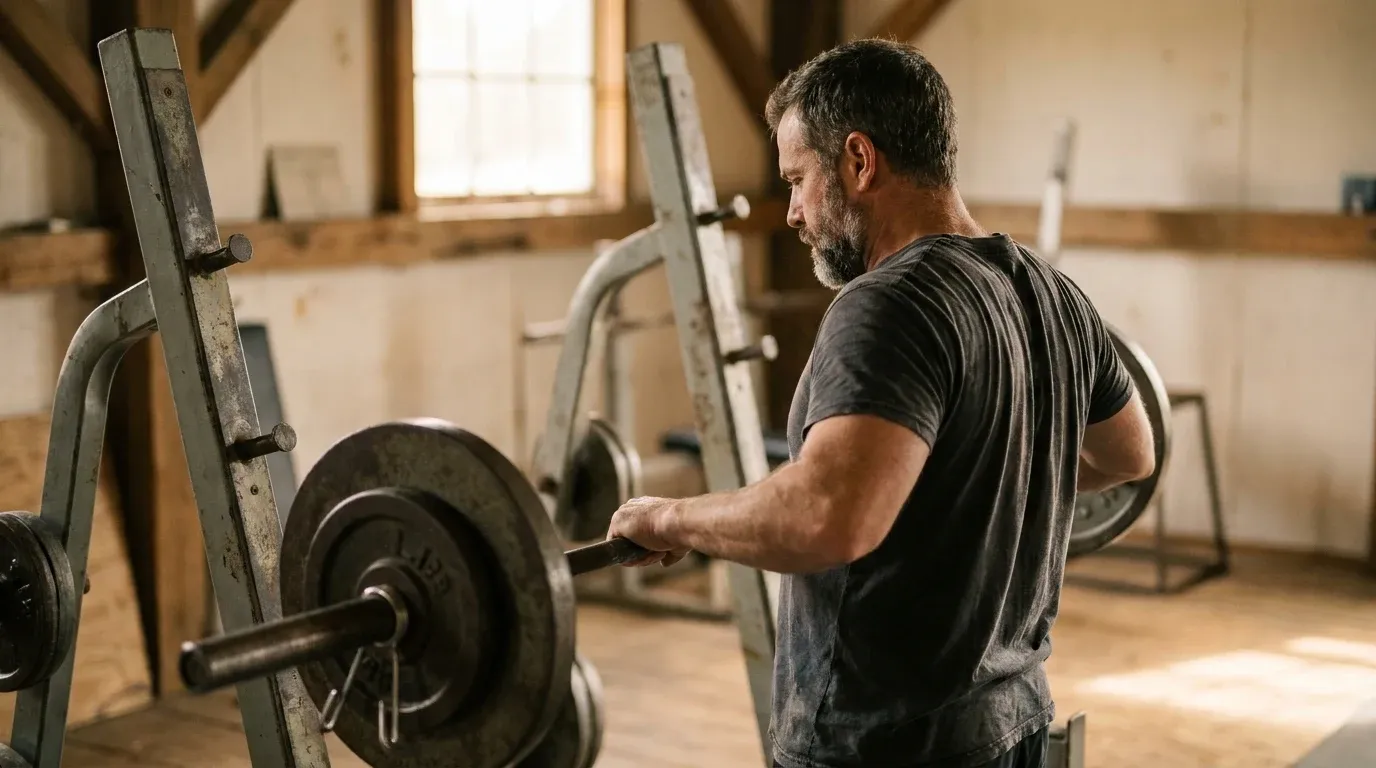
You stopped training. Maybe it was months, maybe it was years. Life happened, and the gym fell off the list. Now you're in your 40s, looking at the bar, wondering if what you built before is gone for good. It isn't. And the science behind why is more encouraging than most people realize.
Muscle memory is real, it's measurable, and it works in your favor. But getting back to lifting after 40 isn't the same process as it was at 25. The strategy matters. Here's what the biology actually says, and how to build a program that works with your body instead of fighting it.
What Muscle Memory Actually Is
Muscle memory isn't stored in the brain the way a skill or a habit is. It's written into the muscle tissue itself. When you train and build muscle, your muscle fibers gain additional nuclei, called myonuclei, through the fusion of satellite cells. These nuclei are the control centers for muscle protein synthesis.
When you stop training and muscle mass decreases, those myonuclei don't disappear. Research suggests they can persist for years, possibly decades. When you resume training, the cellular infrastructure is already in place. Your muscles don't need to rebuild from scratch. They need to reactivate what was already there.
In practical terms, this means you'll regain lost muscle significantly faster than you built it originally. Studies have shown that previously trained individuals can return to prior muscle mass in roughly half the time it took to build it initially. That advantage doesn't expire when you turn 40.
Age Changes the Timeline, Not the Possibility
What does change after 40 is the recovery landscape. Testosterone and growth hormone levels decline gradually through your 30s and continue through your 40s. Muscle protein synthesis rates in response to training are blunted compared to younger adults, though they're still very much triggered by resistance work.
The larger issue isn't that muscle stops responding. It does respond. It's that the response takes longer to complete. Research on older adults consistently shows that the anabolic window, the period during which muscle repair and growth occurs after a session, extends over a longer timeframe than it does in your 20s. That means insufficient recovery between sessions doesn't just slow progress. It actively creates a deficit.
A large-scale study of over 110,000 Americans on aging and exercise reinforced a consistent theme: regular resistance training across the lifespan is associated with significantly better health outcomes in later decades. The people who maintained or returned to lifting fared measurably better than those who didn't. The entry point doesn't have to be early to matter.
Building a Return-to-Lifting Program That Respects Recovery
The most common mistake people make when returning to the gym after 40 is programming like they're 28. The first week feels manageable, the second week feels like too much, and by week three they're either injured or so sore they quit. The fix isn't training less. It's training smarter from day one.
Start with two to three full-body sessions per week, separated by at least 48 hours. This frequency gives you enough stimulus to trigger the muscle memory effect while allowing the longer recovery window your body now needs. Full-body training also means that if you miss a session, every muscle group still got hit at least once that week.
Keep initial volume conservative. For the first two to four weeks, two to three sets per exercise is enough. You're not trying to maximize fatigue. You're trying to establish the training signal and gauge how your body responds. Progress from there based on what you're actually seeing, not what you think you should be doing.
If you're uncertain about where to start with intensity, understanding how hard you should actually be training is a useful framework before you walk back into the gym. Training to true failure in your first few weeks back is counterproductive. Leaving two to three reps in reserve lets you accumulate volume and practice movement patterns without excessive systemic stress.
Protein: The Most Underused Tool After 40
If there's one nutritional variable that separates successful comebacks from stalled ones after 40, it's protein. And the problem isn't just quantity. It's timing, distribution, and the anabolic resistance that develops with age.
Anabolic resistance means that older muscle tissue requires a larger dose of protein to trigger the same muscle protein synthesis response that a smaller dose would produce in a younger person. Research supports a threshold of around 0.7 to 1 gram of protein per pound of bodyweight per day for adults returning to resistance training in their 40s and beyond. For a 185-pound person, that's roughly 130 to 185 grams daily.
Distribution matters as much as total intake. Spreading protein across three to four meals, rather than consuming most of it at dinner, keeps muscle protein synthesis elevated more consistently throughout the day. Each meal should contain at least 30 to 40 grams of protein to reliably clear the anabolic threshold that tends to be higher in older adults.
Post-workout protein timing has been debated extensively, but the practical guidance after 40 is clear: don't wait. Consuming 30 to 40 grams of high-quality protein within an hour of finishing your session takes advantage of the training-induced increase in muscle sensitivity. That window is real, even if it's not as narrow as it was once thought to be.
Food quality also plays a role that's easy to overlook. Getting more nutritional value from whole foods, including parts of produce most people discard, can support micronutrient intake that underpins recovery. The parts of produce you throw away are often the most nutritious, and those micronutrients contribute to inflammation management, hormone function, and tissue repair.
Sleep, Stress, and the Hormonal Context You Can't Ignore
Training and protein don't exist in a vacuum. The hormonal environment you're training in matters, and two factors quietly undermine recovery more than most people account for: sleep and stress.
Sleep is when the majority of growth hormone is released. It's also when muscle protein synthesis rates peak. Disrupted or irregular sleep doesn't just leave you tired. It compresses the anabolic recovery process that your sessions depend on. The research on irregular sleep patterns and long-term health risk is striking, and the implications extend directly to how well your body adapts to training.
Cortisol, the primary stress hormone, is catabolic. Chronically elevated cortisol from work, life pressure, or under-recovery actively opposes muscle growth. Stress affects far more than your mood, including how your body manages glucose and recovery signals. If your life is high-stress, your program needs to account for that with more conservative volume and more deliberate recovery days, not the same load you'd assign to someone sleeping eight hours in a low-stress environment.
This isn't an excuse to train less. It's a reason to be precise. The lifters who make consistent progress after 40 are the ones who treat recovery as part of the program, not as the absence of training.
Tracking Progress from Week One
Starting conservatively only works if you're measuring what's happening. Without tracking, it's impossible to know when to increase load, when to back off, or whether the program is actually producing results.
Keep a training log from your first session. Record the weight, sets, and reps for each exercise. Note how you feel 24 and 48 hours after each session. That soreness data tells you a lot about how your body is absorbing the training load. If you're still significantly sore 72 hours later, your volume is too high or your recovery is too low for that frequency.
Progress systematically. Add weight or reps when you can complete all prescribed sets with two or more reps left in reserve. Don't jump load. Small, consistent increments compound over weeks into significant strength gains. That approach reduces injury risk, improves adherence, and builds the kind of confidence that keeps people in the gym long-term.
- Track every session: weight, sets, reps, and subjective recovery notes
- Add load only when form is clean and reps are well within capacity
- Log soreness timing: significant soreness past 48 hours signals too much volume
- Check progress monthly, not weekly: short-term fluctuations are noise
If you're returning to training after a long break and want structured accountability from the start, working with a coach, even for a few sessions, can compress the learning curve significantly. Understanding what to expect from your first session with a coach takes the uncertainty out of that investment.
The Realistic Timeline
Most people returning to lifting after 40, with a prior training history and a sound program, see measurable strength gains within four to six weeks and visible muscle changes within eight to twelve. That's not a slow timeline. That's the muscle memory effect doing exactly what the research describes.
What it requires is consistency over novelty. The best program for returning to lifting after 40 isn't the most sophisticated one. It's the one you'll follow for six months without breaking down physically or mentally. Start conservative, train with structure, eat enough protein, sleep with intention, and let the biology do the work it was always capable of doing.
Your 40s aren't a limitation. With the right approach, they're a genuinely productive decade to build, or rebuild, a body that performs.