
Every few years, a new food access initiative launches with genuine optimism. More grocery stores in underserved neighborhoods. Subsidized produce programs. Expanded SNAP benefits. And yet, diet quality across income groups remains stubbornly unequal. The gap isn't closing the way anyone hoped.
At FNCE 2026, the Academy of Nutrition and Dietetics' flagship annual conference, registered dietitians and nutrition researchers surfaced a blunt consensus: proximity to food and the ability to afford it are necessary conditions, but they're nowhere near sufficient ones. The real barriers to eating well are more personal, more cultural, and more practical than most public health frameworks acknowledge.
If you've ever stood in front of a refrigerator full of healthy ingredients and still ordered takeout, you already understand this intuitively.
Why Food Access Programs Often Miss the Mark
The standard model for addressing food insecurity focuses on supply: get more healthy food into more places at lower prices. That logic makes sense on paper. In practice, it ignores a fundamental question. Will people actually eat it?
Practitioners at FNCE 2026 pointed to a recurring pattern in community nutrition programs: when food distributed through access initiatives doesn't reflect the cultural backgrounds of recipients, participation drops and the food goes unused. A family that has eaten rice, beans, and plantains for generations isn't going to pivot to quinoa and kale because a pantry box includes them. It's not stubbornness. It's that unfamiliar foods require unfamiliar knowledge, and that knowledge takes time to build.
Cultural appropriateness isn't a soft concern. It directly predicts whether a nutrition intervention will work. Research on food assistance programs consistently shows that culturally concordant food choices improve both dietary adherence and overall satisfaction with nutrition support. When people recognize the ingredients, they're far more likely to cook with them.
This has real implications beyond community programs. It applies to every meal plan, every dietitian recommendation, and every wellness article that defaults to a narrow set of "healthy" foods without asking who the reader actually is or what their kitchen looks like.
Affordability Is the Floor, Not the Ceiling
Here's a scenario that plays out constantly. Someone lives near a well-stocked grocery store. They have a modest food budget. By conventional measures, they have food access. But they work two jobs, don't own a car, have no working oven, and never learned to cook beyond a handful of basics. The broccoli is available and affordable. It still doesn't get eaten.
FNCE 2026 sessions highlighted three structural barriers that operate independently of price and proximity.
Time. Meal preparation takes an average of 37 minutes per day in US households, according to data from the Bureau of Labor Statistics. For people working multiple jobs or managing childcare alone, that window often doesn't exist. Convenience foods and fast food aren't chosen out of ignorance. They're chosen because they're fast.
Culinary literacy. Knowing how to cook is a skill, and it's one that's been systematically lost across generations as processed food became cheaper and more available. If you didn't grow up watching someone cook from scratch, the gap between raw ingredients and a finished meal can feel genuinely insurmountable. Basic techniques like roasting vegetables, building a sauce, or seasoning proteins aren't obvious without exposure.
Equipment. Not everyone has a functioning stove, a sheet pan, or even consistent access to hot water. Low-income renters in particular often deal with unreliable appliances. Recipes that assume a full, functional kitchen exclude a significant portion of people who are theoretically within reach of healthy eating.
These aren't fringe cases. They're common enough that nutrition practitioners are increasingly designing interventions around them rather than treating them as exceptions.
What Actually Bridges the Gap
The good news is that the practical solutions here are well-tested and accessible regardless of income level. None of them require a perfect kitchen, a culinary background, or an unlimited grocery budget.
Batch Cooking as a System, Not a Sunday Project
The concept of batch cooking often gets presented as a weekend lifestyle activity for people with free time. That framing makes it feel out of reach. But the core principle, preparing components rather than complete meals in advance, works in as little as 20 to 30 minutes.
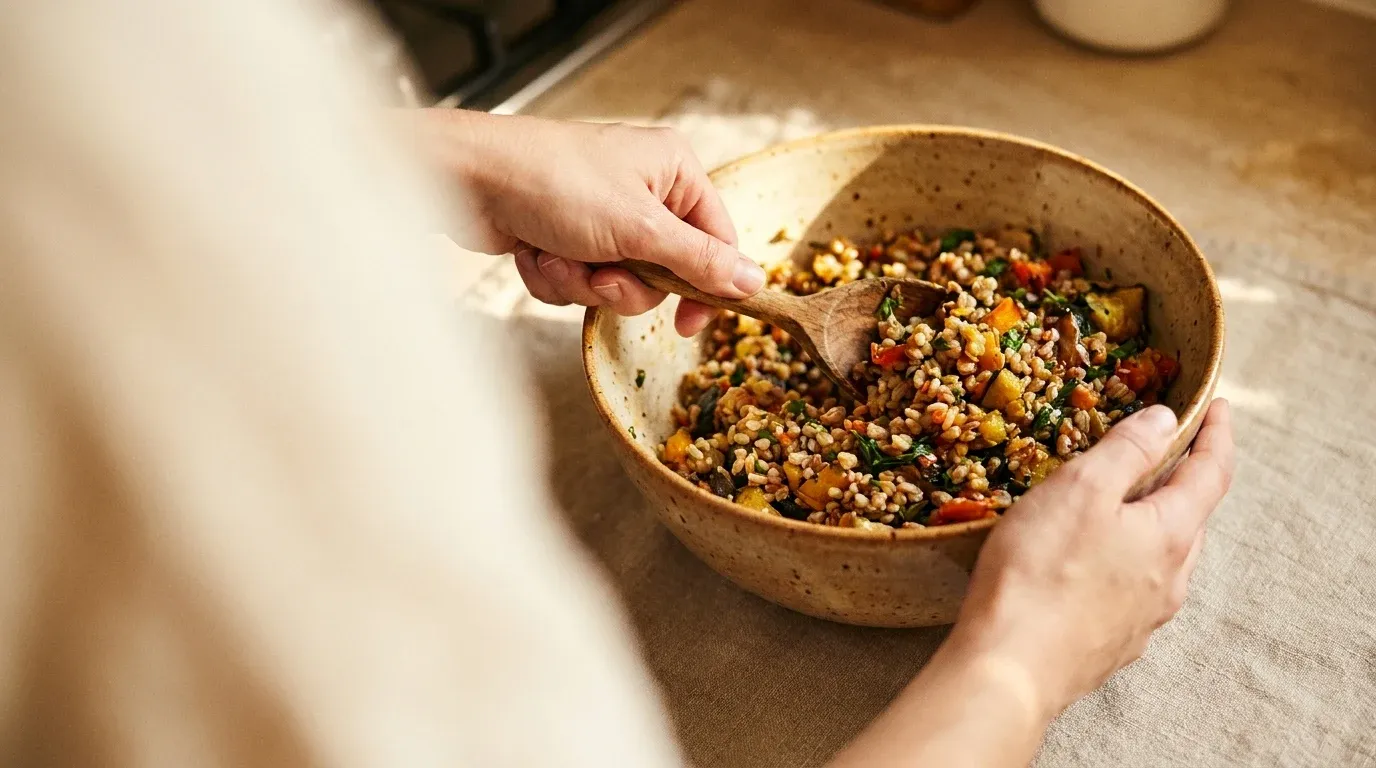
Cook a large pot of grains (rice, oats, or lentils all keep well). Roast or boil a batch of vegetables. Hard-boil eggs or cook a protein in bulk. From those three elements, you can assemble multiple different meals across a week without repeating the same dish. The diversity comes from how you season and combine, not from starting from scratch every night.
This approach also reduces decision fatigue, which is a genuine barrier to eating well. When the components are ready, the choice is easy. When they're not, takeout wins by default.
Culturally Familiar Ingredient Swaps
Nutrition guidance that insists on specific "superfoods" misses an enormous opportunity. Almost every dietary pattern in the world has its own version of the same nutritional wins. High-fiber legumes show up as black beans in Mexican cooking, chickpeas in South Asian and Middle Eastern cuisines, red lentils in Ethiopian food, and edamame across East Asian diets. The nutritional profile is similar. The cultural familiarity is completely different.
If you're trying to eat more plant-based protein, you don't need to adopt a food culture that isn't yours. Start with the legume, grain, or vegetable that already feels like home and build from there. That's not a compromise. It's a more sustainable strategy. The parts of produce you throw away are often the most nutritious, which means working more deeply with ingredients you already use is frequently more valuable than sourcing entirely new ones.
Low-Equipment Meal Frameworks
A microwave, a pot, and a pan cover the vast majority of what you need to eat well. Practitioners working in low-resource settings have developed meal frameworks built entirely around minimal equipment, and they hold up at any income level.
A reliable base framework looks like this:
- A grain or starch: Rice, pasta, oats, bread, or potatoes. These are calorie-dense, cheap, and filling.
- A protein: Eggs, canned fish, canned beans, tofu, or chicken thighs are all affordable and require minimal technique to prepare.
- A vegetable: Frozen vegetables are nutritionally comparable to fresh and cost significantly less. A bag of frozen spinach or mixed vegetables adds micronutrients without adding complexity.
- A flavor element: Soy sauce, hot sauce, olive oil, garlic, or any spice blend you already own. This is what makes the same three components feel different across the week.
That structure works whether you're spending $4 a day on food or $15. It scales. It adapts to different cuisines. And it doesn't require any particular cooking skill to execute reliably.
The Supplement Trap and Where It Fits In
One pattern that nutrition practitioners flagged at FNCE 2026 is the tendency for people facing dietary barriers to turn to supplements as a shortcut. That instinct isn't wrong, but it's easy to over-rely on. Supplements work best as targeted additions to an already reasonable diet, not as substitutes for the food itself.
If you're exploring whether specific supplements address specific gaps, it's worth reading evidence-based reviews rather than marketing claims. Sorting the evidence from the hype on popular supplements like magnesium and probiotics is a useful starting point before spending money on products that may not address your actual gaps. Similarly, recent research on combination supplements for weight loss illustrates why scrutinizing study quality matters before drawing conclusions from headlines.
The Broader Context: Food Is One Variable
Eating well doesn't happen in isolation. It interacts with sleep, stress, physical activity, and economic stability in ways that make it nearly impossible to separate out cleanly. Someone who's sleep-deprived makes worse food choices, not because they lack nutrition knowledge, but because sleep deprivation directly increases appetite for calorie-dense foods while reducing willpower. The research on irregular sleep patterns and health outcomes makes that relationship concrete.
Physical activity compounds the benefits of improved nutrition, particularly for adults navigating life transitions. For people over 40 specifically, the combination of resistance training and adequate protein intake matters more than it did in earlier decades. Whether structured fitness coaching after 40 is worth pursuing is a question worth asking if you're finding it harder to maintain body composition through diet alone.
The point isn't that everything has to be perfect before nutrition can improve. It's that sustainable eating habits are embedded in a life, not extracted from it. Solutions that ignore the full picture, whether they're food access programs or diet plans, tend to produce short-term results at best.
Start Where You Actually Are
The most useful thing FNCE 2026 surfaced for practitioners wasn't a new diet or a new intervention model. It was a reframe. Stop asking "does this person have access to healthy food?" and start asking "does this person have everything they need to actually eat it?"
You can apply that same reframe to yourself. Not: what should I be eating according to the latest guidelines. But: what do I actually have, what do I actually know how to make, and what fits into the time I realistically have this week?
That's not lowering the bar. It's locating the bar somewhere real.