
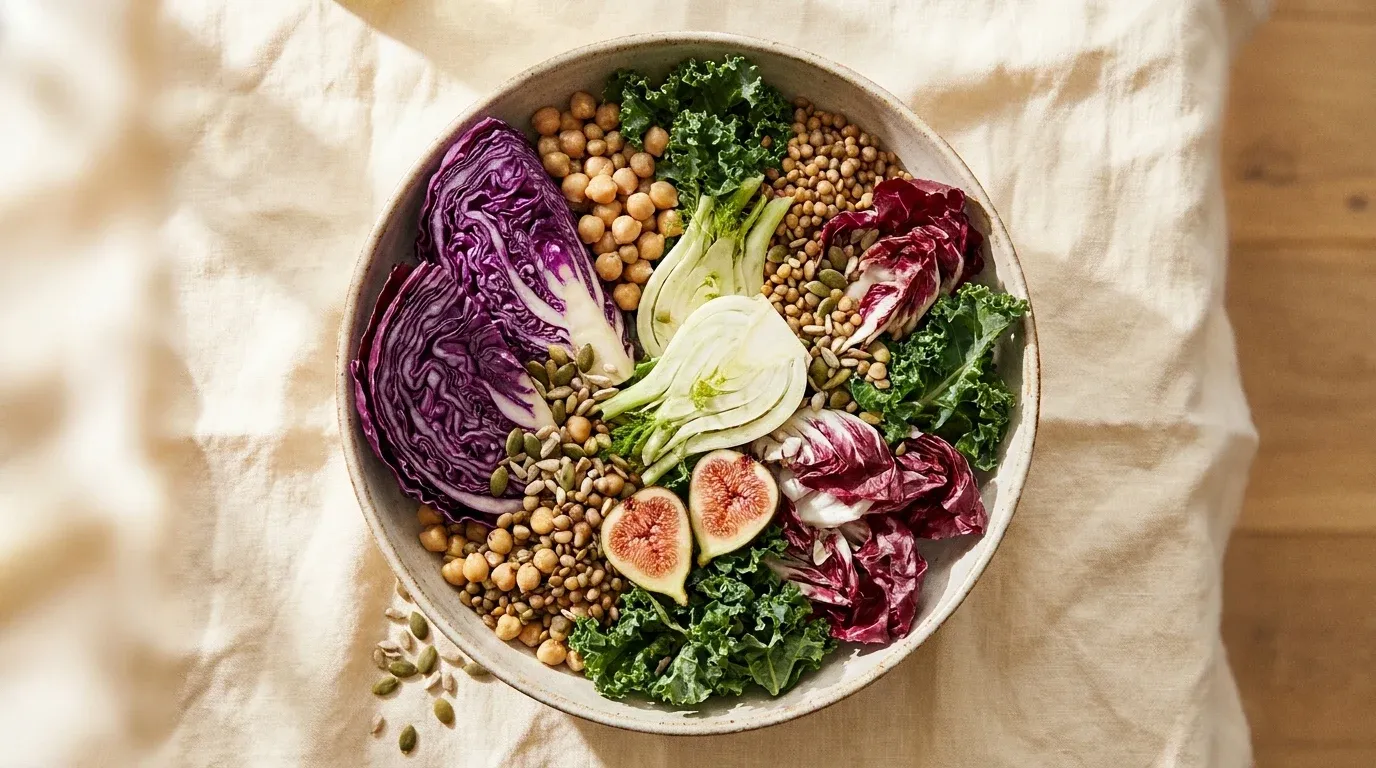
You've seen the headlines. Blueberries boost brain function. Dark chocolate cuts cortisol. A single food gets a week of coverage, then disappears. What the most rigorous gut-brain research of 2025 and 2026 actually shows is less exciting as a headline and far more useful in practice: it's your overall dietary pattern, not any single ingredient, that moves the needle on mood and stress resilience.
Here's what the science says, and what to do with it on a Tuesday night when you're staring into the fridge.
Why Your Gut Talks to Your Brain
The gut-brain axis isn't a metaphor. It's a physical communication network operating through three primary channels: the vagus nerve, neurotransmitter production, and systemic inflammation.
The vagus nerve runs directly from your brainstem to your gut, transmitting signals in both directions. When your gut microbiome is disrupted, those signals change. Roughly 90% of the body's serotonin is produced in the gastrointestinal tract, not the brain. That means the bacterial environment in your intestines directly shapes the availability of a neurotransmitter most people associate only with mood and antidepressants.
Chronic low-grade inflammation, often driven by diet, also crosses the blood-brain barrier and has been consistently linked to elevated depression and anxiety markers in population-level studies. These aren't speculative pathways. They're measurable, and diet sits at the center of all three.
It's also worth noting that stress itself feeds back into the gut. How stress quietly spikes your blood sugar is one side of that loop. The gut microbiome's effect on stress hormones is the other. The relationship runs in both directions, which is exactly why dietary intervention shows up consistently in mental health outcome data.
Diversity Is the Variable That Matters Most
Large cohort studies published in 2025 and 2026 have reinforced what earlier research suggested: microbiome richness, meaning the number and variety of bacterial species living in your gut, is one of the strongest predictors of mood stability and stress tolerance measured in self-reported and biomarker data alike.
And the strongest dietary predictor of microbiome richness isn't any superfood. It's the total number of different plant foods you eat each week.
The target that's emerged from this research is 30 different plant varieties per week. That figure comes from large-scale dietary microbiome studies and has been adopted as a practical, evidence-graded benchmark. It sounds like a lot until you realize that herbs, spices, legumes, grains, nuts, seeds, and fruits all count alongside vegetables.
A handful of walnuts, a teaspoon of cumin, a can of chickpeas, a banana, two types of leafy greens in a salad. You can hit eight or nine varieties in a single meal without any elaborate preparation. The barrier isn't effort. It's awareness.
One practical shortcut: stop discarding parts of produce that are nutritionally dense. The parts of produce you throw away are often the most nutritious, and using broccoli stems, watermelon rinds, and citrus peels adds variety to your plant count without buying more food.
Fermented Foods Beat Fiber Supplements Alone
If you've been adding a fiber supplement to your routine and wondering why you don't feel dramatically different, the research has a partial explanation. Dietary intervention trials over four-week periods have shown that fermented foods outperform fiber supplements alone when the outcome being measured is self-reported anxiety and mood markers.
Kefir, kimchi, sauerkraut, miso, and yogurt with live active cultures introduce actual bacterial strains into the gut environment. Fiber feeds the bacteria already there. Both matter, but the evidence increasingly suggests that inoculating your gut with live cultures produces faster, more measurable psychological effects than fiber alone in short-term interventions.
This doesn't mean you stop eating fiber-rich foods. It means fermented foods earn a regular slot in your weekly eating pattern rather than being an occasional garnish. A daily serving of plain kefir or a couple of tablespoons of kimchi alongside a meal is a low-cost, low-effort starting point. In most US grocery stores, a 32-ounce bottle of plain kefir runs around $5 to $7. It's not a specialty item anymore.
The practical note: heat kills live cultures. Kimchi added to a finished dish after cooking retains its bacterial benefit. Miso stirred into boiling broth does not.
Ultra-Processed Food Damages Your Microbiome Faster Than You Think
One of the more striking findings from recent dietary intervention studies is the speed at which ultra-processed food consumption reduces microbiome diversity. Within 72 hours of sustained ultra-processed food intake, measurable decreases in microbial variety show up in stool samples.
That timeline matters because it removes the abstraction from food choices. This isn't about long-term cumulative risk in the way that smoking and lung cancer are linked. This is a 72-hour feedback loop. What you ate Wednesday is already affecting your gut environment by Saturday.
Ultra-processed foods aren't just fast food. They include many packaged snacks, flavored yogurts with additives, most breakfast cereals, deli meats with preservative loads, and ready-made sauces. The classification is based on degree of industrial processing and additive content, not simply calorie density or fat content.
The practical implication isn't that you never eat these foods. It's that treating them as genuinely occasional rather than background-daily is a meaningful lever, and the science now gives you a concrete timeframe to work with.
A Weekly Eating Framework That Actually Works
Getting to 30 plant varieties per week, eating fermented foods daily, and minimizing ultra-processed foods sounds like a full-time job until you map it out against foods most households already stock. Here's a realistic weekly template built around pantry staples.
Breakfast (across the week):
- Rotate between oats with banana and walnuts, plain yogurt with mixed berries and flaxseed, and eggs with spinach and whole grain toast. That's already 8 to 10 plant varieties before lunch.
- Add a pinch of cinnamon, ground ginger, or turmeric to oatmeal. Each spice counts as a separate plant variety and costs nothing extra.
Lunch (across the week):
- A base of mixed greens with two or three vegetable toppings, a legume (canned lentils or chickpeas), and a seed or nut (sunflower seeds, pumpkin seeds) gives you 6 to 8 varieties in one bowl.
- Rotate the grain: brown rice one day, quinoa another, farro a third. Three more plant varieties without any additional effort.
Dinner (across the week):
- Build dinners around a protein and two or three vegetables that differ from what you had at lunch. Frozen vegetables count. A bag of frozen peas, edamame, or mixed stir-fry vegetables is as effective for microbiome diversity as fresh.
- Add a fermented food as a condiment or side: kimchi alongside grain bowls, plain kefir as a base for sauces or dressings, miso stirred into soups off the heat.
Snacks and extras:
- Mixed nuts (almonds, cashews, pistachios together) add three plant varieties instantly.
- Dark chocolate at 70% or above contains flavonoids that function as prebiotic fiber. A square or two is both a snack and a plant variety.
- Herbal teas, ground spices on savory dishes, fresh herbs as garnish. These small additions accumulate quickly across the week.
Tracking your 30 plants doesn't require an app. Keep a running list on your phone's notes for the first two weeks until you develop an intuition for the numbers. Most people discover they were already hitting 18 to 22 varieties and that the gap to 30 closes faster than expected once they start paying attention.
What Else Supports the Gut-Brain Connection
Diet is the most direct lever, but it doesn't operate in isolation. Sleep quality affects gut microbiome composition and vice versa. Research on irregular sleep patterns and their impact on health outcomes consistently shows disrupted gut function as one of the downstream effects of poor sleep architecture.
Exercise also drives microbiome diversity through mechanisms separate from diet. The data from a study of 110,000 Americans examining exercise and aging shows physical activity as one of the strongest modifiable factors for sustained health across multiple systems, including gut function. You don't need to maximize intensity. Consistency is what the research rewards.
The honest summary is this: your gut is not a secondary system you optimize after everything else is in order. It's a primary driver of how your brain chemistry operates day to day. Eating a wider variety of plants, adding fermented foods consistently, and reducing ultra-processed food intake are three changes that work through established physiological pathways. None of them require a new supplement, a complicated protocol, or a significant budget increase. They require a framework. Now you have one.