
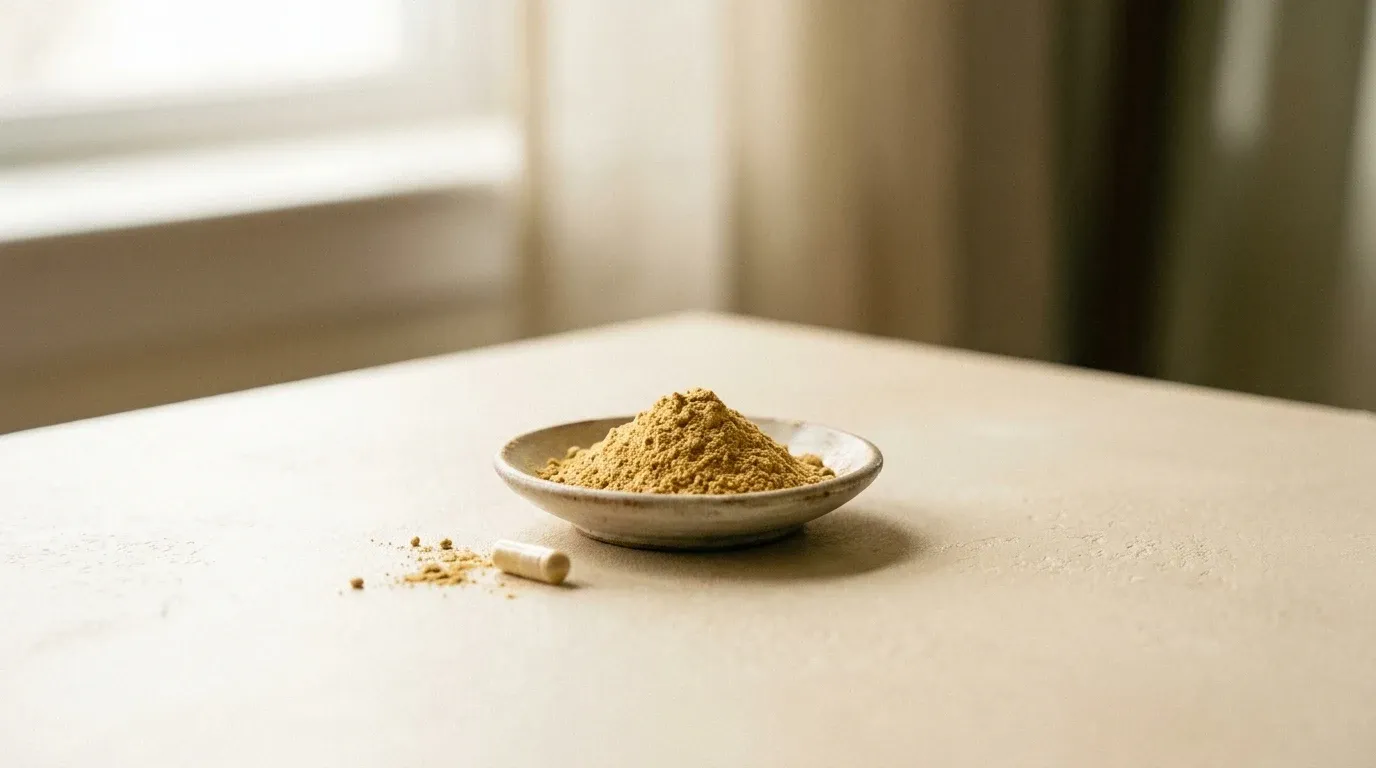
Walk into any supplement store or scroll through your social media feed long enough and you'll find a new category of products making bold promises. GLP-1 support powders, capsules, and blends are positioning themselves alongside the most talked-about drug class in modern medicine. The marketing is slick. The science is considerably messier.
Before you spend $60 to $120 a month on a powder that promises to "activate your GLP-1," you need to understand what these products actually do, where the evidence holds up, and where companies are quietly stretching the truth.
What GLP-1 Actually Is
GLP-1, or glucagon-like peptide-1, is a hormone your gut produces naturally in response to food. It signals your pancreas to release insulin, slows gastric emptying, and sends satiety messages to your brain. In short, it helps regulate blood sugar and tells you when you've had enough to eat.
Pharmaceutical GLP-1 receptor agonists like semaglutide and tirzepatide work by mimicking or enhancing this signaling at the receptor level. They bind directly to GLP-1 receptors with a potency and duration that your body's natural hormone production simply cannot match. That's why these medications produce the dramatic weight loss results you've been reading about. The effect size is large and well-documented across thousands of clinical trials.
Natural GLP-1 supplements work through a fundamentally different mechanism. They don't bind to GLP-1 receptors. They don't mimic the hormone. Instead, they attempt to stimulate your body to produce slightly more of its own GLP-1. That distinction matters enormously when you're evaluating marketing claims.
The Ingredients Actually Worth Discussing
Most GLP-1 support products rely on a core set of ingredients that have genuine research behind them, even if that research doesn't always support the claims printed on the label.
Berberine is the standout. A compound found in plants like barberry and goldenseal, berberine has been studied for its effects on blood sugar regulation for decades. Several studies have shown it can activate AMPK (an enzyme that plays a central role in energy metabolism), improve insulin sensitivity, and modestly increase GLP-1 secretion from intestinal L-cells. A 2022 meta-analysis found berberine reduced fasting blood glucose by an average of around 20 mg/dL in people with metabolic dysfunction. That's meaningful, though not comparable to pharmaceutical intervention.
Inulin and other soluble fibers appear in many formulas. Fermentation of these fibers by gut bacteria produces short-chain fatty acids, which in turn stimulate GLP-1 release from the gut lining. The effect is real but modest and highly dependent on baseline diet and microbiome composition.
Cinnamon extract is commonly included based on research showing it can improve insulin sensitivity. Its direct impact on GLP-1 secretion is less established. Studies exist, but effect sizes are small and methodologies vary widely.
Bitter melon, gymnema sylvestre, and alpha-lipoic acid round out many formulas. Each has some evidence for blood sugar support. The GLP-1 angle is frequently extrapolated rather than directly demonstrated.
Where the Evidence Actually Stands
Here's the honest picture. Some of these ingredients, particularly berberine and fermentable fiber, do have credible mechanistic and clinical evidence suggesting they can modestly stimulate endogenous GLP-1 release and support blood sugar regulation. That's not nothing.
But "modestly stimulates your body's own GLP-1 production" is a very different claim from "supports GLP-1 like effects" or the more egregious implication that these products function similarly to prescription medications. The effect sizes in supplement research are typically small to moderate. Study populations are often limited. Industry funding introduces bias that independent replications frequently fail to resolve.
Cravings reduction is one of the most frequently marketed benefits. Some users do report reduced appetite with berberine supplementation. Whether this is primarily a GLP-1 effect or a consequence of improved blood sugar stability is hard to disentangle. The honest answer is probably both, and neither explanation tells you how much of an effect you'll personally experience.
If you're trying to understand the broader regulatory landscape for these products, The Bill That Could Reshape the Supplement Industry is worth reading. Proposed legislation would significantly change how supplement companies can market products that reference drug mechanisms, which is directly relevant to this entire category.
These Are Not GLP-1 Medications
This needs stating plainly. A supplement that nudges your gut to release slightly more of a hormone you already produce is not pharmacologically equivalent to injecting a modified peptide that activates GLP-1 receptors with sustained, supraphysiological effect.
Prescribed GLP-1 receptor agonists like semaglutide produce average weight loss of 10 to 15 percent of body weight in clinical trials, with some individuals losing significantly more. They are approved drugs with robust Phase III trial data, established safety monitoring protocols, and real side effect profiles that require medical oversight.
Natural GLP-1 supplements, even the ones with solid individual ingredient research, are not producing outcomes at that scale. If you're managing obesity, type 2 diabetes, or significant metabolic dysfunction, these products are not a substitute for a conversation with your doctor about evidence-based treatment options.
Where these products do have a reasonable role is as lifestyle adjuncts for people who are already exercising, eating well, and looking for additional support around blood sugar stability and cravings. That's a narrower, more honest positioning than most brands use, but it's the one the evidence supports.
Nutrition quality underneath any supplement matters far more than the supplement itself. If you're struggling to understand why your weight isn't budging despite strong habits, You Eat Well and Train Hard. Why Are You Gaining Weight? breaks down the factors that are often overlooked.
The Marketing Problem
The GLP-1 supplement category has a serious overclaiming problem. Part of it is the regulatory environment. The FDA does not require supplements to prove efficacy before going to market. Part of it is that "GLP-1" is now a culturally recognized term, and brands know that attaching it to a product drives sales regardless of mechanism accuracy.
Watch for these red flags when evaluating products:
- Before/after testimonials featuring dramatic weight loss. These are almost never attributable to the supplement alone and are frequently misleading.
- Language implying equivalence to prescription medications. Phrases like "natural Ozempic alternative" should immediately raise skepticism.
- Proprietary blends that hide individual ingredient doses. If you can't verify that berberine is dosed at the clinically studied level (typically 500 mg two to three times daily), you can't evaluate whether the product is likely to do anything.
- Citations to mechanism studies rather than outcome studies. A study showing berberine activates AMPK in vitro is not the same as a clinical trial showing it produces weight loss in humans.
- Short study durations used to support long-term claims. Many GLP-1 supplement studies run for 8 to 12 weeks. Extrapolating from that to sustained lifestyle outcomes is speculative.
For context on how underfueling can confuse appetite and metabolic signals in active people, 80% of Female Athletes Are Underfueling shows how common this issue is and why it matters when you're assessing whether a supplement is actually doing anything.
How to Evaluate Whether One Might Be Right for You
If you're considering a GLP-1 support supplement, the evaluation framework is straightforward.
First, look at what's actually in it and at what dose. Berberine at 1,000 to 1,500 mg per day in divided doses has genuine research support. A formula with 200 mg of berberine buried in a proprietary blend of twelve ingredients does not.
Second, assess your baseline. Are you eating enough fiber? Are you managing blood sugar through diet and exercise? These supplements work better as additions to a solid foundation, not as substitutes for one. If your training load is inconsistent, Deload Week: When You Need One and How to Do It Right is a useful starting point for thinking about how recovery affects your metabolic baseline.
Third, set a realistic expectation window. If berberine is going to help you, you'll likely see some signal within six to eight weeks in the form of improved post-meal energy stability or reduced cravings. You're not going to lose 15 pounds from a supplement.
Fourth, talk to a healthcare provider if you're on any medications. Berberine in particular has known interactions with metformin and some statins. It's not a benign powder just because it comes from a plant.
The Bottom Line
Natural GLP-1 supplements occupy a real but limited space in the nutrition landscape. Some ingredients, particularly berberine and soluble fiber, have genuine evidence for modest improvements in blood sugar regulation and endogenous GLP-1 stimulation. That evidence does not support the dramatic positioning these products often receive, and it absolutely does not support comparisons to pharmaceutical GLP-1 receptor agonists.
You're allowed to be interested in these products. Just be a precise consumer. Read the ingredient labels, check the doses, and calibrate your expectations to what the clinical evidence actually shows rather than what the marketing department decided to print on the front of the bag.