
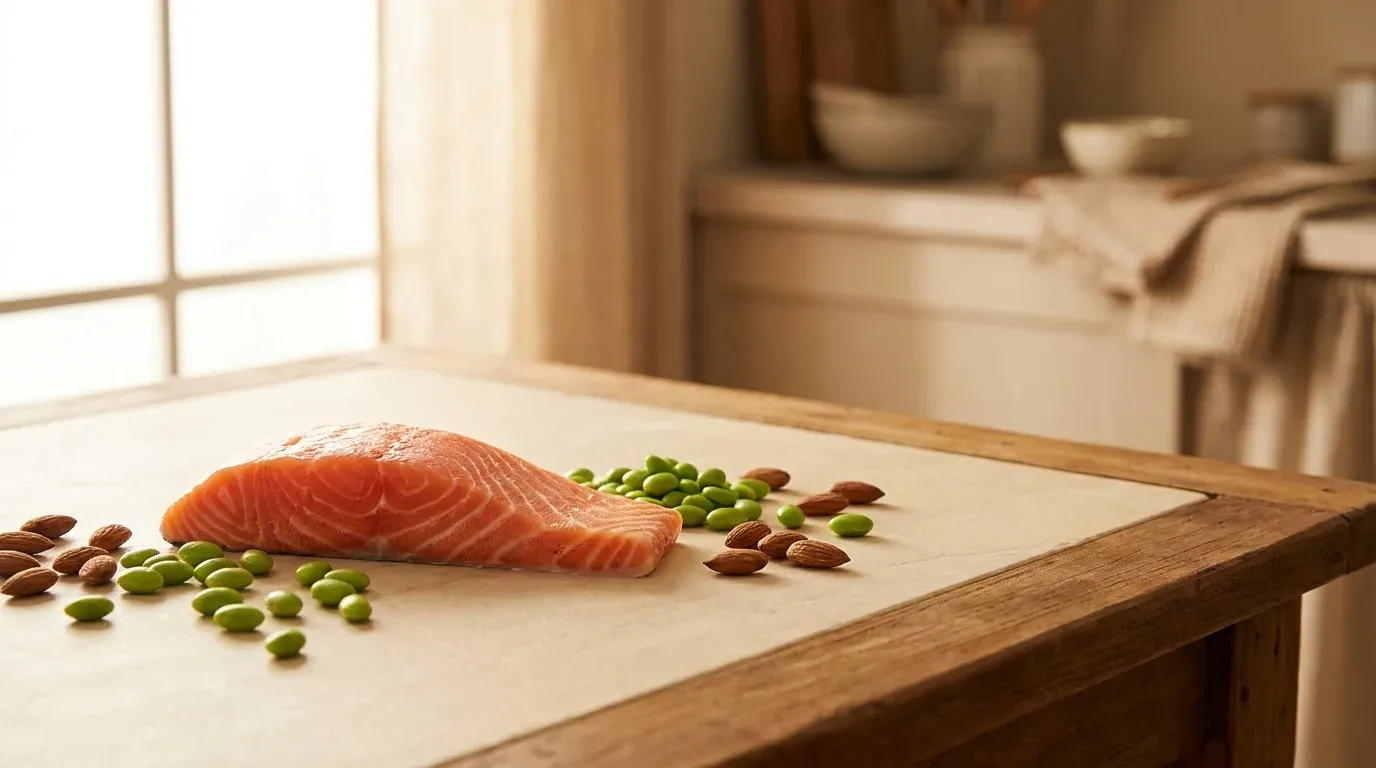
Most nutrition conversations around protein start and end with grams. Hit your number, the thinking goes, and you're covered. But that framing misses something critical: the same 30 grams of protein from a chicken breast and 30 grams from a bowl of lentils don't produce the same effect inside your muscle cells. The source, the amino acid composition, and how well your body actually absorbs the protein all determine what happens next.
Here's what the research actually shows, and how to build a daily strategy that works regardless of what you eat.
Why Leucine Is the Metric That Actually Matters
Muscle protein synthesis doesn't respond to total protein intake alone. It responds to amino acid availability, particularly the concentration of leucine, the branched-chain amino acid that acts as the primary trigger for the mTOR signaling pathway responsible for building new muscle tissue.
Research consistently points to a leucine threshold of around 2 to 3 grams per meal to maximally stimulate muscle protein synthesis in healthy adults. Below that threshold, the anabolic response is blunted, regardless of how much total protein you consumed. This is why a protein source's leucine content per serving is a more clinically useful number than the headline gram count on a nutrition label.
Animal proteins tend to hit this threshold reliably. A single egg contains roughly 0.6 grams of leucine, a 4-ounce chicken breast delivers around 2.5 grams, and whey protein concentrate provides close to 2.5 to 3 grams per 25-gram serving. Many plant-based sources fall short in a single serving. A cup of cooked lentils has approximately 1.3 grams of leucine. Tofu delivers around 1.4 grams per half-cup. Pea protein isolate sits closer to 2 grams per serving, making it one of the stronger plant options.
This doesn't mean plant proteins are inadequate. It means serving size and food pairing become more important calculations for anyone eating primarily plant foods.
DIAAS Scores Reveal What Absorption Data the Label Doesn't Tell You
Beyond leucine, overall protein quality depends on digestibility and the completeness of the essential amino acid profile. The Digestibility Corrected Amino Acid Score (DIAAS), introduced by the Food and Agriculture Organization as a more accurate replacement for the older PDCAAS method, measures how effectively a protein source delivers essential amino acids to the body after digestion.
DIAAS scores above 1.0 indicate high-quality protein. Whole eggs score around 1.13. Milk comes in around 1.14. Whey protein concentrate scores 1.09. By contrast, many plant proteins score below 1.0 individually. Cooked chickpeas score around 0.83. Pea protein isolate scores approximately 0.82 to 0.93 depending on processing. Rice protein sits lower, around 0.59 to 0.74.
The practical implication isn't that plant proteins are inferior. It's that plant-based eaters need to account for both the quantity and the strategic combination of sources to achieve equivalent amino acid delivery. A meal combining rice and legumes, for example, produces a complementary amino acid profile that closes many of the individual gaps. You don't need to combine them within the same meal, as research on protein complementarity suggests that total daily amino acid balance matters more than precise meal-by-meal pairing.
If you're navigating this on your own and finding it confusing, the kind of personalized guidance covered in what makes a trainer-client partnership actually work applies equally well to nutrition coaching, where individualization makes a real difference.
The Heart Health Variable That Changes the Equation
A recent review published in a major cardiovascular journal raised questions about high total protein intake and cardiovascular risk, particularly when protein comes from certain animal sources high in saturated fat. The review stopped short of recommending protein restriction, but it added a layer of nuance: total intake isn't the only lever you're pulling when you optimize protein.
For people who want to preserve or build muscle while keeping total protein moderate, this research makes protein source selection more strategic, not less important. A diet that delivers sufficient leucine and strong DIAAS-rated proteins without relying on high volumes of processed red meat looks meaningfully different from one that simply hits a gram target through whatever is convenient.
This matters especially as you get older. Muscle loss accelerates with age due to factors explored in the research on why aging muscles lose strength, and the anabolic resistance that develops over time means older adults may actually need higher leucine concentrations per meal, not lower ones, to achieve the same muscle protein synthesis response as younger people. Higher-quality protein sources become more valuable, not less, as you age.
Practical Strategy for Omnivores
If you eat animal products, the goal is distributing quality protein across meals rather than loading it into one sitting. Your body can only use roughly 35 to 40 grams of protein for muscle protein synthesis per meal, with diminishing returns beyond that point. Spreading intake across three to four meals optimizes utilization.
A functional daily template might look like this:
- Breakfast: Three whole eggs plus Greek yogurt, delivering approximately 30 grams of high-DIAAS protein and well above the leucine threshold.
- Lunch: 5 ounces of canned salmon or grilled chicken over greens, providing around 35 grams of complete protein.
- Post-training or afternoon snack: Cottage cheese or a whey-based option if needed to close a gap.
- Dinner: 5 to 6 ounces of lean meat or fish with legumes or whole grains as supporting carbohydrate.
This structure keeps leucine thresholds met at most meals without pushing total daily intake into territory where cardiovascular risk conversations become relevant. You're also leaving room for dietary diversity rather than eating chicken and rice four times a day.
Practical Strategy for Plant-Based Eaters
A plant-based approach to protein quality requires more planning upfront, but it's entirely achievable with a few structural habits. The core challenge is hitting leucine thresholds per meal, so the strategy centers on volume, density, and complementarity.
- Anchor meals around high-leucine plant foods: Soy-based proteins, including edamame, tofu, and tempeh, have the most complete amino acid profiles of any plant source, with DIAAS scores approaching those of some animal proteins. Tempeh in particular offers around 1.8 grams of leucine per 3.5-ounce serving.
- Use pea protein isolate strategically: Among plant-based protein powders, pea protein isolate consistently outperforms rice, hemp, and most seed proteins on both leucine content and DIAAS scores. If you want to understand how to evaluate powder quality more critically, protein powder's big claims: what the industry won't tell you covers the marketing gaps that matter.
- Increase total serving sizes where needed: If a plant protein source scores low on DIAAS, the practical correction is eating more of it, not abandoning it. Lentils are nutritionally dense and valuable. A larger serving gets you closer to leucine targets.
- Combine sources across the day: Legumes plus grains, seeds plus legumes, or soy plus any other plant source creates a complementary amino acid profile that closes individual gaps. You don't need to engineer each plate, but variety across the day is essential.
Recovery also plays into this equation. Protein timing around training matters, but so does the quality of recovery itself. The evidence on which recovery methods work best in the first 24 hours shows that muscle protein synthesis peaks in that post-exercise window, making the quality of what you eat after training especially relevant.
Stopping the Gram-Counting Spiral
The point of understanding leucine thresholds and DIAAS scores isn't to replace one obsession with another. It's to give you a smarter framework that requires less daily micromanagement once you understand the fundamentals.
If you're consistently eating two to three servings of high-quality protein per day, distributing those servings across meals, and anchoring each meal around a food that genuinely clears the leucine threshold, you're already doing more meaningful work than someone who hits 160 grams of total protein from low-quality sources spread unevenly through the day.
Protein quality and protein quantity are not competing ideas. They're two parts of the same calculation. But for most people, quality has been the underrepresented half of that equation, and closing that gap is where the actual results live.
Women, in particular, have historically been underrepresented in protein and muscle research. The growing body of work on the health risks that exercise actually reduces for women underscores why getting protein strategy right matters across all demographics, not just the athletic male population that dominates most nutrition studies.
Start with your leucine. Build from there.