

A growing body of research is making something clear: treating obesity as a character flaw rather than a health condition doesn't motivate people to change. It drives them away from care entirely. A new paper is now drawing on the global HIV response as a blueprint for how medicine, fitness, and nutrition fields can do better.
For anyone working with clients who have higher body weights, or anyone navigating their own health journey, the evidence has real implications for what works, what doesn't, and why the conversation around weight needs to change.
What the HIV Model Gets Right
The comparison might seem unexpected at first. But researchers arguing for a stigma-reduction framework in obesity care point to a specific pattern: when HIV was treated primarily as a moral issue, public health outcomes suffered. Shame-based messaging reduced testing rates, discouraged treatment-seeking, and pushed affected populations further from the care they needed.
The shift that changed outcomes wasn't purely pharmacological. It was structural. Community-led advocacy, integrated service models, and a deliberate reframe of the condition as a health issue rather than a lifestyle failure all contributed to better engagement and, ultimately, better outcomes.
The new paper argues that obesity care is at a similar inflection point. The tools now exist, from behavioral interventions to newer pharmacological options like GLP-1 receptor agonists, but stigma is undermining access and adherence at every level of the system.
Weight Stigma Has Measurable Health Consequences
This isn't about feelings. The research linking weight stigma to concrete health outcomes is substantial and consistent.
Studies show that people who experience weight-based discrimination are more likely to avoid preventive care, delay medical appointments, and disengage from fitness programs. One frequently cited analysis found that weight stigma is associated with increased cortisol output, elevated inflammatory markers, and higher rates of disordered eating. In other words, stigma doesn't just correlate with poor outcomes. It actively produces them through physiological pathways.
The data on care avoidance is particularly striking. Research has found that a significant proportion of people with obesity report postponing or canceling medical appointments specifically because of anticipated judgment from healthcare providers. When patients do attend, stigmatizing interactions have been linked to shorter consultation times, fewer diagnostic tests ordered, and lower rates of appropriate referral.
In fitness contexts, the picture looks similar. Clients who have experienced body-based shame in gym environments report lower self-efficacy, reduced program adherence, and higher dropout rates. The environment and the language used in it shape behavior as much as the program itself.

Framing Weight as a Moral Issue Contradicts the Evidence
Current scientific understanding of body weight regulation is a long way from simple willpower narratives. Research consistently points to a complex interplay of genetics, gut microbiome composition, hormonal signaling, sleep quality, socioeconomic stressors, and the food environment. The idea that weight is primarily a reflection of personal discipline isn't supported by the evidence base.
Genetics alone account for an estimated 40 to 70 percent of BMI variation across populations. Hormones like leptin and ghrelin regulate hunger and satiety in ways that actively resist deliberate caloric restriction. This is why approaches combining dietary change with structured activity tend to produce more durable results than restriction-only protocols. The biology is working with you or against you depending on the entire system, not just what's on the plate.
When fitness and nutrition professionals operate from a moral framework, attributing excess weight to laziness or poor choices, they're not just being unkind. They're working from an outdated and inaccurate model. And that model produces worse client outcomes, not better ones.
Language and Program Design Are Clinical Variables
If you're a nutrition professional, a personal trainer, or a wellness coach, here's the practical implication: how you talk to clients matters as much as what you tell them to eat or how you structure their training.
Research on patient-provider communication consistently finds that weight-neutral, behavior-focused language improves engagement. This doesn't mean avoiding the topic of weight. It means framing conversations around health behaviors, functional goals, and measurable outcomes rather than body size as a proxy for personal worth.
Some concrete applications:
- Use person-first language. "A person with obesity" rather than "an obese person" shifts the frame from identity to condition. It's a small change that research suggests has meaningful effects on how clients receive information.
- Focus on behavior-based goals. Sleep, strength, energy, blood sugar stability, and cardiovascular function are all targets that matter independent of scale weight. Building programs around these creates momentum that isn't tied to a number.
- Audit your environment. Gym equipment weight limits, the language on intake forms, before-and-after imagery in marketing materials. All of these communicate who your space is designed for.
- Avoid urgency framing tied to shame. Phrases like "before it's too late" or "get your body under control" activate threat responses that undermine the prefrontal engagement needed for sustained behavior change.
Program design follows the same logic. Strength-based programming that emphasizes capacity gains, for example, gives clients a performance narrative rather than a deficit narrative. The longevity evidence for resistance training is strong enough to anchor a program entirely around what the body can do, not what it weighs.
Integrated, Destigmatized Care Models Produce Better Adherence
The HIV parallel becomes most instructive here. What turned the tide in HIV outcomes was integration: mental health support alongside medical treatment, community advocacy embedded in clinical pathways, and a consistent message that people deserved care regardless of how they got sick.
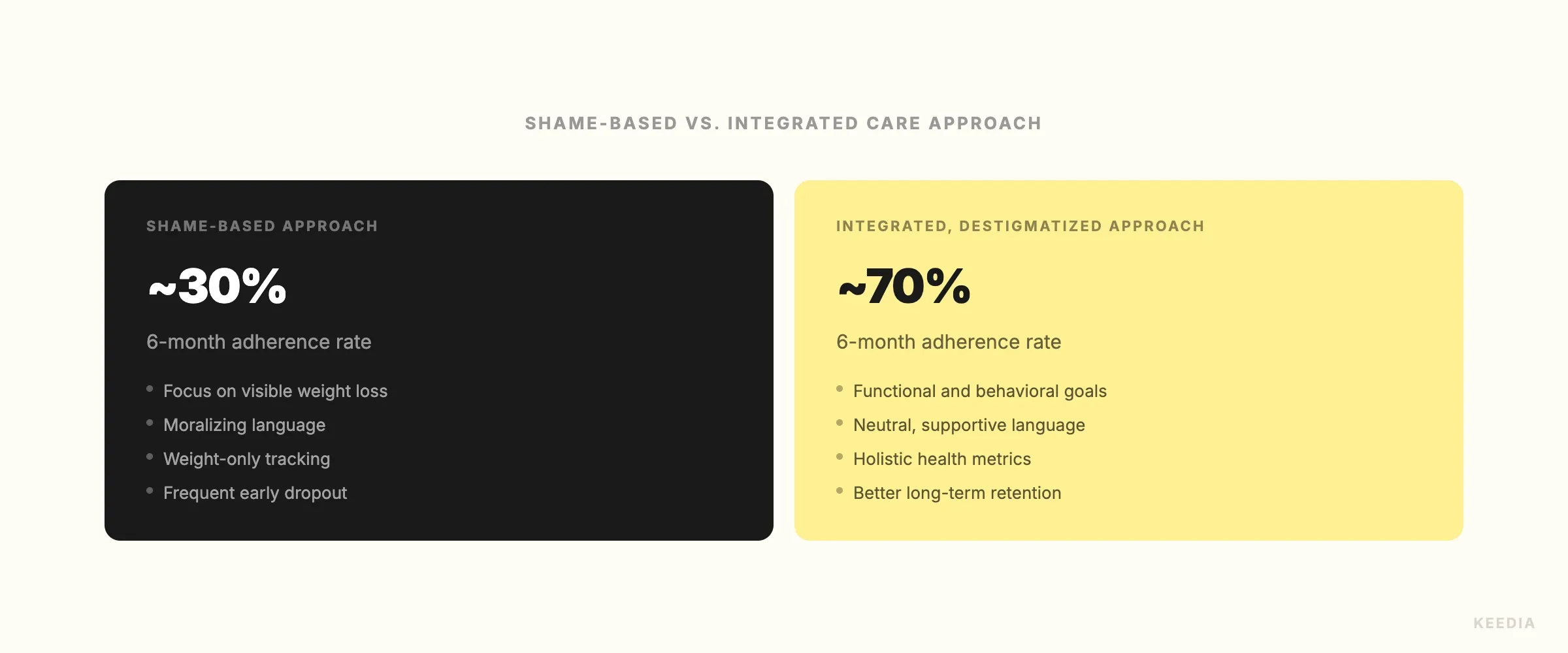
In obesity care, integrated models that combine nutritional support, behavioral health, physical activity guidance, and primary care coordination consistently outperform siloed, weight-centric approaches in long-term adherence studies. The difference isn't the specific diet or the specific exercise protocol. It's whether the person feels seen, supported, and free from judgment throughout the process.
This is worth sitting with if you work in the fitness or nutrition space. A client who trusts you, who doesn't dread their appointments, who feels that the program was designed for them rather than against their current body, is a client who shows up. Consistently. And consistency is the variable that actually drives outcomes over time.
The metabolic benefits of regular physical activity are well-documented. Research on how exercise influences hormonal signaling and metabolic function makes the case clearly: regular movement improves blood sugar regulation, lipid profiles, and insulin sensitivity in ways that benefit health at any body weight. But those benefits are only accessible to people who actually engage with exercise. Stigma is one of the most reliable predictors of non-engagement.
What the Field Needs to Change
The paper drawing on HIV advocacy calls for structural changes: community involvement in designing care models, training for clinicians and fitness professionals on weight stigma and its effects, and a shift in how success is measured. Outcomes like blood pressure, HbA1c, mobility, and mental health offer a fuller picture than scale weight alone.
For individual practitioners, the ask is more immediate. It starts with examining your own assumptions and the implicit messages embedded in how you run your practice.
It's also worth recognizing that clients with higher body weights are often navigating multiple systems simultaneously. Food access, sleep quality, chronic stress, and socioeconomic pressures all affect body weight in ways that no nutrition plan can fully offset. Knowing that combining dietary and activity interventions produces synergistic metabolic effects is useful. Recognizing that those interventions need to be accessible, sustainable, and free from shame is what makes them work in practice.
The evidence on weight stigma is no longer preliminary. It's consistent, it's physiologically grounded, and it points in a clear direction. Shame doesn't work. Integrated, destigmatized, person-centered care does. The HIV response proved it. The question now is whether the fitness and nutrition field is ready to apply the lesson.