
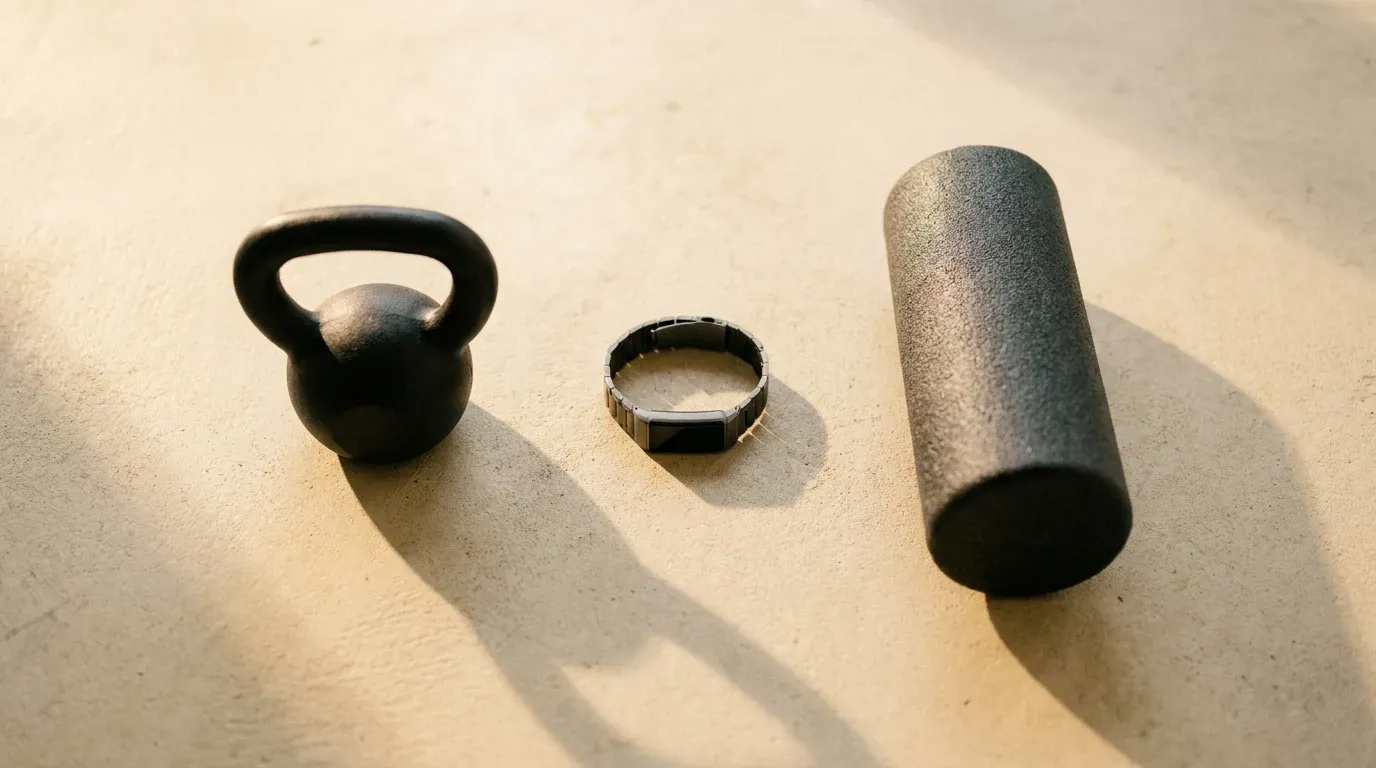
The home gym category is no longer a hardware business. If you're a fitness brand still selling connected equipment as a premium version of a dumbbell, you're already behind. The 2026 market has consolidated around three pillars: smart strength equipment, wearable integration, and recovery tech. The brands capturing recurring revenue are the ones that operate across all three. The ones losing ground are selling boxes that don't talk to anything.
This isn't a gradual shift. It's a structural reset, and the competitive window for repositioning is narrowing faster than most brand teams are moving.
Smart Strength Has Replaced "Connected" as the Consumer Baseline
An August 2026 home gym market guide confirms what purchasing data has been signaling for over a year: smart strength equipment and hybrid training models are now the dominant buying drivers, not price or aesthetics. Consumers aren't asking whether a piece of equipment is connected. They're asking what it connects to, what it learns, and how it adapts.
That's a fundamentally different evaluation framework than the one brands optimized for in 2020 or 2021. The pandemic-era home gym buyer wanted space-saving hardware and decent build quality. The 2026 buyer wants a system. They want equipment that fits into a training ecosystem, syncs with their existing data, and delivers some version of personalized coaching without requiring a separate subscription to a human trainer.
The brands that understood this early, including those building AI-driven resistance systems and cable machines with embedded rep tracking, have used that positioning to justify price points that commodity manufacturers can't approach. A resistance trainer with real-time form feedback and progressive overload automation commands $2,500 to $4,000 at retail. A comparable-looking selectorized unit without software integration struggles to hold $800.
That pricing gap isn't about manufacturing cost. It's about data architecture. And it's only going to widen.
Wearable Integration Is No Longer Optional
For the third consecutive year, wearable technology has topped the American College of Sports Medicine's annual fitness trend survey. That's not a coincidence or a fad. It's a signal that wearables have become the default health interface for the consumer segment that buys premium home gym equipment.
If your equipment doesn't communicate with Apple Health, Google Fit, Garmin, Whoop, or Oura, you're asking the buyer to manage a gap in their data. And increasingly, they won't. They'll choose the brand that closes that gap, even if the hardware specs are marginally inferior.
This is the interoperability problem that legacy equipment brands have underestimated. Their product teams think in terms of physical performance. Their competitors are thinking in terms of data continuity. When a Whoop user finishes a strength session and their HRV, strain score, and recovery data automatically inform tomorrow's programming, that's a closed-loop experience. An equipment brand that interrupts that loop with a siloed app and no export functionality is a liability in the consumer's wellness stack, not an asset.
The implications extend beyond consumer preference. recent investment activity in FitTech platforms suggests that the capital flowing into this space is specifically targeting wearable-adjacent software layers, not hardware manufacturing. That's where the valuation multiples are. Equipment brands that don't build or acquire API-layer capability are going to find themselves commoditized by software companies that simply use better hardware as a distribution vehicle.
Recovery Tech Is the Upsell Category Brands Are Missing
The fastest-growing adjacent category in the home gym space isn't another piece of strength equipment. It's recovery and longevity tech: infrared saunas, compression devices, percussive therapy tools, and sleep-tracking hardware. This category is expanding at a rate that outpaces core fitness equipment in both unit volume and average selling price growth.
For equipment brands, this is a bundling opportunity that most are leaving completely on the table. The consumer who spends $3,500 on a smart cable machine is already primed for a $600 compression recovery system and a $400 infrared therapy panel. They've self-identified as someone who takes physical performance seriously enough to invest at that level. The cross-sell logic is obvious.
What's less obvious is the data integration angle. Recovery tech that feeds sleep quality, HRV trends, and soreness indicators back into a training platform creates a genuinely adaptive programming loop. If your smart strength equipment knows that last night's sleep score was 62 and your resting heart rate is elevated, it can adjust today's planned session before you even pick up a weight. That's not a feature. That's a retention mechanism.
The brands building partnership strategies with recovery tech companies now are going to own that data relationship with the consumer. The ones that wait until the category matures will find the ecosystem positions already filled.
It's worth noting that recovery optimization is increasingly relevant beyond the home gym context. Research confirms that extreme heat can impair recovery for up to 72 hours, which makes data-informed recovery tools even more relevant to consumers training in variable conditions.
Data-Driven Coaching Is the Differentiator That Justifies Premium Pricing
Here's the core competitive argument for brands investing in smart equipment infrastructure: AI-embedded coaching at the hardware level is the only sustainable justification for premium pricing in a market where Chinese manufacturers can replicate physical components within 18 months of any product launch.
Rep counting, real-time form feedback, tempo guidance, and progressive overload automation are not gimmicks. They're the functional equivalent of having a coach in the room. And they're what separates a $3,000 product from a $700 product in the consumer's mind when the weight stacks look identical.
The coaching layer also creates subscription revenue. If your equipment delivers adaptive programming, that programming needs to update, personalize, and evolve. That's a software service. And software services generate monthly recurring revenue in a way that one-time hardware sales never will.
This dynamic is already reshaping how fitness professionals think about their own positioning. the real numbers behind personal trainer earnings in 2026 show that trainers who integrate smart equipment data into their remote coaching workflows are commanding higher rates than those who don't, because they're delivering more measurable outcomes. Equipment brands that enable that integration are becoming infrastructure for the coaching economy, not just consumer products.
Owning the Data Layer Changes Everything About Competitive Dynamics
Traditional fitness equipment companies competed on build quality, weight tolerances, warranty terms, and brand reputation. Those things still matter. But they're table stakes now, not differentiators. The actual competitive moat in 2026 is the data layer.
Brands that own the training data, including movement patterns, progressive overload history, recovery correlation, and behavioral engagement metrics, are building switching costs that no legacy equipment company has ever had access to. When a consumer has 18 months of strength progression data, personalized programming history, and body composition correlations locked into your ecosystem, they don't leave. The friction is too high. The data is too valuable to abandon.
This is the core reason software-first competitors are winning market share from pure-hardware players. It's not that their equipment is better. It's that their equipment is the physical expression of a data business. And data businesses have fundamentally different unit economics than manufacturing businesses.
The commercial gym sector is already processing this lesson. analysis of where the $298 billion fitness market is heading by 2034 consistently points to member data and digital engagement as the primary drivers of operator valuation, not square footage or equipment inventory. The same logic applies at the home gym scale. The brand that knows the most about how you train is worth more than the brand that built the thing you train on.
It also changes the M&A landscape. Equipment companies with strong data layers are acquisition targets for health tech platforms, insurance companies, and employer wellness programs. Pure-hardware players are acquisition targets for private equity looking to cut costs. Those are very different outcomes.
What Brands Need to Do Right Now
If you're operating in the home gym equipment space, the strategic priorities are clearer than they've ever been. Here's where the leverage is:
- Build or license wearable API integrations immediately. Whoop, Garmin, Apple Health, and Oura are non-negotiable starting points. Every month you delay is another cohort of buyers who choose a competitor that closes the data loop.
- Identify a recovery tech partner and structure a bundling offer. You don't need to manufacture infrared panels. You need a co-marketing agreement and a data integration protocol with someone who does.
- Invest in the coaching software layer before a software company does it for you. AI form feedback and progressive overload automation are buildable in 12 to 18 months. If you're not building, a competitor is, and they'll use your hardware category as distribution while capturing the subscription margin.
- Reframe your pricing around outcomes, not components. The consumer justifying a $3,500 purchase to a partner isn't talking about steel gauge or pulley ratios. They're talking about what results the system delivers. Your marketing needs to reflect that language.
- Protect your data architecture as a strategic asset. Interoperability is a feature. Proprietary training intelligence is a moat. Know the difference and structure your platform agreements accordingly.
The home gym market isn't slowing down. US gym traffic is outpacing record 2025 levels at midyear 2026, which means consumer investment in physical training, both inside and outside the home, is accelerating. The brands that capture the home segment of that spend will be the ones that built connected ecosystems, not just connected equipment.
The difference sounds subtle. The revenue outcomes are not.