
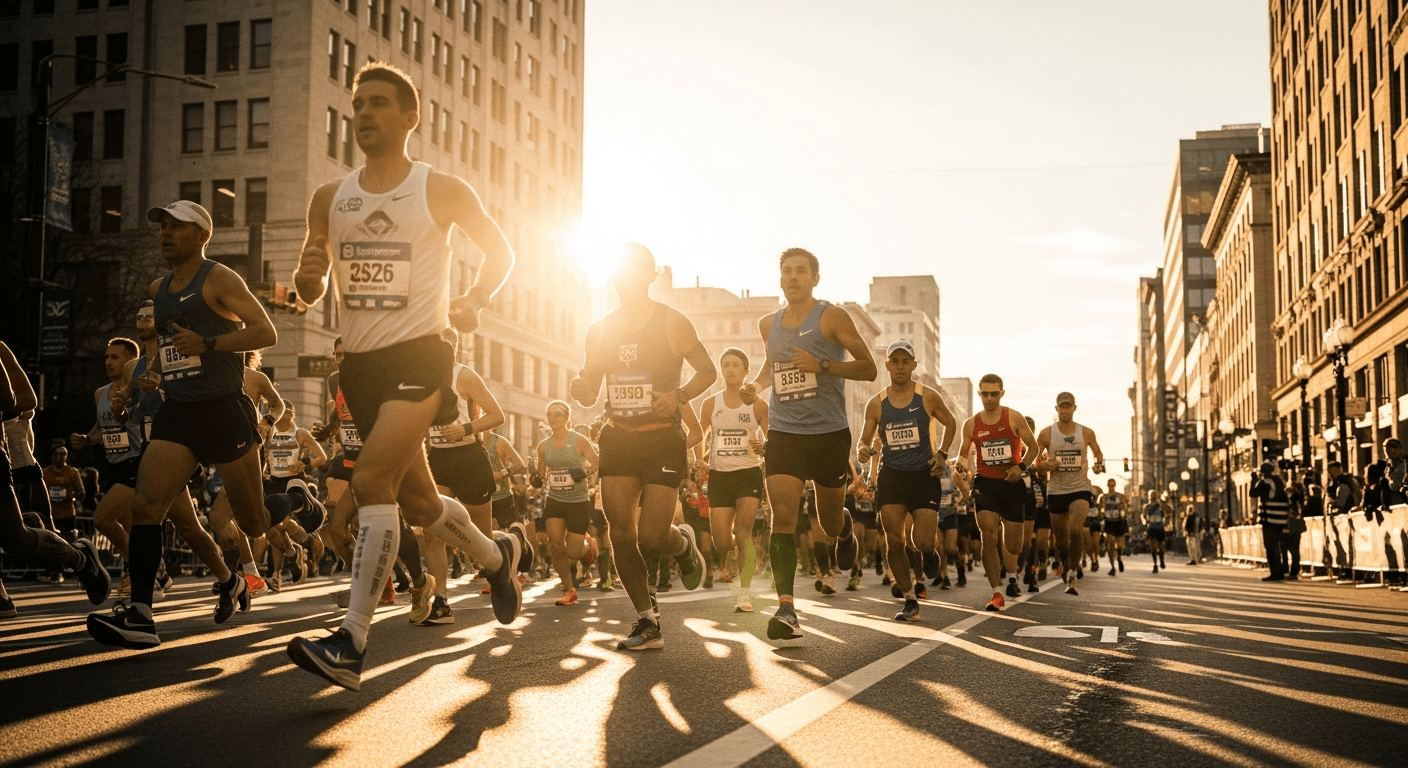
Something shifted. Not gradually, not quietly. Marathon running in 2026 isn't a niche pursuit for elite athletes or obsessive early risers. It's a mainstream cultural movement, and the numbers back that up at every level of the sport, from New Brunswick to the streets of London.
Understanding how we got here, and what it means if you're lacing up for the first time or chasing a personal best, is worth your attention.
Fredericton Proves the Boom Is Everywhere
The 48th Fredericton Marathon drew 3,600 participants in 2026. That's not a typo, and Fredericton isn't London or Chicago. It's a mid-sized Canadian city, and its marathon has become one of the clearest signals that the running explosion isn't just concentrated at the prestigious six major races. It's spreading deep into community events worldwide.
Race directors across North America, the UK, and Australia are reporting similar trends. Entry numbers for regional half marathons and full marathons are up sharply compared to pre-2020 figures, with many events introducing waitlists for the first time. The Fredericton result reflects a grassroots energy that's hard to manufacture. Runners want to race. They want a bib, a finish line, and a community around them when they cross it.
This matters because it changes the entire culture around marathon training. When your neighbor is running 20 miles on a Sunday, when your coworker is following a structured build, when social groups form around long runs rather than around bars, participation normalizes. And normalization drives more participation.
What Actually Drove the Cultural Shift
The marathon's rise to cultural prominence didn't happen overnight. Three interconnected forces pushed it forward over the past decade, and they're still accelerating.
Social media visibility. Running is visually compelling and personally meaningful. A finish-line photo, a Strava segment, a time posted in a WhatsApp group. these moments of shared achievement created a feedback loop that no traditional marketing budget could have bought. Running became something you performed publicly, not just something you did alone at dawn. That visibility recruited millions of new runners who saw themselves reflected in ordinary people completing extraordinary distances.
The rise of running clubs. Running clubs have transformed from modest local associations into social infrastructure. In cities like London, New York, Sydney, and Toronto, clubs now operate less like training groups and more like communities with identity, aesthetics, and culture. Run clubs organize group workouts, post-run coffee sessions, and weekend long runs that feel more like social events than training obligations. For many runners, the club came before the race goal. The community pulled them into the sport.
Celebrity participation. High-profile figures completing marathons in real time, posting their training, sharing their struggles with injury or pace, have made the distance feel accessible rather than forbidding. When someone with a massive audience documents a 20-week training journey, that's an enormous amount of content modeling the behavior for followers who might otherwise never have considered entering a race. The aspirational pull is real, and it compounds year over year.
London 2027 and the Demand Crisis at the Top
Here's where the cultural story gets complicated. The London Marathon ballot for 2027 received 1.3 million applications. One point three million people trying to get into a race that accommodates roughly 50,000 runners. The acceptance rate is fractional. Most applicants will be rejected, many of them for the fifth or sixth consecutive year.
This isn't a London-specific anomaly. Demand at the six World Marathon Majors, London, Tokyo, Boston, Berlin, Chicago, and New York, has grown so far beyond available entry that the model is functionally broken for most runners. Tokyo's ballot is similarly oversubscribed. Chicago and New York have moved aggressively toward charity and time-qualifier entries, which creates its own access barriers.
The practical consequence is a redirection of energy toward regional and community events. Runners who can't get into London find Fredericton. They find Edinburgh, they find Marine Corps, they find the Gold Coast Marathon. And increasingly, they find that those races offer something the majors can't always deliver: access, atmosphere, and a finish line that doesn't require years of lottery luck to reach.
If you're building your marathon calendar right now, that's not a consolation prize. Regional marathons are well-organized, well-supported, and in many cases faster courses than the big-city events. Managing your race strategy correctly matters as much there as it does anywhere. Understanding negative splits: the race strategy most runners ignore can be the difference between a strong finish and a brutal final six miles, regardless of which event you're running.
Who's Running Now, and Why It Matters
The demographic profile of marathon runners has shifted substantially. The sport is no longer dominated by a narrow band of competitive age-groupers. Participation data from major running associations in the US, UK, and Australia consistently shows growth across age brackets, with notable surges among women aged 25 to 44 and among first-time runners in the 35 to 55 range.
That breadth matters for how the culture feels. A race with 3,600 runners where a significant portion are completing their first marathon has a different energy than a field of performance-focused competitors. It's inclusive, visible, and emotionally charged in ways that recruit the next wave of participants. People cross a finish line, post about it, and set something in motion for people watching.
Training standards have also evolved. The information available to average runners in 2026 is genuinely excellent. Accessible content on periodization, load management, and race-day fueling means that first-time marathon runners are arriving at start lines better prepared than their counterparts a decade ago. Nutrition science in particular has moved into mainstream runner awareness. Dialing in your carbohydrate timing across a long training block isn't esoteric anymore. For the current evidence on fueling endurance work, trail nutrition in 2026: what the science actually says covers the glycogen and carbohydrate research in clear, applied terms.
The Community Marathon as the New Normal
There's a reasonable argument that the community marathon, not the major, is now the defining event of modern running culture. Events like Fredericton succeed because they're built around participation rather than spectacle. The logistics are human-scale. You can register without a ballot. You can bring your family, walk the expo without fighting crowds, and find your people at the finish.
The six majors will always carry prestige. Running Boston means something specific. Getting into London after years on the ballot carries weight. But the cultural engine of the sport runs on events where ordinary runners can actually participate, year after year, without depending on luck.
For runners dealing with training in difficult conditions, whether that's heat, humidity, or schedule disruption, maintaining consistency across a long marathon build is genuinely hard. How to train through summer heat without losing fitness is directly relevant if your race falls in autumn and your build runs through the summer months.
What You Should Take From This Moment
If you're considering your first marathon, or returning to the distance after time away, the environment around you is as supportive as it's ever been. Running clubs exist in almost every city and many smaller towns. Training resources are deep and freely available. Race calendars are packed with accessible events at every distance.
The fact that you can't get into London this year isn't a reason to wait. Fredericton had 3,600 runners. Whatever your nearest community marathon is, it has a bib with your name on it if you register in time.
The cultural shift is real, and it's not slowing down. Marathon running in 2026 belongs to more people than it ever has. That's not a dilution of the sport. It's the sport finally becoming what it was always capable of being.
One last point worth making: the marathon's growth isn't happening in isolation. It's part of a broader explosion in structured endurance participation that includes trail running, triathlon, and hybrid fitness formats. Runners curious about how those adjacent spaces are growing can look at why anyone can actually race HYROX, which covers the accessibility angle of one of the sport's fastest-growing competitive formats. The appetite for organized, community-based physical challenge is running through everything right now.