
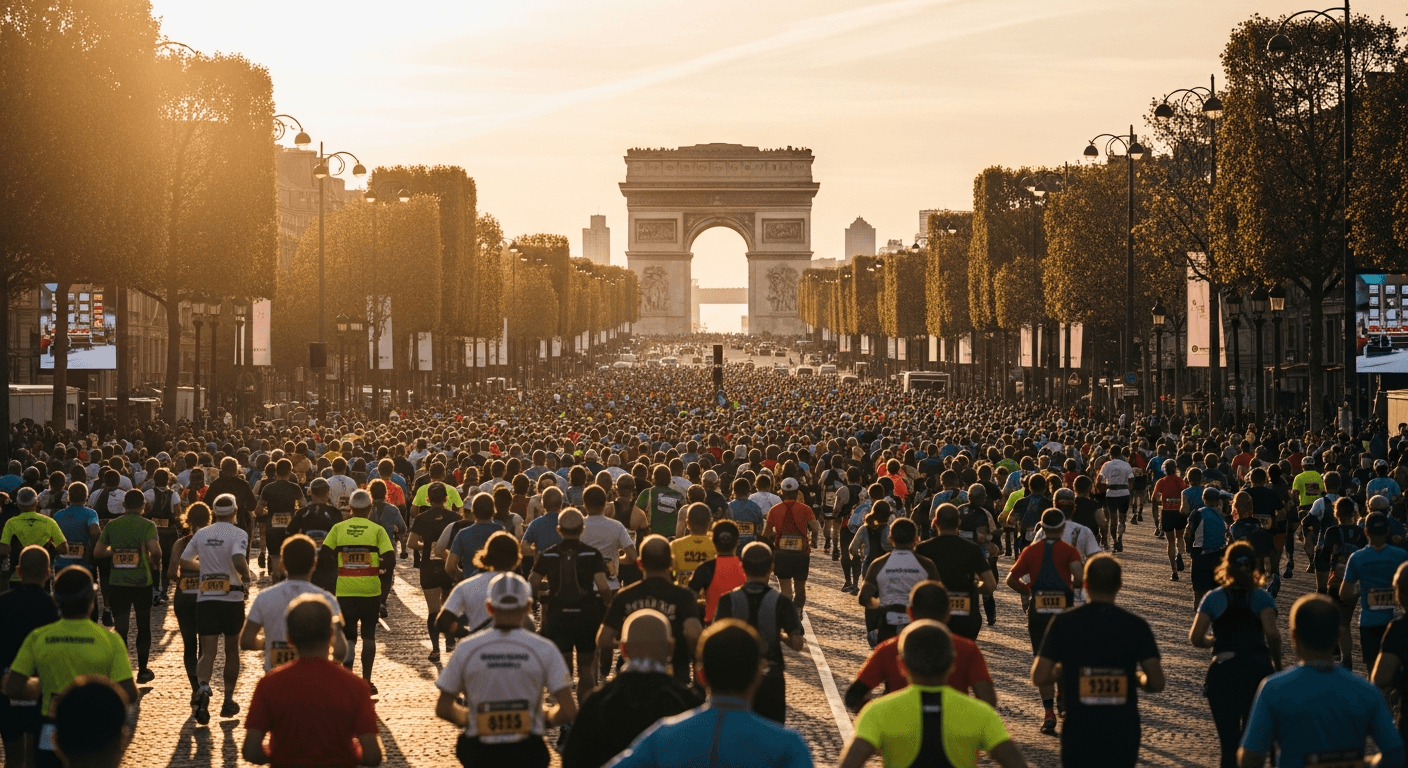
The 49th Edition: A Festival of 60,000 Runners
On Sunday, April 12, 2026, Paris once again transformed into a playground for 60,000 runners from around the world. The 49th edition of the Paris Marathon, launched from the Champs-Élysées under favorable skies, delivered on every front.
Sixty thousand participants. That's one of the largest marathon fields ever assembled in Europe. And behind that number: wildly different stories. Kenyan and Ethiopian elites fighting for victory. First-time marathoners crossing a milestone. Groups of friends who spent months training for this one morning.
That's what Paris does. It doesn't split elite from amateur — it puts everyone on the same course, on the same morning, for the same finish line on Avenue Foch.
A Course That's a Spectacle in Itself
The Paris course is well-known, but it never gets old. Starting on the Champs-Élysées, running along the Seine, passing under the Eiffel Tower, through the Bois de Boulogne, past Notre-Dame still in its final stages of reconstruction — there aren't many marathons in the world that can match that itinerary for sheer visual impact.
For international runners experiencing Paris for the first time from the start line, the emotion is often doubled. There's the race itself, with its pacing goals and leg fatigue. And then there's Paris, scrolling past on both sides for 42 kilometers.
That combination explains why Paris consistently ranks among the most sought-after marathon entries in the world. The 2026 waitlist reached tens of thousands before official registration even opened — much like the complete pre-race breakdown we published ahead of April 12 drew record readership.
Race Day Weather: A Critical Variable
Paris in April can be anything. This year, conditions were broadly favorable for most participants: temperatures around 10-12°C at the early morning start, minimal wind, and a cloud cover that kept direct sun exposure in check during the first few hours.
Those are close to optimal marathon conditions. Not too hot, not too cold. Runners who'd targeted a personal best had the right environment to deliver it — assuming their preparation held.
For the elite field, the conditions allowed for a classically tactical opening 30 kilometers, with a compact lead pack before the decisive accelerations in the final 12 kilometers.
Paris Among the World Marathon Majors
The Paris Marathon joined the World Marathon Majors in 2013, alongside Boston, Tokyo, London, Berlin, and Chicago. It's the formal recognition of where Paris stands among the sport's most prestigious events.
But Paris occupies a distinct position in that group. Where some Majors optimize for world records and elite performance, Paris optimizes for the overall experience. The city, the course, the crowd energy across all 42 kilometers, and the logistics of managing 60,000 starters without chaos. Runners chasing a qualifier might also be eyeing Boston 2026's tighter qualifying standards and new downhill rule as their next target.
It's this balance between elite competition and mass participation that defines Paris. The 49th edition confirmed it once again.
What's Coming Next Year
The 50th edition of the Paris Marathon in 2027 is shaping up to be something special. Round-number anniversaries in marathon history tend to bring record participation numbers, heightened media coverage, and sometimes a bit of extra magic on the course.
For runners who missed 2026 or want to be part of the 50th anniversary, registrations for 2027 should open in the coming months. Given Paris's consistent demand, entries won't last long.
For now, the 60,000 finishers of the 49th edition can enjoy their medals. Each one was earned, kilometer by kilometer, on the streets of Paris.