
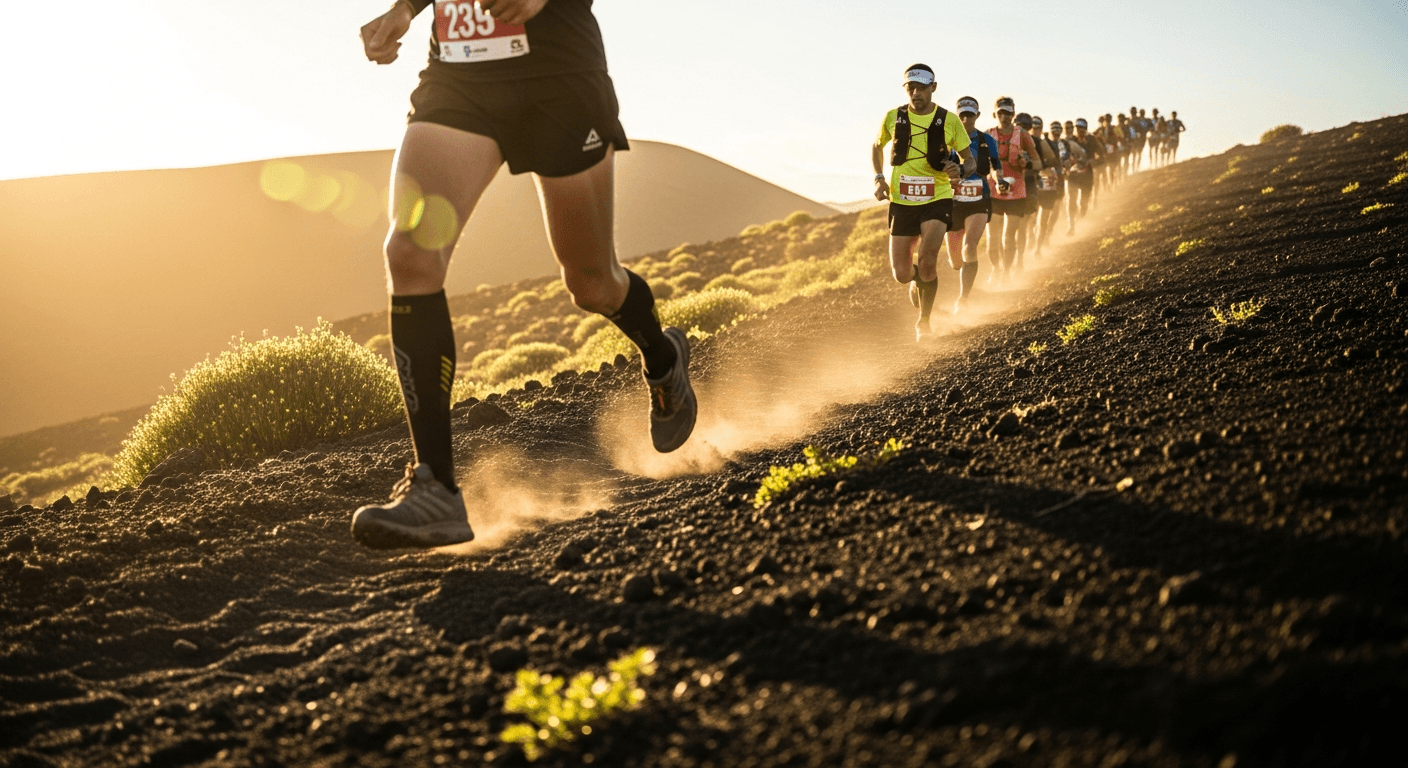
Elite trail running had a landmark weekend on La Palma. At the 2026 Transvulcania Ultramarathon, both the men's and women's course records fell. David Sinclair and Blandine L'Hirondel didn't just win their respective races. They reset the performance ceiling on one of the most punishing ultra courses on the planet.
For serious amateur trail runners, what happened on that volcanic island carries real lessons. Not because you're aiming to break records yourself, but because the strategies that produced those performances are the same ones that separate runners who finish strong from those who suffer through the final third of any long race.
What Happened at Transvulcania 2026
David Sinclair crossed the finish line in a time that bettered the previous men's record by over four minutes. Blandine L'Hirondel, already one of the most technically accomplished climbers in the women's field, shaved nearly six minutes off the women's mark. Both performances came in full race conditions, with no meaningful tailwind advantage and temperatures that peaked well above 25°C (77°F) along the coastal sections.
What makes these records particularly striking is the course itself. Transvulcania covers roughly 74 kilometers with approximately 4,300 meters of vertical gain. The route begins near sea level, climbs through pine forests to the island's ridge at nearly 2,400 meters, then descends sharply to the finish at Tazacorte. There's no flat section you can bank time on. Every kilometer demands a decision.
The race has been part of the elite ultra calendar for over a decade, and the previous records had stood up against some of the strongest fields in the sport. That both fell in the same year, on the same day, suggests the sport is entering a period of genuine performance acceleration.
Why Transvulcania Is Different
Most ultramarathons are described as brutal. Transvulcania earns that label with specificity. The volcanic terrain means trail surfaces shift constantly: loose pumice, embedded rock, compacted ash, and technical root sections. Footing is unpredictable at speed. Heat builds fast on the exposed coastal descent, often hitting runners who are already deep in glycogen debt.
Altitude compounds the challenge. The ridge crossing at over 2,000 meters is cold and frequently windy, sometimes requiring a mid-race clothing swap. Then, within two hours, runners are descending into full sun and heat. Managing the physiological whiplash between those two environments is as much a race strategy problem as a fitness one.
There's also the crowd psychology element. Transvulcania draws runners from across Europe and beyond, and the local support on the island is intense. Pacing conservatively through the early forest sections when you feel strong, surrounded by runners going hard, requires discipline that most people underestimate until they've been burned by it.
Pacing Strategy: What the Records Actually Tell You
Both Sinclair and L'Hirondel ran what observers described as textbook conservative starts through the first major climb. Rather than pressing from the gun, each settled into a sustainable effort on the ascent to Roque de los Muchachos and built pace progressively from the midpoint onward.
This isn't new advice, but the evidence keeps pointing the same direction. Negative splits: the race strategy most runners ignore is exactly what happened at the front of both Transvulcania fields this year. Runners who go out hard on the first big climb almost always pay for it after kilometer 50. The course doesn't forgive early aggression.
For amateur runners, applying this principle means resisting the social pressure of race starts. Your first climb should feel uncomfortable only because it's a climb. It should not feel hard in the cardiovascular sense. If your heart rate is spiking early, you're borrowing from a budget you'll need later.
A useful self-check: if you can't speak in short sentences on a long climb in the first half of an ultra, you're too far into the red. That's not being cautious. That's how you run the back half of the course instead of surviving it.
Heat Adaptation: A Non-Negotiable for Volcanic Island Races
The coastal sections of Transvulcania have a reputation for destroying runners who didn't prepare for heat. The shift from alpine cold to direct sun at low elevation is rapid, and your body's ability to manage core temperature under those conditions depends heavily on what you did in training.
Heat adaptation is one of the most underutilized tools in amateur trail runners' preparation. Consistent exposure to heat stress, even through methods as simple as running in warmer parts of the day or using a sauna post-workout, triggers measurable adaptations: increased plasma volume, improved sweat rate, lower core temperature at equivalent effort levels.
If you're preparing for any warm-weather ultra, how to train through summer heat without losing fitness is a practical framework worth building into your preparation cycle. The key is starting heat exposure early and keeping the volume manageable so you're adapting, not just accumulating fatigue.
Both record-holders at Transvulcania this year trained in environments that included heat stress as a deliberate variable. That's not coincidence.
Vertical Gain Preparation: The Part Most Runners Skip
Here's where a lot of trail runners leave performance on the table. Logging horizontal kilometers on flat surfaces doesn't prepare your legs for 4,000-plus meters of climbing. The muscle demands are fundamentally different, and the eccentric load on descents is where races are often won or lost.
Specific vertical preparation means incorporating structured climbing into your weekly plan, whether that's stair repeats, treadmill incline sessions, or actual hill intervals. It also means training your quads for downhill running, which is its own skill set. A runner who climbs efficiently but brakes on descents gives up significant time and takes unnecessary muscular damage.
Strength work plays a supporting role that's easy to underestimate. Single-leg movements, hip hinge patterns, and posterior chain strength all directly translate to climbing efficiency and descent control. This isn't the same approach as training for an indoor functional fitness format like the 12-week HYROX plan: every station explained, but the underlying principle of sport-specific strength work applies across disciplines.
For your training block, a reasonable target is 30 to 40 percent of your weekly vertical in dedicated climbing sessions rather than incidental gain from rolling terrain. Track your elevation data and treat it with the same seriousness as weekly mileage.
Fueling That Actually Supports Long Climbs
Both record performances at Transvulcania involved athletes who clearly had their nutrition dialed in. Neither showed the visible deterioration in form that typically signals late-race glycogen depletion. That takes planning before and during the race.
The research on carbohydrate timing for endurance efforts longer than three hours is consistent: frequent small doses outperform infrequent larger ones. Gut tolerance under heat stress is also reduced, which means what you can absorb during a controlled training run is not necessarily what you can absorb at race pace in 28°C heat. Practice your race-day nutrition in conditions that approximate race stress.
For a full breakdown of the current evidence on fueling for trail efforts, trail nutrition in 2026: what the science actually says covers carbohydrate timing, sodium, and hydration strategies grounded in recent research rather than convention.
Start fueling earlier than feels necessary. Waiting until you feel hungry or depleted in a race like Transvulcania means you're already behind. Most athletes underestimate how much the climb suppresses appetite while simultaneously burning through carbohydrate reserves at a high rate.
What Recreational Runners Can Take Forward
You're probably not racing Transvulcania next year. But the principles that produced two course records on a volcanic island ultra translate directly to your next 50K, your first mountain marathon, or any trail race with significant elevation gain.
Pace conservatively early. Adapt to heat deliberately. Build vertical-specific strength. Fuel before you need to. These aren't elite-only concepts. They're the variables that separate a race you run well from one you just get through.
What happened at Transvulcania 2026 is a useful reminder that performance records don't fall randomly. They fall when preparation is more complete than it's ever been before. That standard is available to any runner willing to organize their training around what actually matters.