
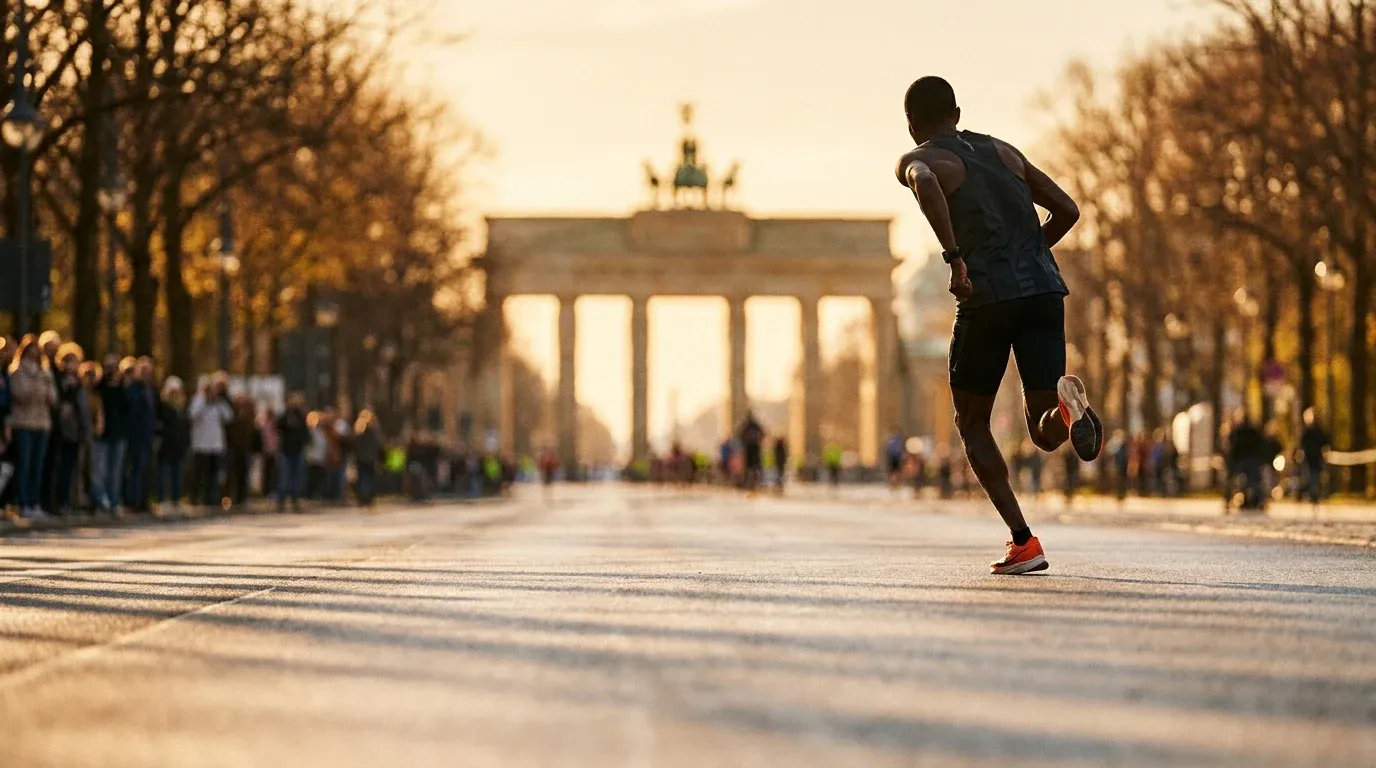
Thirteen world records. One city. That number alone should make every serious runner stop and ask why. The Berlin Marathon hasn't stumbled into its reputation as the fastest course on the planet. Every element, from the asphalt beneath your feet to the date circled on the calendar, has been engineered, refined, and tested over decades to produce the conditions where humans run 26.2 miles faster than anywhere else on Earth.
Whether you're chasing a podium finish or a personal best, understanding what makes Berlin so fast gives you a framework you can apply to any race you run.
Thirteen World Records Isn't a Coincidence
No other marathon course comes close. Boston, London, Chicago, Tokyo. All legendary races. None of them can claim the record-breaking frequency that Berlin has produced since it adopted its current route through the reunified city.
The core reason is elevation, or more precisely, the near-total absence of it. Berlin's course profile sits at roughly 34 meters of total elevation gain across the entire 42.2 kilometers. For context, that's less than the height of a ten-story building spread over more than 26 miles. Boston's course, by comparison, features over 200 meters of cumulative climbing. Even courses marketed as flat often disguise rollers that cost you seconds per kilometer in muscular fatigue.
When your legs don't have to fight gravity, they can do one thing well: move forward. The metabolic math is simple. Every 1% incline in grade costs roughly 4 seconds per kilometer for an elite runner. Multiply that across a full marathon and the gap between a hilly course and a flat one isn't measured in seconds. It's measured in minutes.
The road surface compounds this advantage. Berlin's boulevards are paved with smooth, uniform asphalt that minimizes ground contact irregularities. Studies measuring running economy have consistently shown that surface stiffness and consistency affect energy return. A harder, smoother surface returns more energy with each footstrike. Over 40,000 steps in a marathon, that return adds up to a meaningful performance gain.
The September Weather Window Is Not an Accident
Race organizers didn't choose late September arbitrarily. They chose it because decades of meteorological data pointed to a narrow window when Berlin's climate consistently delivers the two conditions that matter most to endurance performance: cool temperatures and low wind.
Heat is one of the most aggressive performance suppressors in distance running. Research shows that for every degree Celsius above the optimal racing temperature of approximately 10 to 12°C, marathon finishing times slow by roughly one to two percent. At 20°C, an elite runner loses several minutes. At 25°C or above, finishing times across the field degrade significantly. Berlin's average race-day temperature in late September sits between 10 and 15°C. That's not luck. That's a deliberate calendar decision.
Wind matters just as much. A headwind of just 10 kilometers per hour increases your aerobic demand enough to noticeably slow your pace. Berlin's geography, positioned on a broad, flat plain in northeastern Germany, produces low-wind conditions on most race days. The course itself threads through buildings and tree-lined streets that naturally buffer any ambient breeze.
If you're thinking about your own race selection, temperature and wind conditions on race day should be weighted heavily in your decision. A perfectly trained athlete on a cool, calm day will outperform the same athlete on a hot, windy day by a margin no training block can fully compensate for. The same logic applies to your taper and race-week preparation. Your Fall Race Is Close: How to Prep Your Mind and Legs covers how to manage the final days before a target event, and the environmental factors in that piece apply directly to any runner entering race week.
Wide Boulevards and the Physics of Pacing Groups
Here's where Berlin's advantage extends beyond elite runners and into the experience of every recreational participant in the field.
Berlin's course runs through some of the widest urban roads in Europe. The Kaiserdamm, the Kurfürstendamm, and the approach to the Brandenburg Gate offer widths that most city marathon courses simply cannot match. That width creates something most runners never consciously think about: efficient pacing group dynamics from the very first kilometer.
Drafting reduces aerobic demand by anywhere from 2 to 7 percent, depending on wind speed and group formation. In a narrow-street race, pacing groups collapse into single-file lines early in the race, and runners on the edges lose most of the drafting benefit. In Berlin, pacing groups can maintain wide, multi-runner formations for large portions of the course. That means more runners, including those in the 3:30 to 5:00 finishing range, spend significantly more of the race in an aerodynamically protected position.
The congestion factor is equally important. In tight urban courses, the first three to five kilometers often force runners into uneven pacing as the field works through bottlenecks. Surges and sudden braking early in a race spike your heart rate, burn through glycogen faster than intended, and disrupt the rhythm that marathon success depends on. Berlin's wide roads allow the field to spread quickly and settle into race pace within the first two kilometers. That early efficiency has downstream effects on how your legs and energy stores feel at kilometer 30.
What Recreational Runners Can Take From the Berlin Blueprint
You're probably not running a 2:01 marathon. That's fine. The principles that make Berlin fast for Eliud Kipchoge make it measurably better for you too, and they translate into a practical checklist for any race you enter.
- Choose your course carefully. Elevation matters more than most runners account for. Before registering for a race, look up the course elevation profile. A course with under 50 meters of total gain is legitimately flat. Anything above 150 meters will cost you real time, regardless of fitness.
- Prioritize temperature over prestige. A well-organized race in cool conditions will produce a better performance than a prestigious race held in heat. Check historical weather data for your target race's date, not just the general region.
- Use pacing groups strategically. In wider-course races, position yourself inside the pacing group rather than on the edges or behind it. The aerodynamic protection is real and worth fighting for in the corral start.
- Build the aerobic engine that takes advantage of good conditions. Even the perfect course can't compensate for undertrained aerobic capacity. Why Your Easy Runs Are Your Most Important Runs explains why the majority of your weekly mileage should be run at a conversational pace, which is the foundation that lets you actually exploit a fast course on race day.
- Don't ignore nutrition precision. A fast course invites faster early pacing. Faster pacing accelerates glycogen depletion. Your fueling strategy needs to match your target race pace, not your training pace. Get that wrong and even Berlin's perfect conditions won't save the last six miles.
The Course Finish and the Psychological Architecture
Berlin saves one final performance lever for the end. The Brandenburg Gate finish is arguably the most iconic marathon conclusion in the world, and its placement isn't just theatrical. The final two kilometers of the Berlin course are nearly arrow-straight, gently descending, and flanked by enormous crowds. That combination produces measurable performance benefits.
Research on crowd noise and athletic performance consistently shows that auditory stimulation from spectators reduces perceived effort and increases pace output in the final stages of endurance events. A finish line you can see from 800 meters away triggers a neurological pacing response that draws out effort reserves most runners didn't know they had. Berlin's design gives you that visual anchor earlier than most courses do.
The psychological architecture of a race matters more than recreational runners typically acknowledge. Knowing that a course is designed to help you succeed changes your relationship with discomfort at kilometer 35. It shifts the mental frame from survival to execution.
Berlin as a Model, Not Just a Destination
You don't need to run Berlin to use its lessons. The course is a case study in applied performance science, and every variable it controls, elevation, temperature, road surface, width, finish design, is a variable you can evaluate in every race you consider entering.
The world records set in Berlin aren't testimonials to one extraordinary place. They're evidence that the right conditions systematically unlock human performance. When you select a race, prepare your taper, position yourself in a pacing group, and dial in your fueling strategy, you're making the same kinds of decisions that turn a good course into a fast one.
For runners curious about how elite pacing strategies translate across different race distances and formats, Seare Stuns the Ingebrigtsens: What It Means for Running breaks down how tactical execution at the highest level of the sport reveals principles that apply well below the elite tier.
Berlin keeps breaking records because it removes every obstacle it can between a runner and their fastest possible self. That's the real lesson. Your job on race day is to do the same.