
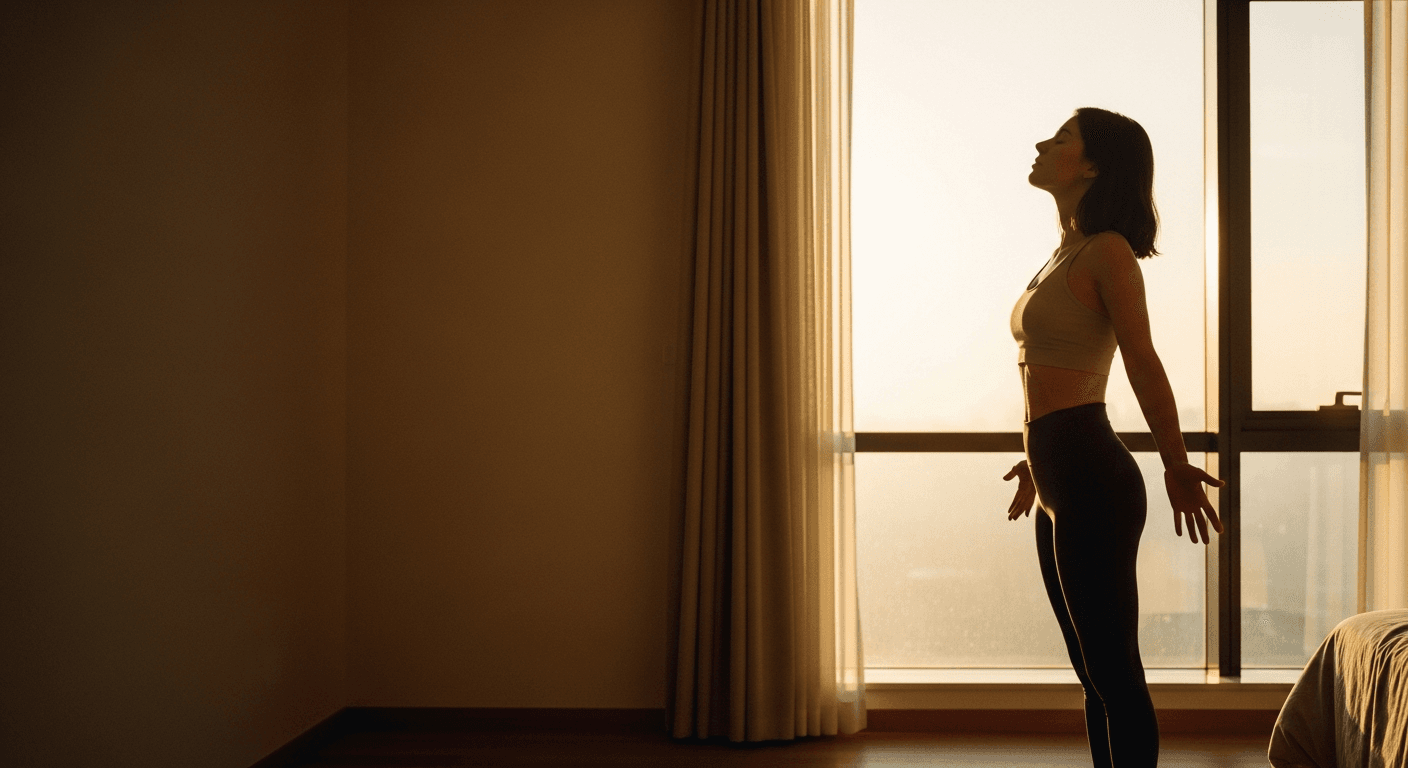
Most stress management advice falls into one of two traps: it's either too vague to act on, or it demands 90 minutes you simply don't have. What follows is neither. It's a concrete, science-supported sequence that takes 15 minutes, requires no equipment, and works by aligning with your body's hormonal rhythms rather than fighting them.
The key is understanding what's already happening in your body the moment you wake up. Once you do, the routine practically designs itself.
Why the First 45 Minutes After Waking Define Your Stress Baseline
Within 30 to 45 minutes of opening your eyes, your cortisol levels naturally spike. Researchers call this the cortisol awakening response (CAR), and it's not a flaw. It's a priming mechanism. Your body is mobilizing energy, sharpening alertness, and preparing your immune system for the demands ahead.
The problem isn't the spike itself. The problem is what most people do during it: reach for their phone, scroll through emails or social media, and immediately load the nervous system with low-grade threat signals. Studies consistently show that perceived psychological stress during the CAR window amplifies cortisol output and elevates the overall stress baseline for hours afterward.
What you do in that window doesn't just affect your mood. It sets the hormonal tone for your entire day. The 15-minute routine below is built specifically around this window, using three tools that have measurable physiological effects: breathwork, light exposure, and movement.
Minutes 1 to 5: Breathwork Before You Check Anything
Before you pick up your phone, before you speak to anyone, spend the first five minutes breathing deliberately. This isn't a metaphor for "calm down." It's a direct intervention on your autonomic nervous system.
Slow diaphragmatic breathing, typically at a rate of five to six breath cycles per minute, activates the parasympathetic branch of the nervous system. Research shows this pattern measurably reduces perceived stress, lowers heart rate variability in a favorable direction, and blunts the cortisol spike associated with the awakening response.
Here's a simple protocol you can start today:
- Inhale slowly through your nose for four counts, letting your belly expand rather than your chest rise.
- Hold gently for two counts.
- Exhale slowly through your mouth or nose for six counts.
- Repeat for five minutes. That's roughly 25 to 30 cycles.
You don't need an app for this, but if structure helps you stay consistent, there's solid evidence that guided tools can improve adherence. Breathwork apps that actually reduce anxiety have been studied in controlled trials, and the results support their use for daily stress regulation rather than just acute episodes.
Do this lying in bed, sitting on the edge of your mattress, or on a yoga mat. Location doesn't matter. Starting before external inputs reach you does.
Minutes 5 to 10: Get Natural Light on Your Face
Step outside, stand near a bright window, or sit on your porch. This step takes five minutes and has effects that last until midnight.
Your circadian rhythm is regulated primarily by a cluster of neurons in the hypothalamus called the suprachiasmatic nucleus (SCN). It's essentially a biological clock that runs on light. When short-wavelength light (the blue spectrum dominant in natural morning sunlight) hits your retina within the first 30 minutes of waking, it sends a clear signal to the SCN: the day has started. That signal sets off a cascade that includes suppressing lingering melatonin, reinforcing cortisol timing, and scheduling melatonin production again around 14 to 16 hours later.
In practice, this means better alertness in the morning and better sleep at night. A growing body of research links consistent morning light exposure to lower evening cortisol, reduced sleep onset time, and improved mood stability throughout the day.
Overcast days still work. Even on a cloudy morning, outdoor light delivers 10,000 to 20,000 lux. A typical indoor environment delivers 100 to 500 lux. The difference is significant enough that indoor light alone won't reliably anchor your circadian rhythm.
If outdoor access is genuinely impossible, a calibrated light therapy lamp (10,000 lux, positioned at eye level, used for 10 to 20 minutes) is a reasonable substitute. They're widely available for $30 to $80 in the US and have clinical backing for circadian support.
Minutes 10 to 15: Five Minutes of Low-Intensity Movement
You don't need to work out. You need to move. There's a meaningful difference, especially in the morning when your joints are stiff, your blood sugar is low, and your body is still transitioning out of sleep physiology.
Research comparing sedentary mornings to mornings with five to ten minutes of low-intensity movement shows the latter produces measurably lower fasting cortisol levels. Light walking, gentle mobility flows, or dynamic stretching are enough to initiate this effect. The mechanism involves improved circulation, mild sympathetic activation (the kind that supports alertness without tipping into stress), and signaling to your body that it's time to shift from rest mode to active mode.
What this is not: high-intensity training. Vigorous early-morning exercise can actually spike cortisol further in people who are already sleep-deprived or chronically stressed. If you train hard in the mornings and notice you feel wired, anxious, or fatigued by early afternoon, your cortisol response may be a factor worth examining. Understanding your heart rate training zones can help you calibrate morning session intensity so it supports recovery rather than adding to your stress load.
For the purposes of this 15-minute routine, keep it gentle. A short walk around the block, five minutes of hip circles, spinal rotations, shoulder rolls, and bodyweight squats is genuinely sufficient. You can always train harder later in the day.
What to Avoid During This Window
The routine works partly because of what you do. It works equally because of what you don't do.
- Don't check your phone until after the 15 minutes are complete. Email and social media introduce social comparison, urgency, and conflict-adjacent content. All of these elevate cortisol during the CAR window.
- Don't consume caffeine immediately. Cortisol and caffeine both operate through some overlapping pathways. Drinking coffee during peak CAR (roughly 30 to 45 minutes post-waking) reduces caffeine's net effect and may increase tolerance faster. Waiting until 90 minutes after waking is associated with better alertness outcomes.
- Don't skip the sequence on "easy" mornings. The value of this routine is cumulative. Occasional practice produces modest effects. Daily repetition restructures your default stress response over weeks.
Supporting Your Stress Response Beyond the Morning
The 15-minute routine addresses the hormonal window, but chronic stress has roots that a single morning practice can't fully address on its own. Nutrition, recovery, and supplementation all interact with your cortisol baseline.
On the nutritional side, certain compounds have research backing for stress modulation. If you're looking at evidence-based supplementation for stress and recovery, the article on adaptogens for stress and what the science actually says covers ashwagandha, rhodiola, and ginseng with appropriate nuance. Some of these compounds have demonstrated statistically significant effects on cortisol and perceived stress in randomized trials, though results vary by population and dosage.
Recovery practices matter too. If you're training regularly, your off-day habits significantly affect your stress baseline. The off-day recovery routine that heavy lifters rely on offers practical strategies for managing accumulated physical and psychological stress between training sessions.
Consistency Outperforms Complexity
The most common failure mode in wellness routines isn't laziness. It's over-engineering. People design elaborate 60-minute protocols, stick to them for two weeks, and then abandon the whole thing when life gets busy. The science on habit formation is clear: a simple, repeatable sequence done daily produces stronger behavioral entrainment than a complex one done sporadically.
This routine has exactly three steps. It takes 15 minutes. You can do it in your bedroom, your backyard, or a hotel room. There's nothing to buy, no membership required, and no optimal version you need to work up to. The version you do tomorrow morning is already the right version.
Start with the breath. Add the light. Add the movement. Do that tomorrow, and the day after, and the week after. Your cortisol curve will follow.