
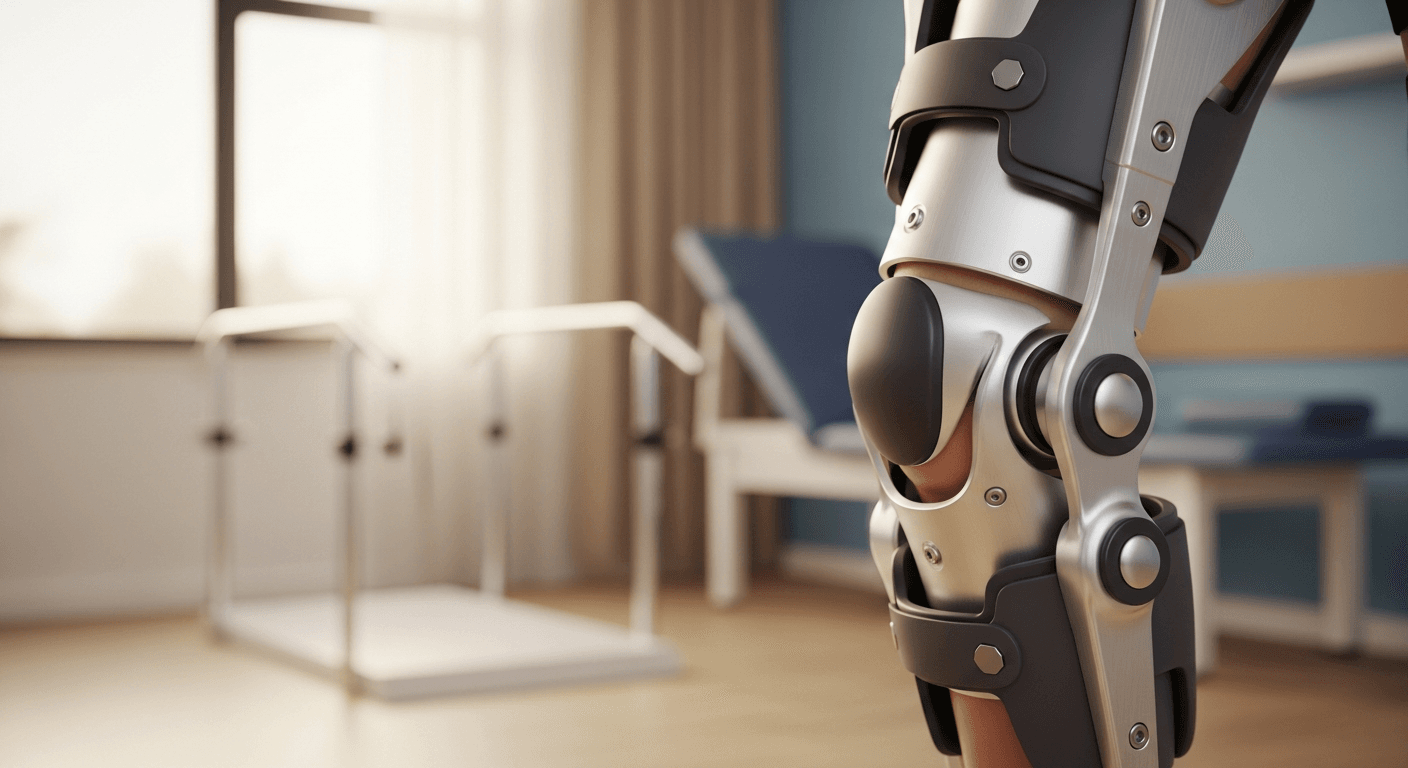
If you've ever rehabbed a knee, a shoulder, or a hamstring, you know how much of the process depends on feel. Your physiotherapist watches you walk, asks how things feel on a scale of one to ten, and adjusts your program based on what they can observe with their eyes. That model is being fundamentally rethought. AI-powered gait analysis and robotic rehabilitation systems are entering sports medicine at speed, and the shift isn't limited to elite facilities anymore.
Research published in June 2026 confirms what high-performance medical teams have been quietly implementing for several years: advanced robotic gait training systems and immersive VR tools, when integrated into structured rehabilitation, produce measurably better outcomes than conventional therapy alone. The question is what that actually means for everyday athletes and regular gym-goers who get hurt.
What These Systems Actually Do
Robotic rehabilitation systems aren't science fiction hardware. They're exoskeletons, motorized treadmills with dynamic body-weight support, and sensor-laden platforms that record every element of how you move. In a clinical setting, a patient recovering from an ACL repair, for example, steps onto a system that captures joint angles, force distribution, stride symmetry, and ground contact time with a precision no human eye can match.
VR overlays add a feedback layer. Instead of being told to shift weight onto your recovering limb, you're shown a real-time visual representation of your own movement and coached by the system to correct it, rep by rep. The environment adjusts based on your performance, not a fixed protocol someone wrote in a manual six months ago.
This matters because injury rehabilitation is rarely about one body part in isolation. A torn Achilles changes how you load your hip. A rotator cuff repair alters your entire upper-body movement chain. Robotic systems map these compensations in real time, which is something traditional observation simply can't do at the same resolution.
The Neuroplasticity Angle Most People Miss
Here's where the science gets genuinely interesting. Most athletes think about rehab as mechanical repair. Rest the tissue, rebuild the strength, get back on the field. But a significant proportion of re-injuries and chronic compensation problems aren't mechanical failures. They're neurological ones.
When you're injured, your nervous system adapts. It learns to avoid loading the painful area, recruits different muscles to do the same job, and builds those altered movement patterns into long-term motor memory. You might pass every strength test your physio runs and still be running, jumping, or lifting with a subtly dysfunctional pattern. That pattern is what puts you back on the treatment table six months later.
Advanced robotic and AI systems specifically target neuroplasticity. The repetitive, precise, sensory-rich feedback they provide doesn't just tell your body what to do. It retrains the neurological pathways that govern movement at a level that traditional exercise cannot replicate as efficiently. Research on stroke rehabilitation and lower-limb injury recovery consistently shows that this kind of intensive movement feedback accelerates the relearning process and reduces the likelihood of compensatory re-injury.
This is also why sleep remains a critical, often underestimated variable in rehabilitation. Motor learning consolidates during sleep, and the neurological gains made during robotic training sessions are partly locked in overnight. Sleep and Athletic Performance: The Evidence-Based Protocol covers the mechanisms in detail, and they're directly relevant to anyone doing intensive neuromotor rehab work.
Data Over Guesswork: How AI Changes the Feedback Loop
One of the most significant practical shifts AI brings to rehabilitation is the move away from subjective pain reporting as the primary clinical signal. Traditional rehab protocols rely heavily on how you say you feel. That's understandable given the tools available, but pain is an unreliable marker of tissue readiness. Athletes underreport pain. Others overreport it out of anxiety. Neither gives the clinician an accurate picture.
AI-driven systems generate continuous, objective performance data. Load symmetry, movement velocity, joint torque, muscle activation sequencing. These metrics don't lie, and they update in real time. A practitioner can see that your left-right load distribution improved three percent this week, or that your knee flexion angle under fatigue is still falling short of baseline, regardless of what you report about your pain levels.
This allows protocols to be adjusted dynamically. If you're progressing faster than expected, the system can escalate intensity without waiting for your next scheduled appointment. If a metric signals that a specific movement pattern is deteriorating under load, the practitioner gets flagged before that deterioration becomes an injury.
That kind of continuous monitoring also integrates naturally with broader recovery tracking. Factors like nutrition status and sleep quality influence tissue repair rates, and the more data a rehabilitation team has, the more accurately they can contextualize performance changes. The interaction between recovery quality and rehab output is more tightly connected than most athletes realize.
Who Has Access Right Now
The honest answer is that the full technology stack is still concentrated in elite and professional settings. NBA, NFL, and Premier League medical teams have had access to sophisticated motion capture and AI analysis for years. Major orthopedic hospitals and university sports medicine departments followed. Pricing at this tier reflects that: comprehensive robotic rehab systems run from $150,000 to over $500,000 for the hardware alone, and clinical programs built around them can cost several hundred dollars per session.
But that picture is changing quickly. Consumer-accessible AI motion analysis is entering the market through two routes. The first is clinical: mid-tier physiotherapy practices are beginning to adopt more affordable AI-assisted gait analysis software, often delivered through tablet-based camera systems that run analysis through cloud platforms. These don't require the full robotic hardware suite, but they bring a meaningful step up in movement assessment precision over the naked eye. Session costs at these clinics typically run $80 to $180 per appointment in the US market, not dramatically different from conventional physiotherapy.
The second route is direct-to-consumer. Smartphone-based motion analysis apps are increasingly accurate for basic gait and movement screening. They're not replacing clinical systems, but they're giving coaches and fitness professionals a tool to flag movement compensations that warrant referral. Fitness studios and personal training facilities are beginning to use them during initial assessments and mid-program check-ins, particularly with clients returning from injury.
This is also relevant context for strength and conditioning professionals working with older populations. Athletes over 60 who are managing joint issues or returning from orthopedic procedures are a natural fit for AI-assisted movement assessment, where precision and injury prevention carry higher stakes. Starting Strength Training After 60: It's Not Too Late — Here's the Evidence outlines the specific adaptations and risks worth understanding in that population.
What the Evidence Shows on Recovery Outcomes
The research picture, while still developing, is directionally consistent. Studies comparing robotic-assisted rehabilitation to conventional therapy for lower-limb injuries show statistically significant improvements in several key outcomes:
- Faster return to functional movement benchmarks. Patients using robotic gait training systems reach symmetrical loading targets and pre-injury movement quality scores faster than those in conventional programs.
- Reduced re-injury rates. AI-monitored rehab programs show lower rates of re-injury in the six to twelve months following return to sport, largely attributed to the earlier detection of movement compensation patterns.
- Better patient adherence. The immediate, real-time feedback loop that robotic and VR systems provide appears to improve adherence to prescribed exercise protocols. Patients can see their own progress quantified, which maintains motivation across longer rehab timelines.
- Improved proprioceptive outcomes. The sensory-rich environment of robotic training accelerates the restoration of joint position sense, a key factor in sport-specific stability and injury prevention.
It's worth noting that the strongest evidence base currently exists for neurological and lower-limb orthopedic conditions. Upper-limb and spinal rehabilitation using these systems is an active area of research, and the evidence is less mature but trending in the same direction.
What This Means If You're Injured Right Now
You don't need access to a $400,000 exoskeleton to benefit from what this technology represents. The broader shift is toward objective, data-driven rehabilitation over intuition-based protocols. And that shift is already influencing how good physiotherapy clinics operate, even without the full robotic hardware.
When you're choosing a rehabilitation provider after an injury, ask whether they use any form of objective movement analysis. Ask whether they measure load symmetry or gait metrics rather than relying exclusively on your pain reports. Ask how they track your neuromotor progress, not just your strength numbers.
These questions reflect a more sophisticated understanding of what recovery actually requires, and clinics that can answer them competently are typically ahead of the curve in other ways too.
Recovery doesn't happen in the clinic alone. How you sleep, how you fuel, and how you manage training load outside of sessions all directly influence the neurological and tissue repair processes that AI-assisted rehab is trying to optimize. Cold Water Immersion: What the Science Actually Says About Ice Baths and Recovery addresses one of the most debated recovery modalities in this space. And for athletes managing overall recovery load, 90 Minutes of Strength Training a Week: The 30-Year Study That Changes the Math provides useful context on how training volume interacts with long-term health outcomes.
The technology is moving fast. What's happening in elite sports facilities today tends to reach mainstream physiotherapy within five to ten years. In this case, that window is already narrowing. If you get injured in the next two to three years, there's a real chance that some form of AI-assisted movement analysis will be part of your treatment. Understanding what it does, and why it works, puts you in a better position to use it effectively.