
Recovery has become its own industry. Walk into any gym, scroll through any athlete's social feed, or browse a wellness brand's product page, and you'll find cupping kits, cold plunge tubs, and sleep supplements all positioned as essential tools for anyone serious about their training. The problem isn't that these methods are useless. The problem is that they're rarely ranked honestly against each other.
This piece does exactly that. Here's what the current evidence actually says about cupping, cold immersion, and sleep so you can spend your time and money where it matters most.
Cupping: Strong on Relaxation, Weak on Hard Evidence
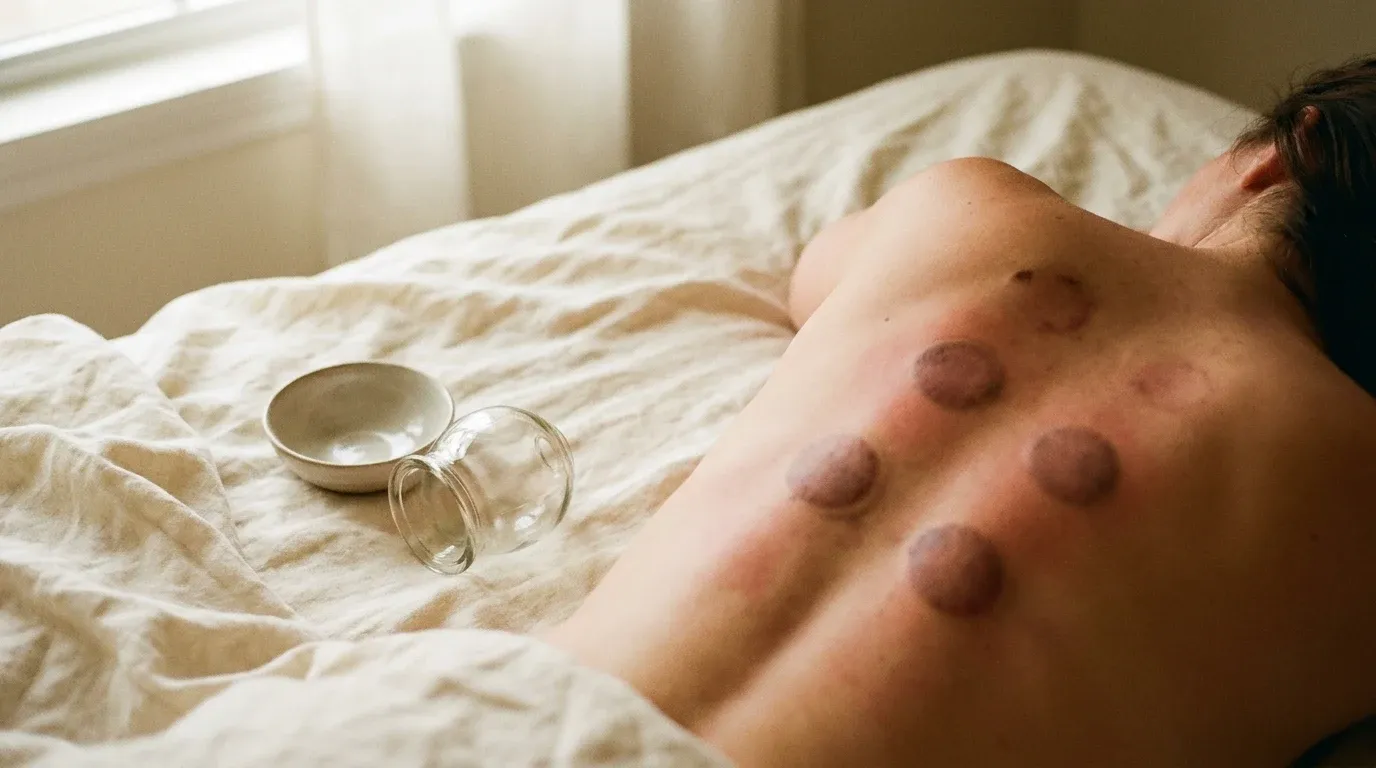
Cupping therapy, which involves placing suction cups on the skin to draw tissue upward, has roots in traditional Chinese and Middle Eastern medicine going back thousands of years. It surged into mainstream fitness culture after high-profile athletes were photographed with the distinctive circular marks at major sporting events. Since then, it's been marketed aggressively as a tool for accelerating muscle recovery.
The research tells a more complicated story. Systematic reviews of randomized controlled trials show that cupping produces statistically significant reductions in pain scores, but the effect sizes are generally small and the study quality is often poor. Blinding participants in cupping trials is nearly impossible, which makes it difficult to separate the real physiological effect from the placebo response.
That placebo effect, though, is worth taking seriously. A meaningful reduction in perceived pain and tension can lower psychological stress, improve sleep onset, and reduce the subjective effort of your next session. Dismissing cupping entirely because it lacks robust mechanistic evidence misses this point. What you shouldn't do is treat it as a substitute for evidence-based recovery, or pay $150 per session expecting it to accelerate muscle protein synthesis or reduce inflammation in any measurable way that a well-designed study can reliably detect.
If you find cupping genuinely relaxing and it fits your budget, it's not wasted. Just be honest about what you're buying: a relaxation experience with a plausible but unconfirmed physiological upside, not a validated performance recovery tool.
Cold Immersion: Real Benefits, Real Trade-offs
Ice baths and cold water immersion have a stronger evidence base than cupping. Multiple controlled trials confirm that immersion in cold water (typically between 50 and 59°F / 10 and 15°C) for 10 to 15 minutes reduces delayed-onset muscle soreness (DOMS) in the 24 to 72 hours following intense exercise. For athletes managing a heavy competition schedule or back-to-back training days, that's a meaningful benefit.
The mechanism is reasonably well understood. Cold exposure causes vasoconstriction, which reduces local blood flow and may limit the inflammatory cascade that contributes to soreness and tissue swelling. When you come out of the cold, the rebound vasodilation may help clear metabolic waste products. It's not magic, but it's physiologically coherent.
Here's where it gets complicated. That same inflammatory response that causes soreness also drives adaptation. Several well-designed trials have found that regular post-training cold immersion after strength sessions can blunt the hypertrophic signaling pathways, specifically by suppressing satellite cell activity and reducing the anabolic response that leads to muscle growth over time. In plain terms: if you're ice-bathing after every lifting session because it's part of your routine, you may be slowing the gains you're training for.
The practical implication is timing and context. Cold immersion makes more sense after aerobic or endurance sessions where soreness management matters more than maximizing hypertrophy. If your priority is building strength and muscle, you're better off reserving ice baths for competition weeks or particularly brutal sessions, rather than using them as a daily default. Why training consistency matters more than intensity is a principle that applies here too. A slightly sorer body that's adapting is often more valuable long-term than a comfortable body that's blunting its own progress.
Cold plunge tubs for home use now range from around $500 for basic inflatable models to $5,000 or more for premium units with built-in chillers. Commercial gym sessions typically run $20 to $40 per visit. Before investing, it's worth being clear about what you're actually trying to achieve.
Sleep: The Only Method With a Clean Sweep of the Evidence
Sleep is not a wellness trend. It's a biological requirement, and it's the only recovery modality that shows consistent, replicated benefits across every dimension of athletic and cognitive performance that researchers have bothered to measure.
Here's what happens when you sleep enough. Growth hormone secretion peaks during slow-wave sleep. Cortisol levels drop, allowing tissue repair to occur without the catabolic interference that stress hormones create. Muscle protein synthesis continues during sleep, particularly if you've consumed protein close to bedtime. Inflammatory markers that accumulate during training are cleared. Neural pathways involved in movement learning are consolidated, which matters for everything from technique refinement to reaction time.
When you don't sleep enough, the consequences are measurable and fast. Studies show that restricting sleep to six hours or fewer for as few as five nights produces testosterone suppression, elevated inflammatory cytokines, reduced pain tolerance, and impaired glucose metabolism. One frequently cited study found that collegiate basketball players who extended sleep to ten hours per night improved sprint times, shooting accuracy, and reaction time. No supplement, no ice bath, and no cupping session produces results like that.
The injury prevention data is particularly striking. Athletes sleeping fewer than eight hours per night have been shown in prospective studies to be significantly more likely to suffer injuries than those sleeping eight hours or more. The proposed mechanisms include reduced proprioception, impaired neuromuscular coordination, and lower pain thresholds that prevent adequate self-protection during training.
Research published over the past few years has connected consistent sleep with slower biological aging markers, which aligns with findings covered in a study showing that 12 months of exercise slows biological aging. Sleep and structured training appear to work through overlapping pathways, and sacrificing one to fit in more of the other is rarely the right trade.
If you're struggling with sleep quality, the evidence on behavioral interventions is worth reviewing before reaching for supplements. Timing your yoga practice correctly is one low-cost, evidence-adjacent option with plausible sleep benefits. And if you're considering cannabinoid-based sleep aids, the findings from a recent RCT on CBD and THC for insomnia offer a useful starting point for understanding what the current science actually supports.
Comparing the Three Side by Side
- Cupping: Limited controlled evidence for performance recovery. Genuine relaxation and stress-reduction effect. Low risk, moderate cost depending on practitioner, not a first-line tool.
- Cold immersion: Good evidence for DOMS reduction. Meaningful trade-off for strength athletes due to blunted hypertrophic signaling. More appropriate for endurance contexts or competition phases. Cost varies widely ($0 for a cold shower to $5,000+ for a dedicated plunge unit).
- Sleep: The only modality with consistent, large-effect evidence across soreness, hormones, cognitive performance, and injury risk. Available to everyone. Free. Consistently underused.
What This Means for Your Recovery Stack
Most people building a recovery approach are doing it in the wrong order. They're investing in tools that sit at the edge of the evidence base while under-investing in the one thing that's been proven to work across every population studied.
The smart approach is to build from the center out. Prioritize sleep first, which means protecting seven to nine hours with consistent timing, a cool room, and limiting alcohol and blue light exposure in the evenings. Once that's genuinely in place, not just aspirationally, you have a foundation that will amplify everything else you do in the gym.
From there, cold immersion has a real place in your toolkit if you're doing high-volume endurance training, managing a competition schedule, or dealing with acute soreness that's affecting your next session. Just be strategic rather than reflexive about it. If building muscle is your main goal and you're doing compound strength movements like hip thrusts as the core of your program, post-session ice baths should be the exception, not the default.
Cupping is the lowest priority for performance recovery, but it's not a reason to feel foolish if you enjoy it. If it reduces your stress and helps you show up to your next session feeling more settled, that's a real benefit. Just price it accordingly and don't let it displace sleep or sound nutrition in your hierarchy of effort. Speaking of which, recovery doesn't stop with physical methods. What you eat around training, including carbohydrate timing for endurance athletes, plays a supporting role that's backed by solid evidence of its own. The debate over carbohydrate intake during endurance sessions is worth understanding if fueling is part of your recovery strategy.
The honest answer to which recovery method wins is the one that costs nothing and that most people are still shortchanging every week.