
Heart rate variability has gone from a measurement reserved for sports science labs to a number you check before coffee. Oura Ring, WHOOP, Garmin, Polar. Millions of people now wake up to an HRV score and try to decide what it means for their day. Most of them are misreading it.
Key Takeaways
- A peer-reviewed study analyzing 536 nights of multi-device sleep data compared consumer wearables against clinical ECG measurements.
- Oura Ring Gen3 and Gen4 showed the strongest agreement with ECG for both HRV and resting heart rate.
- A 5 to 7-day trend line tells you something worth acting on.
That's not a criticism. The metric is genuinely complex, and the way wearables present it encourages the wrong kind of thinking. Here's what the recent research actually shows, and how to use your data without letting it run your training into the ground.
Not All Devices Measure HRV Equally
Before you trust a number, it's worth knowing how accurate your device actually is. A peer-reviewed study analyzing 536 nights of multi-device sleep data compared consumer wearables against clinical ECG measurements. The results weren't flat across the board.
Oura Ring Gen3 and Gen4 showed the strongest agreement with ECG for both HRV and resting heart rate. WHOOP, Garmin, and Polar all showed meaningful variance from clinical benchmarks. That doesn't make those devices useless. It means the absolute number matters less than the trend, and it means you shouldn't compare your WHOOP score to a friend's Oura reading as if they're the same currency.
What this research reinforces is a principle that applies across all wearable metrics: your device's internal consistency over time is more valuable than the raw number on any given morning.
What HRV Is Actually Measuring
HRV measures the variation in time between consecutive heartbeats. Your heart doesn't beat like a metronome. The intervals between beats fluctuate, and that fluctuation is driven by your autonomic nervous system. Higher variability indicates that your parasympathetic nervous system (rest and recovery) is in a relatively dominant state. Lower variability suggests sympathetic dominance, meaning your body is under stress, whether from training, illness, poor sleep, or psychological load.
Counter-intuitively, higher HRV is the good signal. A lower number doesn't mean your heart is working harder in a beneficial way. It means your system is under strain and has less adaptive capacity in that moment.
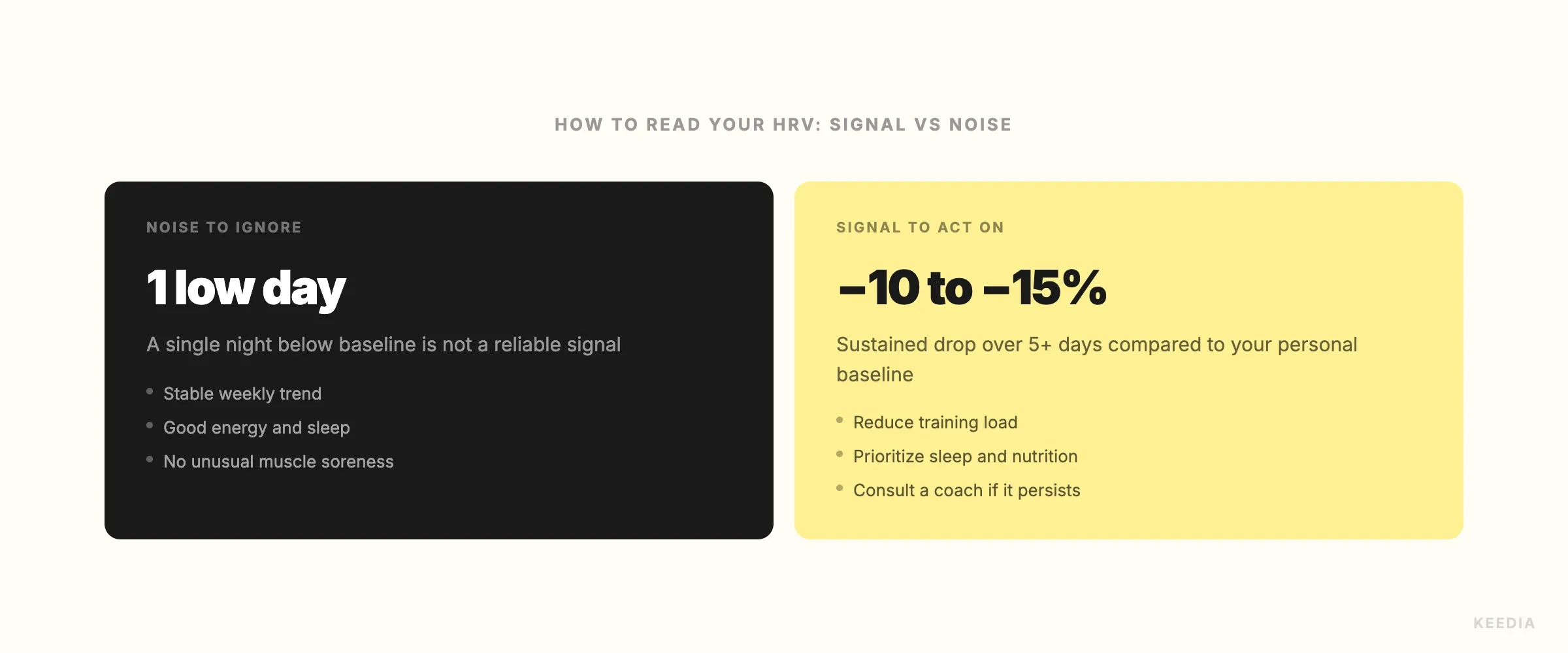
One night's reading, though, is almost always noisy. Alcohol, a late meal, a stressful conversation before bed, even ambient temperature can shift your HRV without reflecting any meaningful change in your training readiness. A single data point tells you very little. A 5 to 7-day trend line tells you something worth acting on.
The Time Lag Problem Most Runners Get Wrong
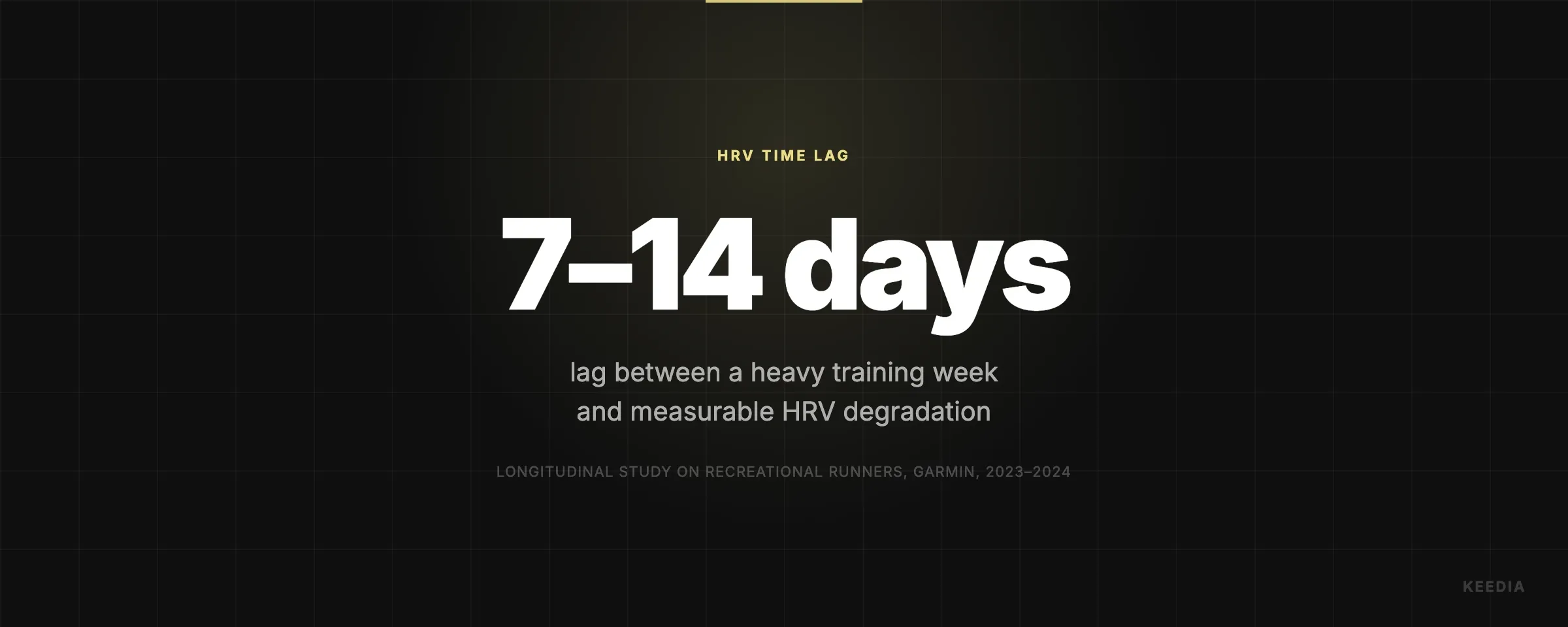
Here's the finding that changes how you should interpret your daily score. A year-long longitudinal study tracking recreational runners using Garmin devices found that increases in training load degrade HRV with a time lag of several days to weeks. Today's low HRV reading often doesn't reflect last night's sleep. It reflects the accumulated training stress from the past week or more.
This has a direct practical implication. If you hammered long intervals on Tuesday and Thursday, and your HRV drops on Sunday, that's not a mystery. Your body is processing cumulative load, and the autonomic nervous system is still absorbing it. The instinct to blame Sunday night's sleep is usually wrong.
This also connects to what the 2026 research on sleep and athletic performance makes clear: sleep quality and training recovery are related but distinct signals. A good night's sleep won't fully rescue an HRV that's been suppressed by two weeks of hard training.
The Single-Day Mistake (and What to Do Instead)
The most common misuse of HRV data is straightforward: you see a low score, you skip your workout, you feel like you made the smart call. Sometimes that's right. Often it's not.
A single low HRV day, when your trend line has been stable and your subjective feel is normal, is almost certainly noise. Skipping training based on one data point means you're letting a statistically unreliable reading make decisions for you.
The threshold that's actually worth responding to is a sustained drop. If your HRV falls 10 to 15 percent below your personal baseline and stays there for five or more consecutive days, that's a meaningful signal. At that point, your body is telling you something coherent, not random. Reducing training load, prioritizing sleep, and examining other stressors makes sense.
The inverse is also true. A sustained elevation above your baseline trend is a genuine green light. Not to blow up your training plan, but to recognize that your recovery capacity is high and you can likely handle a harder session without negative consequence.
HRV Alone Isn't Enough
The research is consistent on this point: HRV-guided training works better when it's paired with subjective data. Energy levels, motivation, muscle soreness, sleep quality as you experienced it. Neither the device number nor your subjective feel is sufficient on its own.
Studies on overreaching prevention show that combining objective HRV trends with self-reported readiness scores predicts overreaching and illness risk more accurately than either input alone. When your HRV trend is low and you also feel flat and unmotivated, that's a compound signal. When your HRV is low but you feel strong and sharp, the data conflict is worth noting. In that case, a moderate session rather than a full rest day is often the right call.
This is the same principle underlying good coaching practice. As outlined in how to measure client progress beyond weight and performance numbers, single metrics rarely capture the full picture of an athlete's state. Stacking multiple signals is what generates reliable insight.
For a structured framework on managing this balance week to week, the complete guide to active recovery and training load management is worth working through alongside your HRV data.
A Practical Framework for Reading Your Data
- Use a rolling 7-day average. Most wearables calculate this automatically. If yours doesn't, track it manually. Day-to-day swings are noise. The trend is the signal.
- Know your personal baseline. HRV varies widely between individuals. A reading of 45ms might be excellent for one person and low for another. Your baseline, not a population average, is the only reference point that matters.
- Factor in training lag. When your HRV dips, look back 5 to 10 days at your training load before assuming last night was the cause.
- Combine with subjective readiness. Rate your energy, motivation, and muscle soreness each morning. Even a simple 1 to 10 scale adds meaningful context to your HRV number.
- Reserve strong responses for sustained trends. A 10 to 15 percent drop held over 5 or more days warrants a genuine load reduction. A single bad morning doesn't.
The Bigger Picture
HRV tracking is one of the more legitimate tools to come out of the consumer wearable boom. The underlying physiology is sound, and the research supporting HRV-guided training is growing in rigor and scale. But the metric is only as useful as your understanding of what it's actually capturing.
It's not a daily grade. It's not a verdict on your sleep. It's a slow-moving reflection of your autonomic system's relationship with accumulated stress, and it rewards patient, contextual reading rather than reactive decision-making.
Used alongside solid sleep habits and a structured training plan, it can meaningfully reduce overreaching risk. The 2026 research on exercise and mental health also points to autonomic regulation as a key pathway through which consistent training improves psychological resilience. Your HRV data, read correctly, gives you a window into that process in real time.
The wearable on your wrist is capturing something real. Now you know how to read it.
Frequently Asked Questions
How many hours of sleep do athletes need for optimal recovery?
Most active adults need 7 to 9 hours. Athletes in heavy training phases benefit from the higher end of that range, as growth hormone release and muscle repair peak during deep sleep.
What are the signs of poor recovery?
Persistent fatigue, declining performance, sleep issues, irritability, unusual joint pain, and plateauing despite consistent training are the main warning signs.
Do wearables accurately measure recovery?
Fitness wearables provide useful trends, especially for sleep and HRV tracking. But they don't replace listening to your body and working with a qualified professional.