
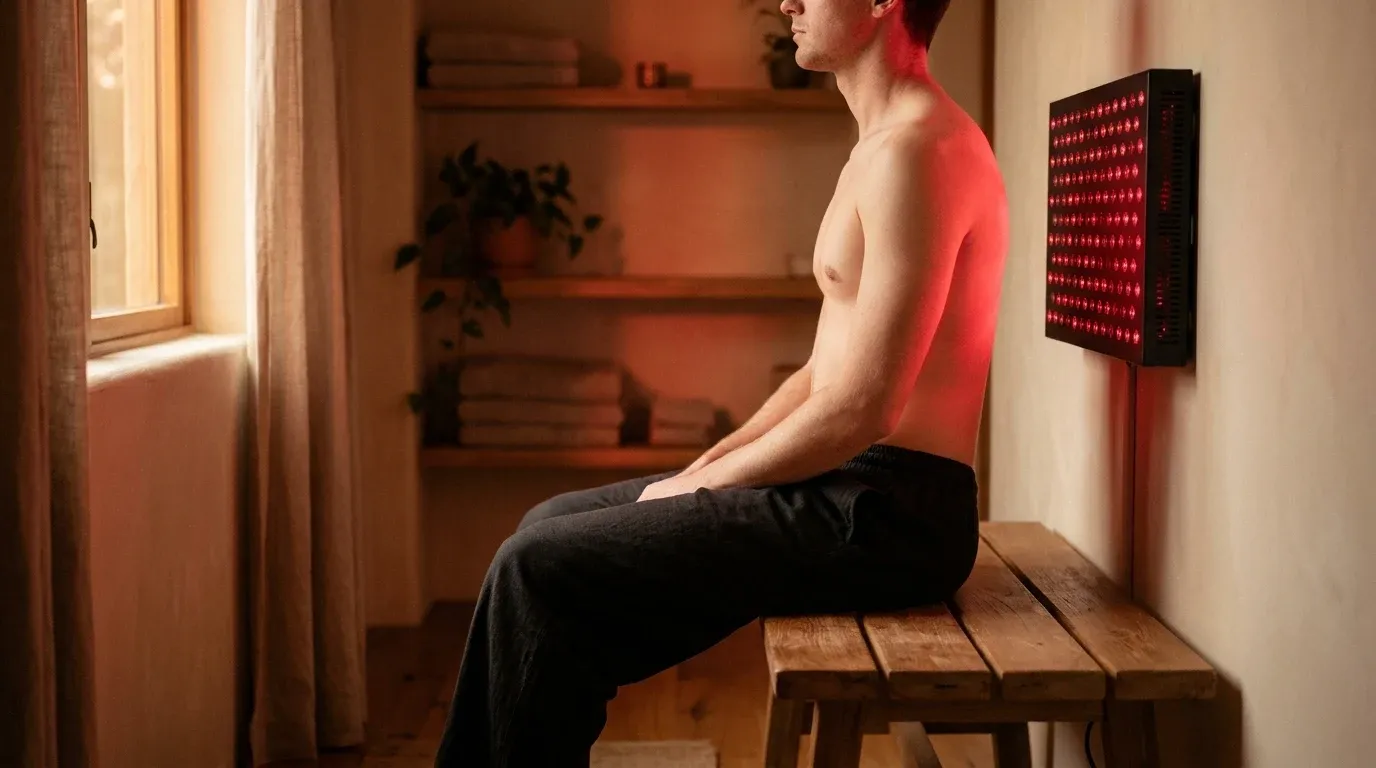
Red light therapy panels are showing up in professional locker rooms, biohacker home setups, and wellness studios charging $50 a session. The pitch is compelling: stand in front of a device for ten minutes and recover faster. But most people using it are treating it like a passive wellness ritual rather than a tool with specific application windows. That distinction matters more than the device you buy.
Here's what the science actually says about when to use red light therapy, and when it may be working against you.
What Photobiomodulation Actually Does
Red light therapy operates on a process called photobiomodulation (PBM). Specific wavelengths of red and near-infrared light, typically between 630 and 850 nanometers, penetrate the skin and reach muscle tissue. Once there, they interact with cytochrome c oxidase, a protein inside the mitochondria that plays a central role in producing cellular energy (ATP).
The practical result is that stressed or damaged cells receive a stimulus that accelerates their energy production. This matters after hard training because inflammation, micro-tears, and metabolic waste products all slow the recovery process at the cellular level. By giving mitochondria a boost, PBM appears to help cells repair and clear that damage more efficiently.
This is not the same as infrared saunas, heat therapy, or massage. Those modalities work through different mechanisms. PBM is a photochemical response, not a thermal one. The device doesn't need to feel warm to be doing something.
The Evidence on Recovery Timing
Studies examining PBM for muscle recovery consistently show that application timing is not a minor detail. It's one of the primary variables determining whether the therapy helps or does nothing measurable.
The strongest evidence clusters around immediate post-exercise application. Multiple randomized trials across sports including cycling, resistance training, and rugby have found that applying red light therapy within minutes of finishing intense exercise reduces markers of muscle damage (creatine kinase levels), decreases delayed-onset muscle soreness, and shortens the time to return to baseline performance.
The working hypothesis is that the inflammatory cascade triggered by exercise is still in its early phases immediately post-workout. Applying PBM during this window appears to modulate that response, reducing excessive inflammation without shutting it down entirely. That nuance matters. You don't want to eliminate inflammation after hard training. It's part of the adaptation signal. You want to keep it from spiraling into the kind of systemic soreness that costs you two or three days of training quality. If you're trying to calibrate how hard you should actually train at the gym, managing recovery quality is part of that calculation.
Pre-exercise application has also been studied, and the results are mixed but not useless. Some data suggests pre-treatment can reduce fatigue and increase force output during the subsequent session. But the evidence is thinner, and the effect size is smaller than post-exercise use. If you have to choose one window, the post-exercise slot wins consistently.
The Sleep Problem Most People Ignore
Here's where a lot of casual users are quietly undermining their own recovery. Red and near-infrared light at the wavelengths used in PBM devices are distinct from blue light, but that doesn't make them neutral at night.
Some research suggests that high-intensity light exposure in the evening, even in the red spectrum, can influence circadian signaling and alertness. More directly, the stimulating effect on cellular metabolism that makes PBM useful after exercise is precisely what you don't want when your body is trying to downregulate for sleep.
Recovery from training doesn't happen in the gym or in front of a light panel. It happens during sleep, particularly in the deep slow-wave stages when growth hormone is released and muscle protein synthesis peaks. Using a PBM device at 10 p.m. because that's when you finally have time is trading a marginal daytime benefit for a meaningful hit to sleep quality. The research on how disrupted sleep undermines physical recovery is not ambiguous. Irregular sleep patterns carry measurable health risks that extend well beyond feeling groggy the next morning.
The practical rule: finish your red light therapy session at least two to three hours before bed. If you train in the evening, apply it immediately post-workout and then let the rest of your wind-down routine do its job without further light stimulation.
Duration and Distance Matter Too
Timing is the most important variable, but it's not the only one people get wrong. Session length and distance from the device both affect dose, and underdosing is at least as common as poor timing.
Most research uses sessions between five and twenty minutes per targeted area. Longer isn't automatically better. PBM follows a biphasic dose-response curve, meaning too little light produces minimal effect and too much can actually inhibit the response. The sweet spot depends on device power output (measured in milliwatts per square centimeter) and your distance from the panel.
Consumer devices vary widely in actual irradiance. A device marketed at 300 watts may deliver a very different biological dose than the numbers suggest depending on the LED configuration and lens design. As a general guide, most quality panels recommend positioning yourself six to twelve inches from the device. Standing across the room because the panel looks intense is a common error that dramatically reduces the photonic dose reaching your tissue.
Who Actually Benefits and Who Is Wasting Money
Red light therapy is not equally useful for every type of training or every individual. The clearest evidence of benefit shows up in:
- High-frequency training blocks where accumulated fatigue is a genuine performance limiter.
- Post-competition recovery in team sports or events where athletes need to perform again within 24 to 72 hours.
- Injury-adjacent situations where tissue repair is a bottleneck, particularly soft tissue injuries to muscle and tendon.
If you're training three times a week at moderate intensity with adequate rest, your body's natural recovery mechanisms are probably handling the job. Adding a $500 light panel won't meaningfully change your outcomes. The recovery ceiling you're hitting is more likely nutritional, sleep-related, or programming-related than it is a photon deficiency. Understanding your recovery signals will tell you more about where your actual limits are than any device will.
For athletes training six or seven days a week, competing under accumulated load, or dealing with stubborn soft tissue issues, the cost-benefit calculation looks different. At that point, the evidence supports giving PBM a structured trial, applied correctly, over four to six weeks before drawing conclusions.
Separating Device Quality from Marketing
The red light therapy market is saturated with products making claims that far outrun the evidence. Devices range from under $100 to over $3,000, and price alone doesn't tell you much about efficacy.
What to look for: wavelengths in the therapeutic range (630 to 660 nm for red, 810 to 850 nm for near-infrared), independently verified irradiance output, and panels large enough to cover the muscle groups you're targeting without having to move repeatedly. A panel that covers your legs in a single position is more practical than a handheld device you're moving around for twenty minutes.
Be skeptical of devices that only publish wattage without irradiance data. Watts measure power draw from the wall, not what's reaching your body. It's the same kind of marketing sleight of hand that shows up in supplement labeling, where ingredient totals look impressive until you check whether each compound is actually present at a therapeutic dose. That gap between label and reality is worth keeping in mind across your broader wellness stack, including the nutrition side. For example, the parts of produce most people throw away are often the most nutritious, which is a similar case of overlooking what actually drives the benefit.
Building Timing Into Your Routine
If you decide PBM is worth adding to your recovery protocol, the structure is straightforward. Apply it within fifteen minutes of finishing your hardest sessions of the week. Keep sessions between ten and twenty minutes. Maintain the distance recommended by your device manufacturer. Don't use it within three hours of your intended sleep time.
Track your soreness, training quality, and sleep separately for four weeks. If the data suggests it's helping, it earns its place in the routine. If it doesn't move those numbers, the problem is likely elsewhere. Training load, protein intake, sleep consistency, and stress management all have larger effect sizes on recovery than any single modality. Chronic stress quietly disrupts recovery through cortisol and glucose dysregulation in ways that no light panel can offset.
Red light therapy is a legitimate tool with real science behind it. But like most tools, it only works when you use it correctly. The timing isn't a minor footnote. It's most of the point.