
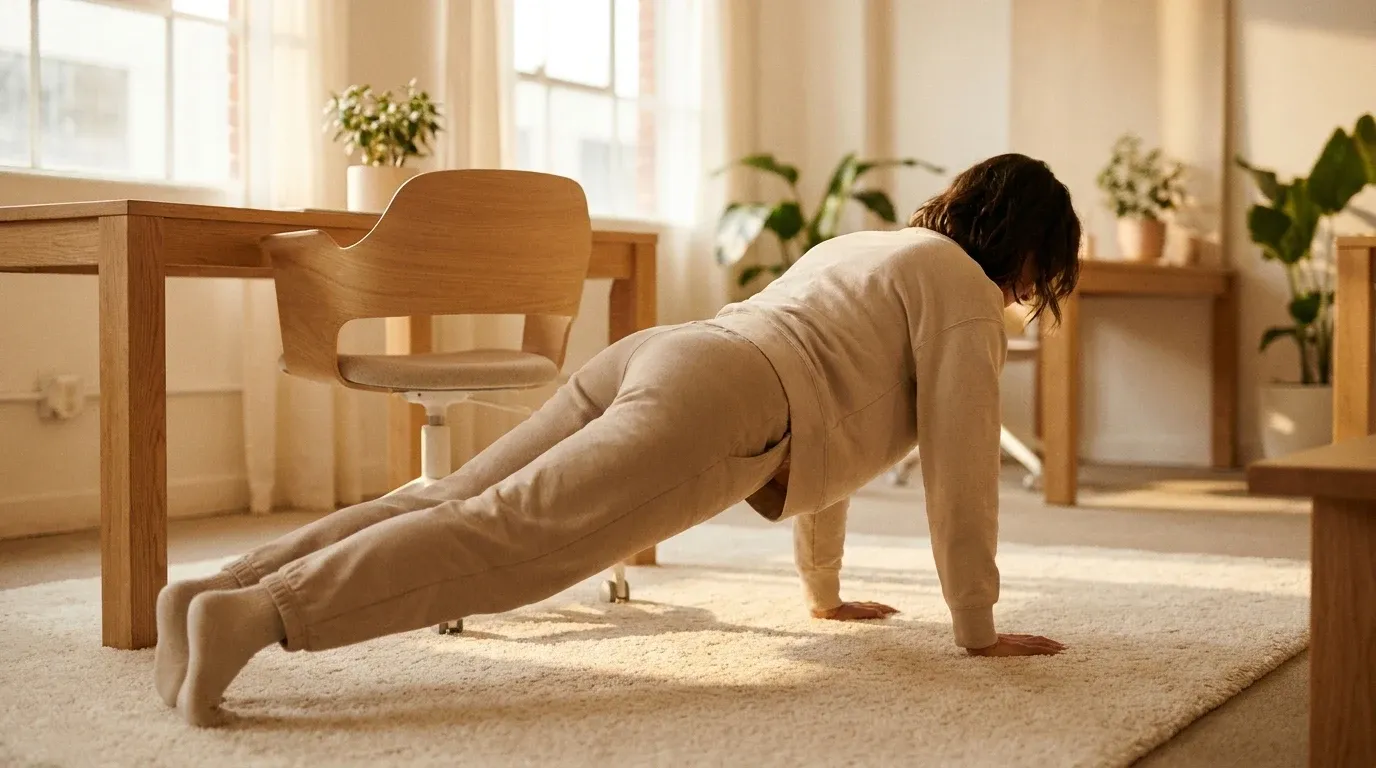
You sit down to work, and within half an hour something starts to shut off. Not your focus, not your motivation. Your muscles. Specifically, the ones responsible for keeping your spine stable, your shoulders back, and your hips functioning like they should. By the time you stand up for lunch, they've already checked out.
This isn't a metaphor. It's a measurable neurological process called neuromuscular inhibition, and it's happening to office workers far faster than most people realize. The good news is that the fix is targeted, brief, and doesn't require a gym, a standing desk, or a wellness budget.
What "Switching Off" Actually Means
Neuromuscular inhibition refers to the reduction in a muscle's ability to generate force, triggered not by fatigue but by sustained static posture. When you sit in a fixed position, the nervous system progressively reduces its excitatory drive to certain muscle groups. Those muscles don't cramp or ache. They simply stop contributing.
Research shows this process can begin within 20 to 30 minutes of continuous sitting. The muscles don't fully shut down, but their force output drops measurably. What makes this particularly insidious is the carry-over effect: even after you stand up and start moving, inhibited muscles don't automatically reactivate. Your body compensates by recruiting other muscles instead, creating movement patterns that load the wrong structures and lay the groundwork for injury.
This is why an ergonomic chair or an adjustable monitor arm often fails to resolve chronic neck and shoulder pain. The equipment addresses posture. It doesn't address the neuromuscular state of the muscles that should be maintaining that posture.
The Three Muscle Groups Most Affected
Not all muscles respond equally to prolonged sitting. Three groups are consistently identified in the research as the primary targets of desk-induced inhibition.
- The glutes. Extended hip flexion compresses and neurologically inhibits the gluteal muscles. Weak or inhibited glutes shift load to the lumbar spine and hamstrings, contributing to lower back pain and altered gait. The phenomenon is so common it has an informal name: gluteal amnesia.
- The deep spinal stabilizers. Muscles like the multifidus and transverse abdominis don't produce visible movement. They control spinal segment stability. When they disengage during prolonged sitting, the larger, more superficial muscles of the back take over, producing the kind of tension and soreness that no amount of stretching permanently resolves.
- The scapular retractors. The rhomboids and mid-trapezius are responsible for pulling the shoulder blades back and down. Hours of forward-reaching keyboard work and screen gazing cause these muscles to lengthen and disengage, allowing the shoulders to round forward. This directly loads the cervical spine and is a primary driver of tension headaches and neck pain in office workers.
These three groups share a key characteristic: they respond well to brief, deliberate activation. You don't need high load or long duration. You need the right signal, delivered regularly.
Why Ergonomics Alone Doesn't Cut It
The ergonomics industry is built on a reasonable premise: if you position the body correctly, it won't degrade. But positioning and muscle activation are two different things. A lumbar support cushion holds your spine in a neutral curve. It doesn't teach the multifidus to fire. A monitor at eye level reduces forward head posture. It doesn't reactivate the scapular retractors that have been silent for three hours.
This distinction was reinforced clearly by a Cochrane review published October 28, 2026, which found that exercise-based interventions outperform ergonomic equipment for arm, neck, and shoulder complaints in office workers. The analysis looked at a broad range of workplace interventions and consistently found that movement, not furniture, produced the stronger and more durable outcomes.
This aligns with what exercise science has been demonstrating for years. Passive solutions address the environment. Active solutions address the body. For neuromuscular inhibition, only one of those approaches works.
The Reactivation Protocol That Actually Works
The core principle is simple: brief, targeted contractions, repeated frequently throughout the day. Research supports 5 to 10 contractions per muscle group, performed every 30 to 45 minutes, as sufficient to maintain neuromuscular activation without requiring employees to leave their workstation or break their workflow for more than 60 to 90 seconds.
Here's what that looks like in practice.
For the glutes: Seated glute squeezes. Sitting upright, contract both glutes simultaneously and hold for three to five seconds. Release and repeat eight to ten times. This is invisible to colleagues and takes under a minute.
For the deep spinal stabilizers: Diaphragmatic bracing. Inhale fully, then gently brace the abdominal wall as if preparing to be lightly tapped in the stomach. Hold for five seconds without holding your breath. Repeat six to eight times. This recruits the transverse abdominis and co-activates the multifidus without requiring any movement at all.
For the scapular retractors: Seated rows or wall-press retractions. If you have a resistance band at your desk, anchor it to a door handle and perform slow, controlled rows. Without equipment, press the back of both hands against the edge of your desk and drive the shoulder blades together and down. Hold five seconds, repeat eight times.
These movements are not exercise in the traditional sense. Think of them as exercise snacking, which research now shows can build real functional strength when practiced consistently. The stimulus is small. The cumulative effect over a full workday is not.
Setting the Right Frequency
The 30-to-45-minute window isn't arbitrary. It's calibrated to the onset timeline of inhibition. Waiting an hour means you're already compensating. Waiting two hours means movement patterns have shifted enough that a brief activation may not fully restore normal recruitment before you sit back down.
The practical trigger most workers find effective is a timed reminder. A phone alarm, a desktop app, or a wearable notification set to 35 minutes creates the habit loop without requiring willpower. After two to three weeks, the check-in becomes automatic enough that many workers begin to notice the inhibition sensation on their own and self-correct without prompting.
This consistency also matters for the broader picture of health. Chronic neuromuscular inhibition doesn't just affect pain. It affects metabolic function, sleep quality, and stress regulation. If you're dealing with disrupted rest, it's worth considering that deep REM sleep is linked to protection against dozens of chronic diseases. Poor movement patterns during the day contribute to the physical tension that disrupts sleep at night. It's a system, not isolated symptoms.
What HR and Facilities Teams Can Do Now
If you're responsible for workforce health, the evidence is clear enough that waiting for a comprehensive wellness program to launch is costing you. Musculoskeletal complaints remain the leading cause of lost productivity and absenteeism in office environments globally, and the intervention cost is genuinely low.
Here are practical, low-friction options that don't require significant budget or infrastructure.
- Movement reminder systems. Deploy a free or low-cost desktop reminder tool across the organization. Set it to prompt brief reactivation every 35 to 40 minutes. Total cost: close to zero. Behavior change: measurable within weeks.
- Structured micro-break protocols. Formalize what many workers already try to do informally. A written protocol that specifies what to do during a two-minute break (not just "get up and stretch") produces better outcomes than open-ended guidance. Include the three reactivation exercises above and post them in shared spaces.
- Short on-site group sessions. A five-minute group activation session at the start of meetings or at the beginning of the afternoon block requires no dedicated space and no equipment. A trained employee or an outside coach can run this. It normalizes movement in the culture, which is often the hardest barrier to clear. For teams managing workplace stress that's now become the professional baseline, structured group movement also reduces cortisol and improves afternoon focus.
- Education, not just instruction. Workers who understand why their muscles inhibit are more likely to act on reminders. A 15-minute lunch-and-learn session on neuromuscular inhibition, delivered once, can shift compliance meaningfully. People don't skip the squeeze when they understand what it's preventing.
It's also worth noting the intersection with remote and hybrid work. Studies show remote work is linked to significantly higher rates of mental health visits, and physical deconditioning is one of the underreported contributors. Workers at home often move less between tasks than they would in an office. The reactivation protocol travels with them. HR policies should reflect that.
Building the Habit Over Time
The three-muscle protocol described here is a starting point, not a ceiling. Workers who build the reactivation habit often find it naturally expands. They add standing hip hinges before a long meeting. They do a few wall angels before a video call. They start to treat their body as something that requires active maintenance during the workday, not just passive support.
If you're new to this kind of intentional movement, understanding what coaches prioritize when building a movement foundation can help you sequence your habits sensibly. The principles that apply to structured training, specificity, consistency, progressive load, apply at the desk level too.
The underlying message is straightforward. Your body is not designed to hold one position for hours on end. The muscles that protect your spine and joints don't maintain themselves passively. They need a signal. Thirty seconds of deliberate contraction, several times a day, is enough to send it.
Your desk isn't going anywhere. But the way your muscles respond to it is entirely within your control.