
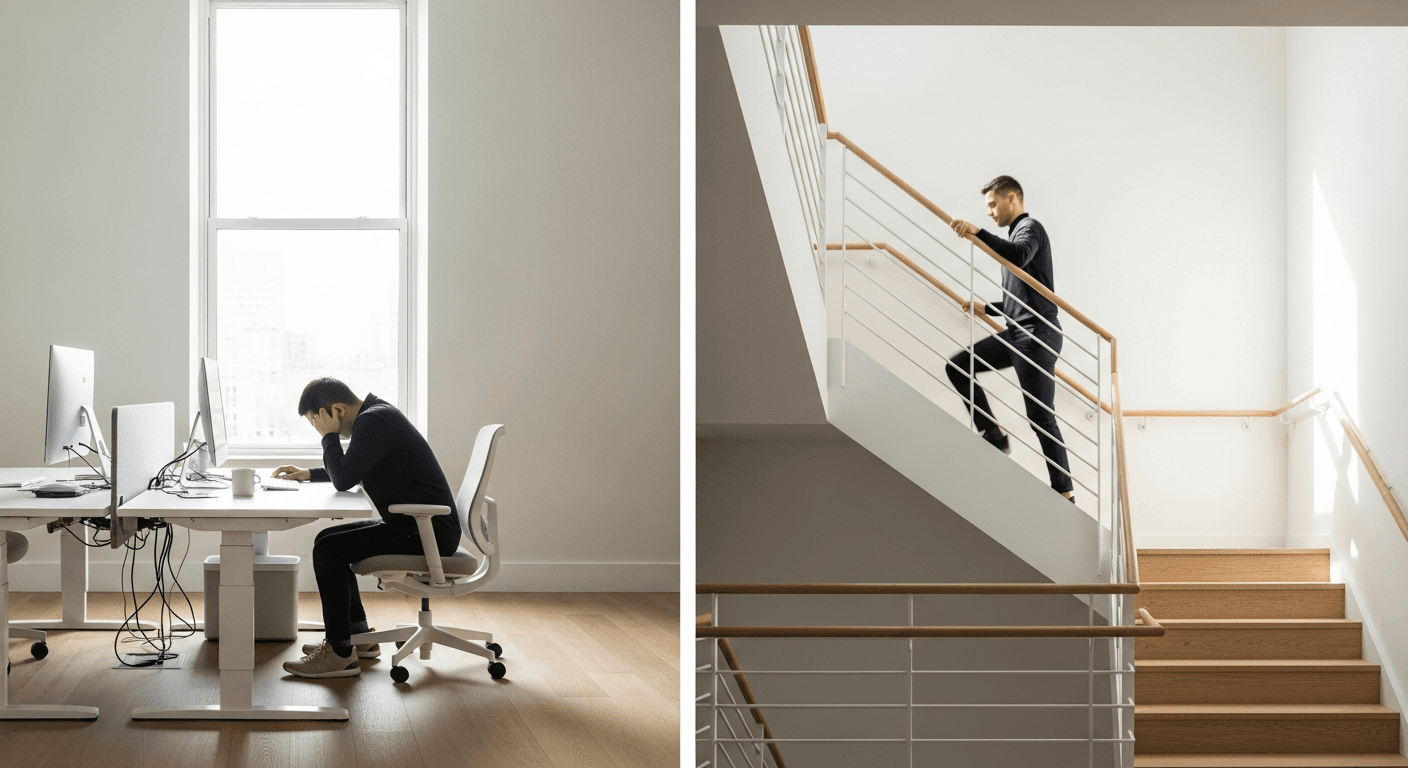
If you spend most of your workday in a chair, your after-work gym session may not be doing enough. A large-scale study published in JAMA Network Open tracked more than 480,000 participants and found that people in predominantly sedentary jobs carry a 16% higher all-cause mortality risk and a 34% higher cardiovascular mortality risk compared to those with more physically active work. Those numbers hold even when researchers controlled for leisure-time physical activity.
That last part is worth sitting with. Exercising regularly after hours helps. But it doesn't fully cancel out what prolonged sitting does to your body during the hours you're actually working.
Why the Standard 150-Minute Guideline Falls Short
The current recommendation of 150 minutes of moderate-intensity exercise per week comes from guidelines calibrated for the general population. That population includes retirees, manual laborers, caregivers, and students. It was never specifically designed for someone logging six to eight hours per day seated at a screen.
When your baseline is that sedentary, 150 minutes spread across a week doesn't generate enough physiological stimulus to counteract the metabolic slowdown, vascular stiffness, and blood sugar dysregulation that accumulate from hours of uninterrupted sitting. The guidelines weren't wrong. They just weren't built with your workday in mind.
This connects directly to a broader conversation about how moderate exercise is the burnout fix HR keeps ignoring. The problem isn't only mortality risk. It's the daily functional decline that shows up as fatigue, poor concentration, and elevated stress long before any clinical event occurs.
What the Research Actually Recommends for Desk Workers
Based on the JAMA findings and supporting research, desk-bound employees need an additional 15 to 30 minutes of moderate physical activity per day on top of standard guidelines to meaningfully offset sitting-related health damage. That translates to roughly 225 to 360 minutes of moderate activity per week total, not 150.
Moderate intensity means brisk walking, cycling at a conversational pace, light swimming, or anything that raises your heart rate without leaving you breathless. It doesn't require a gym membership or a dedicated workout block. A 20-minute walk at lunch and a 10-minute walk after dinner already gets you into the target range on a typical workday.
It's also worth noting that intensity isn't the only variable. Research has consistently shown that you don't need intense workouts to build meaningful fitness. For desk workers, consistency and daily volume matter more than peak exertion.
The 5-Minute Break That Changes Your Blood Sugar
Not all interventions require changing your schedule outside the office. One of the most evidence-backed strategies is also the simplest: take a five-minute light activity break every 30 minutes of sitting.
Studies show that brief walking breaks at this frequency measurably reduce postprandial blood sugar spikes and improve blood pressure responses compared to sitting continuously. The mechanism is straightforward. When large muscle groups in the legs contract, even lightly, they uptake glucose independently of insulin. That process stalls when you're sedentary for extended periods.
A five-minute walk around the office, a set of bodyweight squats, or even standing and doing light movement is enough to restart that process. The cumulative effect across an eight-hour workday is significant, and it requires no equipment, no gym, and no change to your workout routine outside work hours.
This is exactly the kind of low-barrier intervention that HR departments and people managers can deploy immediately. It costs nothing. It requires no budget approval. And the evidence base supporting it is strong enough that it should be considered standard workplace health practice, not a wellness perk.
The Cardiovascular Risk Is Specific and Serious
The 34% higher cardiovascular mortality risk identified in the JAMA study deserves more attention than it typically gets in workplace wellness conversations. Cardiovascular disease is already the leading cause of death globally. Adding a profession-linked risk layer of more than a third on top of baseline population risk is not a marginal finding.
What drives it? Prolonged sitting contributes to reduced circulation in the lower extremities, increased triglyceride levels, reduced HDL cholesterol, and elevated resting blood pressure. None of these changes are dramatic on a day-to-day basis. But over years of predominantly sedentary work, they compound. The cardiovascular system becomes measurably less resilient.
There's also a sleep dimension here that often goes unaddressed. Poor cardiovascular health and sedentary behavior both disrupt sleep architecture, and disrupted sleep further elevates cardiovascular risk. Research into how AI tools are now reading sleep data to predict cardiovascular disease years before symptoms appear underscores just how early these risk pathways begin to form.
It Hits Different Depending on Who You Are
The aggregate risk figures from the JAMA study are informative, but population-level data always obscures individual variation. Age, baseline fitness, body composition, and biological sex all affect how sedentary work impacts your health. The damage isn't uniform.
Metabolic responses to prolonged sitting differ between men and women, and those differences have real implications for how you should structure your activity additions. Research on how obesity and metabolic stress affect men and women differently points toward the need for personalized approaches rather than one-size-fits-all desk-break protocols.
If you're over 40, carry excess weight around the midsection, or have a family history of cardiovascular disease, the additional 15 to 30 minutes of daily activity isn't optional. It's the minimum viable intervention.
What a Realistic Daily Routine Looks Like
Here's a practical framework that fits inside a standard workday without requiring major schedule changes:
- Morning: A 10-minute walk before starting work. This primes your cardiovascular system and sets a movement baseline for the day.
- Every 30 minutes during work: Stand up and move for five minutes. Walk to a colleague's desk, do a lap around the floor, or stand and stretch. Set a timer if you need to.
- Lunch: Use at least 15 minutes of your break for a brisk walk. This is your single highest-leverage movement window of the workday.
- After work: Your standard workout or evening walk. If you already exercise, extend it by 15 to 20 minutes to meet the adjusted target for desk workers.
- Evening: A 10-minute walk after dinner significantly improves blood sugar regulation overnight and supports cardiovascular recovery.
This approach requires no gym, no equipment, and no dramatic restructuring of your schedule. It does require treating movement as non-negotiable during the workday, not as something you'll get to if time allows.
The Workplace Responsibility Question
Individual behavior matters. But the structure of most office environments actively works against it. Open-plan floors where walking to a colleague feels disruptive, back-to-back meeting cultures that eliminate natural movement windows, and the normalization of all-day screen time combine to make sedentary behavior the path of least resistance.
Organizations that are serious about workforce health need to go further than standing desk stipends. The data on the $322 billion annual cost of workplace burnout makes a clear business case for structural change. Scheduled movement breaks, walking meeting policies, and activity-friendly floor layouts aren't soft benefits. They're risk mitigation.
From a recovery standpoint, movement integration during the day also reduces the physiological stress load that accumulates from prolonged inactivity, meaning employees who move more during work hours generally recover faster outside of them.
The Bottom Line
The science is clear. If you work at a desk for most of the day, the standard 150-minute weekly exercise guideline isn't calibrated for your actual activity profile. You need more, and you need it distributed across the day, not saved for a single session.
The good news is that the additional dose required isn't extreme. An extra 15 to 30 minutes of moderate activity per day, combined with light movement breaks every 30 minutes during work, is enough to materially reduce your mortality risk and protect your cardiovascular health over time. That's a high return on a modest investment of time and effort.
You don't need a complete lifestyle overhaul. You need a recalibrated baseline that accounts for the reality of how you actually spend your working hours.