
The American College of Sports Medicine has published its first major resistance training update since 2009, and the findings don't flatter the fitness industry's obsession with optimization. Drawing on 137 systematic reviews and data from more than 30,000 participants, the 2026 Position Stand is the most comprehensive evidence-based guidance ever produced on strength training for healthy adults. The core message is blunt: complexity has been oversold.
Key Takeaways
- ACSM recognizes that a single effective set can produce gains in beginners
- Recommended rest time increases to 2-5 minutes for heavy compound movements
- New guidelines apply to all levels, from beginners to advanced athletes
The Biggest Gain Comes Before You Even Optimize Anything
The single most impactful variable in resistance training isn't load, volume, frequency, or equipment. It's the move from doing nothing to doing something. The evidence is unambiguous: transitioning from zero resistance training to any resistance training produces the largest measurable improvements in strength, muscle size, and physical function.
That finding reframes the entire conversation. Most fitness content focuses on squeezing more out of an already active person's program. The ACSM's data suggests the highest-return intervention is far simpler. Get sedentary adults lifting anything, at any reasonable frequency, and the results follow. Consistency, not calibration, is the primary driver.
This connects directly to what the minimum effective dose framework for strength training has been arguing for years. You don't need a perfectly periodized 12-week block to make meaningful progress. You need to show up.

What the Evidence Actually Recommends by Goal
For those who want specifics, the Position Stand does provide evidence-based targets. But they're less complicated than most training programs suggest.
- For strength: heavier loads around 80% of your one-rep maximum (1RM), performed for 2 to 3 sets per exercise, delivered consistent gains across studies. You don't need six sets to failure to get stronger.
- For hypertrophy: higher weekly volume matters more than any single session. Around 10 sets per muscle group per week was the threshold where meaningful size gains reliably appeared. How you distribute those sets across the week is secondary.
- For power: moderate loads in the 30 to 70% 1RM range, with intentional focus on moving the concentric phase as fast as possible, produced the best outcomes. Power development is about intent and speed, not just load.
These aren't revolutionary numbers. What's significant is the quality of evidence behind them now. Seventeen years of additional research have tightened the confidence intervals considerably.
Three "Rules" the Research Quietly Retired
The more interesting findings are the ones that didn't hold up. Several assumptions embedded in conventional training culture weren't supported by the evidence when put to systematic review at this scale.
Training to momentary failure did not consistently outperform stopping short of failure for strength or hypertrophy in healthy adults. Leaving a rep or two in reserve produces comparable results, with lower injury risk and less accumulated fatigue. For most people, chasing failure every set is unnecessary and potentially counterproductive.
Free weights versus machines produced no consistent advantage for free weights when outcomes were measured as overall strength, muscle size, or functional ability. Both modalities work. The free weights orthodoxy, while not wrong, was overstated.
Complex periodization models, including the elaborate wave-loading and block periodization structures popular in performance coaching, didn't consistently outperform simpler linear or undulating approaches for healthy adults. Programming sophistication matters at the elite end of the performance spectrum, but for the general population it adds complexity without reliably adding results.
If you're a coach tracking client outcomes, this has real implications for how you design programs and explain value. Measuring progress beyond performance numbers becomes even more relevant when the performance variables themselves are less differentiated than the industry assumed.
Home Training Is No Longer a Compromise
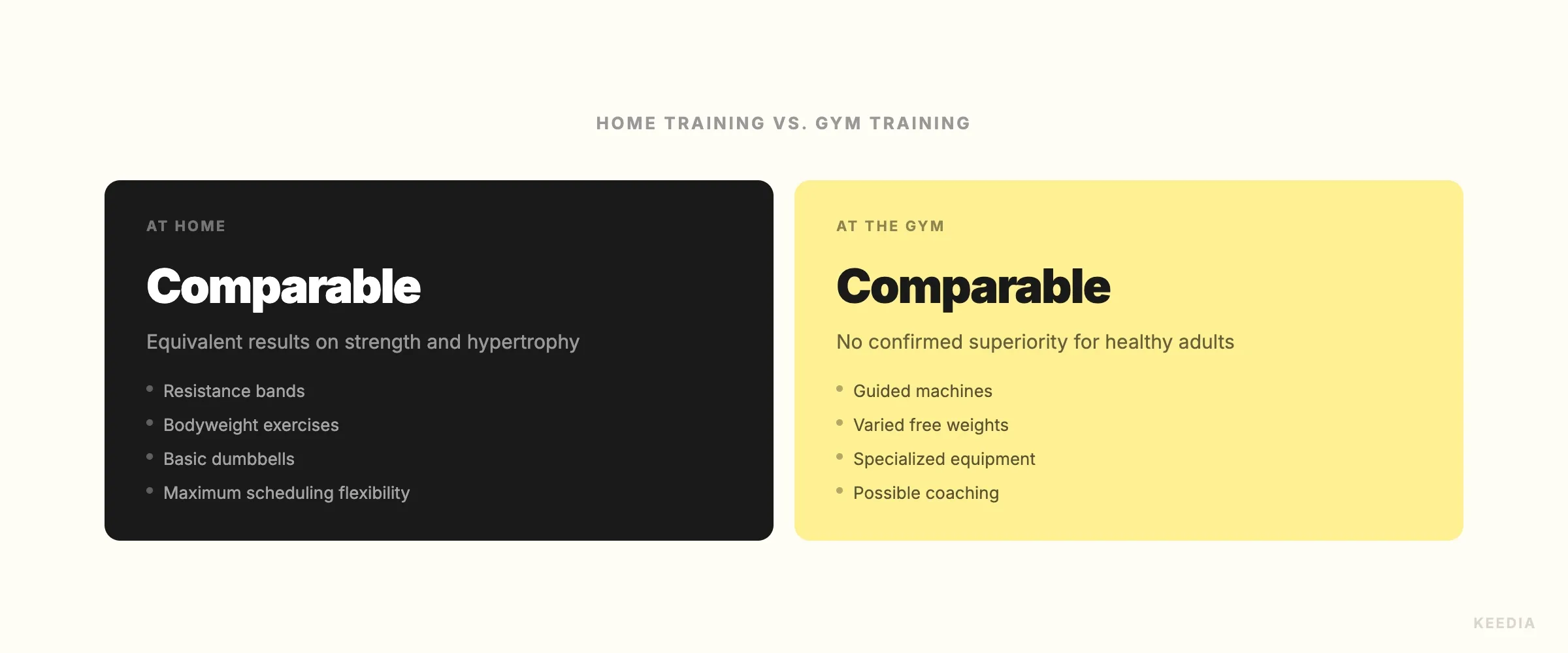
One of the most practically significant findings involves equipment and setting. Bodyweight training, resistance bands, and home-based routines produced results comparable to gym-based training across measures of strength, muscle size, and physical function. The performance gap between a well-equipped gym and a living room with a few resistance bands is smaller than most people believe and smaller than the fitness industry has historically communicated.
This matters for access. Gym memberships in the US average between $40 and $80 per month at most commercial facilities, with premium options running $150 or more. A set of resistance bands costs under $30. If the outcomes are comparable, the financial barrier argument loses most of its force.
It also matters for adherence. Home-based training eliminates commute time, scheduling friction, and social anxiety around the gym floor. All of those factors affect consistency, and consistency is what the data keeps returning to as the dominant variable.
Recovery Still Closes the Loop
The Position Stand doesn't exist in isolation. Resistance training stimulus only converts to adaptation during recovery. The evidence on sleep, in particular, remains some of the most underappreciated in exercise science. What the 2026 research shows about sleep and athletic performance reinforces that sub-optimal recovery blunts adaptation regardless of how well the training itself is structured.
Similarly, managing training load through active recovery isn't a luxury for elite athletes. It's a practical tool for anyone trying to maintain frequency without accumulating fatigue that erodes performance and motivation over time.
What This Means for How You Train
The ACSM's 2026 Position Stand doesn't invalidate structured, thoughtful programming. It puts it in proportion. For a competitive athlete or someone chasing a specific performance ceiling, the finer variables still matter. But for the vast majority of healthy adults, the optimization conversation is largely a distraction from the fundamentals.
Here's what the evidence actually supports for most people:
- Train 2 to 3 days per week with any form of resistance. Bands, bodyweight, machines, free weights. It largely doesn't matter.
- Use loads that feel challenging in the 6 to 15 rep range depending on your goal, and stop a rep or two before complete failure.
- Accumulate roughly 10 sets per muscle group per week if hypertrophy is the goal. Fewer sets work for strength.
- Prioritize showing up over optimizing your program. A simple, consistent routine outperforms a perfect program you follow intermittently.
The fitness industry runs on novelty. New methods, new equipment, new protocols. The ACSM just published 17 years of evidence suggesting the fundamentals were right all along, and that the gap between the best possible program and a good enough one is far narrower than the content around you implies.
You don't need more complexity. You need more consistency.
Related articles
- ACSM Rewrites Strength Training Rules for the First Time in 17 Years
- ACSM Rewrites Strength Training Rules: Key Takeaways
- Strength Training Is America's #1 Fitness Goal for 2026. Coaches Who Get This Are Winning