
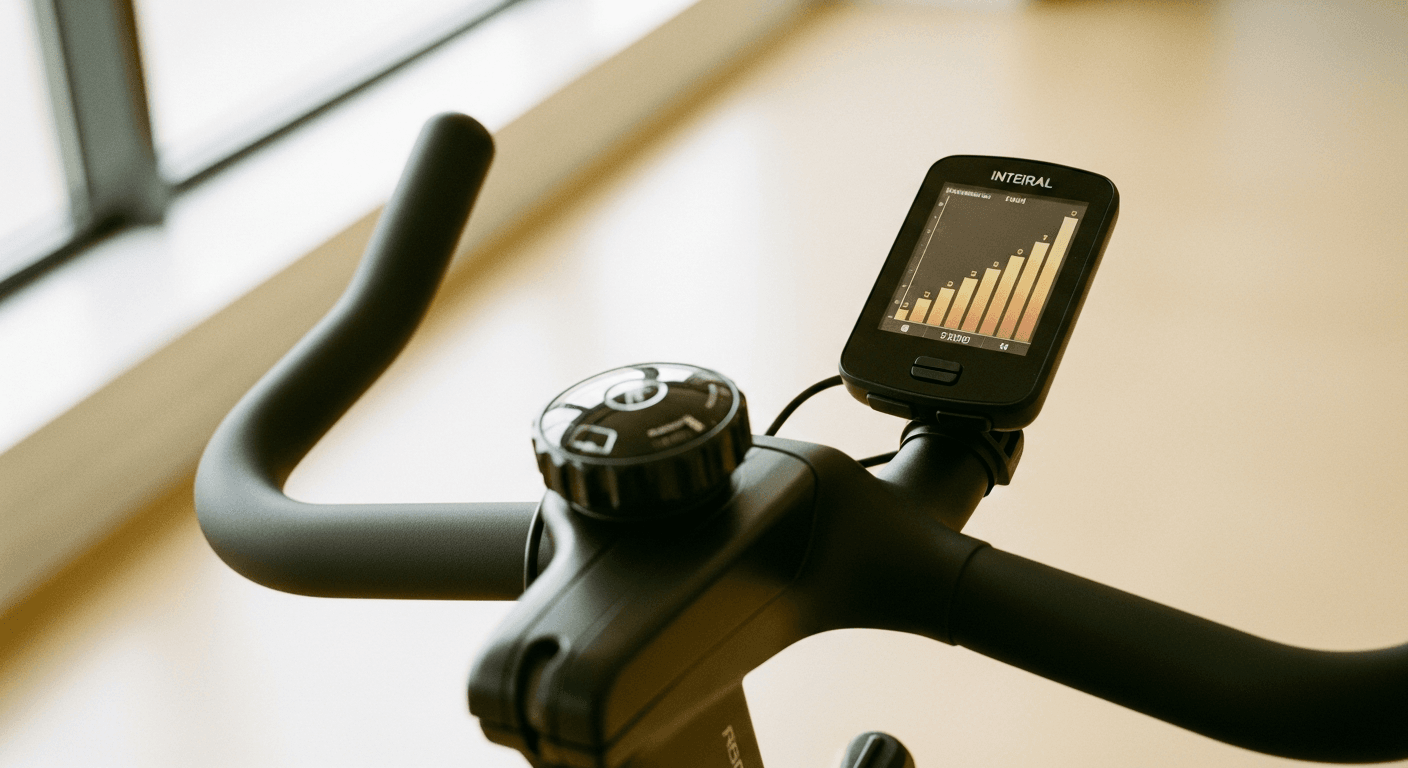
If you've spent any time in a weight room, you know the rule: add weight, add reps, or add sets over time. That's progressive overload, and it's the reason your squat went from 95 pounds to something respectable. But the moment most lifters step onto a treadmill or climb onto an exercise bike, that logic disappears entirely. Same resistance. Same pace. Same 30 minutes. Week after week.
That's not cardio training. That's cardio maintenance. And if you're wondering why your endurance hasn't improved, or why fat loss has stalled despite regular sessions, the answer is almost certainly here.
What Progressive Overload Actually Means
Progressive overload is the systematic increase of training stress over time. The body adapts to demands placed on it. Once it has adapted, the same stimulus no longer drives change. You have to push the threshold again, slightly and consistently, to keep triggering adaptation.
For lifting, this means adding load. For cardio, the variables are different but the principle is identical. You can increase intensity, duration, resistance, interval length, work-to-rest ratios, or incline. The method changes. The logic doesn't.
Research consistently shows that cardiovascular fitness responds to progressive training stimulus the same way muscular strength does. The heart, like a muscle, adapts to increased demand. If you never increase the demand, adaptation stops.
The Static Resistance Problem
Here's one of the most common mistakes in cardio training: setting a fixed resistance on an exercise bike and never changing it. It feels like effort, especially in the first few weeks. Your heart rate is elevated, you're sweating, and it seems like the work is being done.
But physiological adaptation is efficient by design. Within a few weeks, your cardiovascular system and working muscles have optimized for that exact load. The session that used to challenge you now just maintains your current fitness level. You're training your body to be comfortable at one effort, not to exceed it.
This is why two people can spend the same number of hours on a stationary bike over six months and end up with dramatically different outcomes. One followed a progressive structure. The other repeated the same session 78 times.
The same pattern shows up on treadmills. Running at 6.0 mph for 30 minutes might be a real challenge in week one. By week eight, it's a warm-up. If you haven't adjusted pace, incline, or duration, you've stopped training and started coasting.
Practical Progression Models for Cardio
The good news is that applying progressive overload to cardio doesn't require complicated programming. You need a few clear variables and the discipline to move them forward on a defined schedule.
For interval-based training (HIIT):
- Start with intervals you can complete with real effort. A 20-second sprint with 40 seconds of rest is a reasonable starting point for most people.
- Add 5 to 10 seconds to your high-intensity intervals each week. After four weeks, you're working at 40 to 60 seconds of effort per interval. That's a meaningful shift in metabolic demand.
- Once interval duration plateaus, begin reducing rest time incrementally. Dropping rest from 40 seconds to 35, then 30, increases cardiovascular stress without requiring higher absolute intensity.
- Track total high-intensity volume per session. If you started at 4 minutes of total work, aim for 6 to 8 minutes after six weeks.
For steady-state cardio (LISS):
- Increase resistance by one level every two weeks on a bike or elliptical. Small jumps prevent overreach while maintaining forward momentum.
- Add two to three minutes of duration per week until you reach your target session length, then increase intensity instead.
- On a treadmill, raise incline by 0.5 percent every one to two weeks. This increases cardiovascular load without requiring faster speed, which is particularly useful if joint stress is a concern.
These progressions look modest on paper. Over 12 weeks, they produce compounding results that a static approach never will.
Heart Rate as Your Objective Measure
The problem with perceived exertion is that it's subjective and biased. Most people rate sessions as harder than they actually are, particularly when they're tired from work or sleep-deprived. Heart rate data cuts through that noise.
If you're doing what you believe is a hard session but your heart rate is 20 beats per minute lower than it was six weeks ago at the same resistance and pace, one of two things is true: your fitness has genuinely improved, or you've unconsciously reduced your effort. Heart rate data tells you which.
A genuinely progressive session should either maintain your target heart rate zone with increased external load, or push you into a slightly higher zone with the same load. If neither is happening, the session isn't progressive. It's repetition.
For reference, most cardiorespiratory training benefits occur between 60 and 85 percent of your maximum heart rate. The American College of Sports Medicine defines vigorous-intensity cardio as 77 to 95 percent of maximum heart rate. Knowing where your sessions land within those ranges tells you whether you're adapting or plateauing. A chest strap monitor or a reliable wrist-based device is sufficient for this level of tracking.
Heart rate data also connects directly to recovery quality. If your resting heart rate is climbing week over week, or if your heart rate during submaximal efforts isn't dropping as fitness improves, those are signals worth paying attention to. Stanford AI research on sleep and cardiovascular data illustrates just how much physiological signal is available when you track consistently over time.
Combining HIIT and LISS for Sustainable Progression
One of the biggest mistakes people make when applying progressive overload to cardio is applying it to every session simultaneously. Three hard interval sessions per week, each one slightly more demanding than last week, is a fast route to overtraining and burnout.
The smarter approach is to alternate HIIT and LISS sessions within a weekly structure. This gives your cardiovascular system and supporting musculature time to recover between high-demand sessions, which is where actual adaptation happens. The stress of training is only productive if recovery is adequate.
A functional weekly structure for most people looks like this: two HIIT sessions where progressive overload is actively applied (longer intervals, less rest, or higher resistance), and two LISS sessions at moderate intensity that support aerobic base development without adding excessive fatigue. The LISS sessions can progress more slowly, increasing duration or incline at a two-to-four week cadence rather than weekly.
Recovery quality directly shapes how well you absorb training stress. Building a structured recovery routine around your cardio program isn't optional if you want progressive overload to work. Sleep, mobility work, and stress management are all part of what allows adaptation to occur between sessions.
Nutrition also plays a role that often gets overlooked. If you're increasing training volume and intensity without adjusting fuel intake, performance will stagnate regardless of how well-structured your progression is. Endurance-specific nutrition strategies become increasingly relevant as your cardio volume climbs, particularly around session timing and carbohydrate availability.
Common Errors That Undercut Progression
Even athletes who understand the principle often make structural errors that slow results.
- Progressing too fast. Increasing intensity or duration by more than 10 percent per week is a well-established threshold for overuse injury risk. Slow, consistent progress outperforms aggressive jumps every time.
- Ignoring deload weeks. Every four to six weeks, reduce training load by 30 to 40 percent for one week. This isn't falling behind. It's when a significant portion of adaptation actually consolidates.
- Conflating effort with progress. Feeling tired after a session doesn't mean the session was progressive. Effort is necessary but not sufficient. External metrics, resistance levels, interval durations, and heart rate data, are what confirm progression.
- Randomizing sessions. Variety is useful, but only when it's structured. Randomly switching between workouts every few days prevents the systematic overload that drives adaptation. Variety should sit within a progressive framework, not replace it.
Putting It Together
Progressive overload works for cardio the same way it works for the barbell. The variables are different: you're manipulating interval length, resistance, rest periods, and heart rate zones rather than plates. But the underlying mechanism is identical. The body adapts to stress, and when that stress stops increasing, adaptation stops too.
Start by identifying where you are right now. What resistance are you using? What pace? What interval structure? Write it down. Then build a simple 8-to-12 week progression plan that moves at least one of those variables forward every one to two weeks.
Use heart rate data to confirm your sessions are genuinely demanding. Alternate HIIT and LISS to allow recovery. Protect your nutrition. And take deload weeks seriously.
If you want a broader benchmark for where your cardiovascular fitness stands relative to real-world standards, the updated Presidential Fitness Test metrics offer a useful reference point across age groups and fitness levels.
The principle isn't complicated. What it requires is consistency and the willingness to track what's actually happening rather than assuming effort equals progress. That distinction is where most cardio training breaks down, and where yours doesn't have to.