
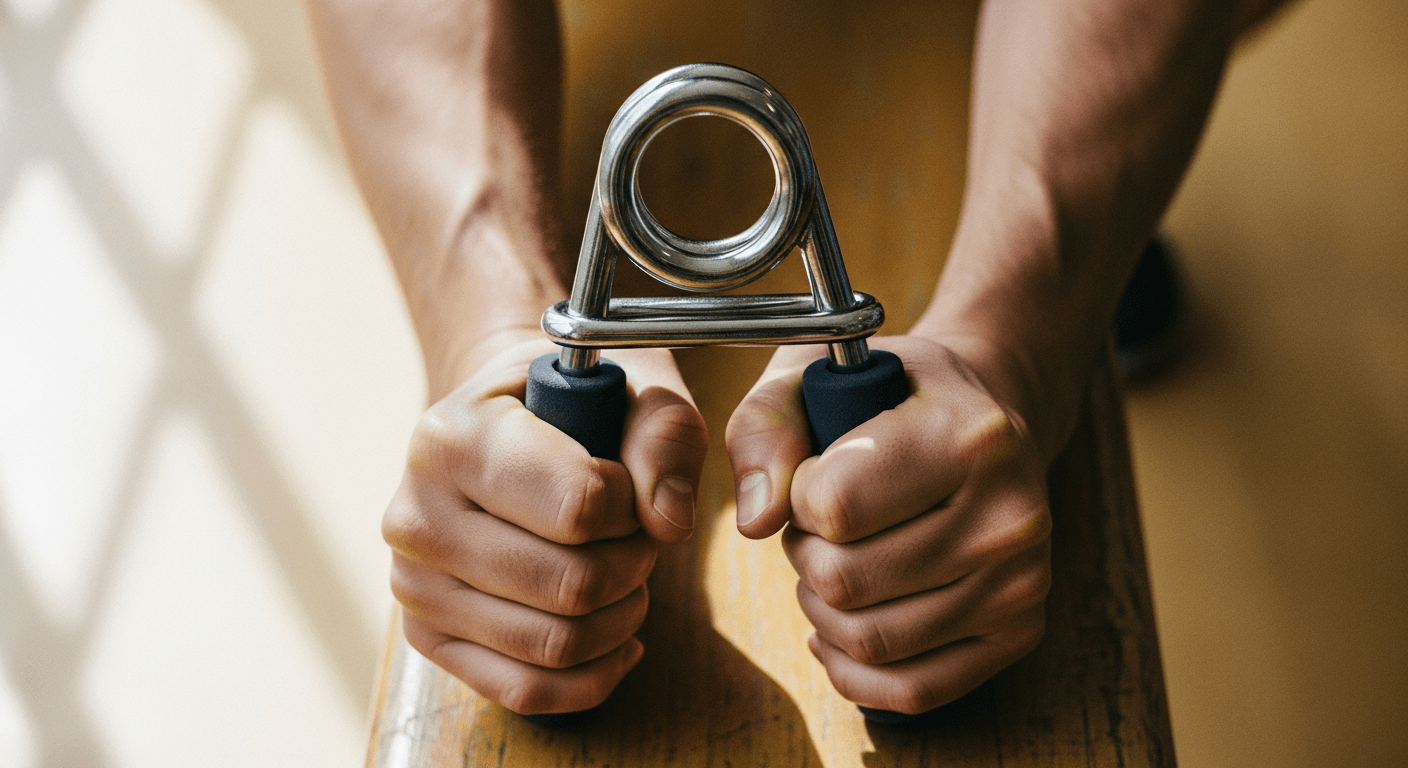
Your grip might be the most underrated number in your entire fitness profile. Not your VO2 max, not your body fat percentage. How hard you can squeeze and how fast you can stand up from a chair are turning out to be two of the strongest predictors of long-term health that researchers have found to date.
A large-scale study tracking over 5,000 women across multiple years found that grip strength and chair-stand performance were strongly associated with cardiovascular health, bone density, and all-cause mortality risk. These aren't obscure lab metrics. You can test both of them today, in your living room or at the gym, in under two minutes combined.
Why These Two Tests Matter More Than You Think
Grip strength is a proxy for overall musculoskeletal health. It reflects the integrity of your tendons, your neuromuscular efficiency, and your lean mass. When grip declines, it often signals broader systemic decline happening well before symptoms appear.
Chair-stand speed tests lower-body strength and power, but also coordination, balance, and the nervous system's ability to recruit muscle fibers quickly. Both markers degrade with age, but they also respond to training. That's the part worth paying attention to.
Research consistently places low grip strength in the same risk category as high blood pressure and smoking when it comes to predicting early death. That's not alarmist framing. That's what the data shows. The good news is that both scores are trainable at any age, and the exercises that move the needle are already staples of effective strength programs.
The 30-Second Chair Stand Test: How to Do It Right
This test is straightforward. You need a standard chair with a seat height of about 17 inches, placed against a wall so it won't slide. Sit in the middle of the seat with your back straight, arms crossed over your chest. Set a timer for 30 seconds.
When the timer starts, stand fully upright and sit back down as many times as you can. No using your arms. No momentum from bouncing. Full extension at the top counts as one rep. Count every complete stand you finish before the timer stops.
Here's how to interpret your score against age-based norms:
- Ages 60-64: Below average is under 14 reps for women, under 14 for men. Average is 14-17. Above average is 18 or more.
- Ages 65-69: Below average is under 12 reps for women, under 13 for men. Average is 12-16. Above average is 17 or more.
- Ages 70-74: Below average is under 11 reps for women, under 12 for men. Average is 11-15. Above average is 16 or more.
- Under 60: If you're in your 40s or 50s, aim for at least 20 reps as a strong baseline. Anything under 15 warrants attention regardless of how good you feel otherwise.
If you scored lower than you expected, don't treat it as a verdict. Treat it as a baseline. That number will move with the right training stimulus, and it moves faster than most people expect.
How to Measure Grip Strength Without a Lab
The gold standard is a hand dynamometer. Commercial models designed for clinical or gym use typically cost between $30 and $80 and give you a reading in kilograms or pounds of force. Squeeze with your dominant hand, elbow at 90 degrees, three attempts, take the best score.
If you don't have a dynamometer, a bathroom scale works as a rough proxy. Place it against a wall at mid-thigh height. Grip the sides and squeeze as hard as you can for three seconds. It's not perfectly calibrated for this use, but it gives you a directional number to track over time.
Here's what the research-backed score ranges look like for a hand dynamometer:
- Women: Under 20 kg is associated with significantly elevated health risk. 20-29 kg is acceptable. 30 kg and above reflects strong functional capacity.
- Men: Under 26 kg is associated with elevated risk. 26-35 kg is acceptable. 36 kg and above reflects strong functional capacity.
- Elite or competitive strength athletes often score above 50 kg for men and 35 kg for women, but you don't need to chase those numbers for health outcomes. Getting above the threshold is the priority.
Grip strength also interacts closely with recovery. Your grip is one of the first things to suffer when you're under-recovered or overreached. If your scores start dropping unexpectedly, it's worth checking in on sleep, stress load, and training volume before adding more intensity. Recovery gadgets vs. the basics: what to prioritize breaks down what actually moves the needle on recovery without overcomplicating it.
The Exercises That Move Both Numbers
You don't need a separate grip program or a dedicated chair-stand protocol. The exercises below directly train the physical qualities both tests measure, and they integrate cleanly into any existing strength routine.
Deadlifts
The deadlift is the single most effective exercise for developing the posterior chain strength and grip endurance that underpin both tests. Use a double overhand grip without straps as often as possible. Your grip will become the limiting factor before your back does, and that's exactly what you want. Train it there.
Start with conventional or Romanian deadlifts at moderate loads. Aim for three to four sets of five to eight reps two times per week. As you get stronger, your chair stand numbers will follow because hip extension power is central to both movements.
Farmer Carries
Pick up two heavy dumbbells or kettlebells and walk. That's the whole exercise. Farmer carries build grip endurance, shoulder stability, core rigidity, and loaded walking capacity simultaneously. They're also one of the most transferable exercises to real-world functional strength.
Use a load that challenges you within 30-40 meters. Carry for distance or time, two to three sets per session. Progress by increasing load or distance over time. If you want to understand why strength training produces such broad benefits beyond aesthetics, weight training beats every other fat loss method covers the underlying mechanisms in detail.
Goblet Squats
The goblet squat trains quad and glute strength in the same pattern the chair stand test demands, with the added benefit of teaching you to keep your torso upright and your knees tracking correctly. Hold a dumbbell or kettlebell at chest height and squat to full depth.
Three to four sets of ten to fifteen reps work well here. As you progress, shift to front squats or barbell back squats for greater loading potential. The key adaptation you're building is the ability to control descent and drive through the floor forcefully, which is exactly what the chair stand test scores.
Barbell Rows
Pulling movements train the same muscular structures grip strength tests measure. Bent-over barbell rows load the forearms, hands, and upper back in a way that translates directly to dynamometer performance. They also reinforce the hip hinge mechanics that carry over to deadlift performance and posterior chain resilience.
Use a pronated grip, keep your torso roughly parallel to the floor, and pull the bar to your lower sternum. Three to four sets of six to ten reps is a solid working range. Avoid using straps during this exercise specifically so your grip is doing the work.
Building These Tests Into Your Training Routine
Run both tests on a fresh day, before your workout, not after. Testing when fatigued produces unreliable baselines. Retest every eight to twelve weeks. You don't need to test more frequently than that. The adaptations you're chasing take time to consolidate.
If your chair stand score is lagging behind your grip, prioritize goblet squats and split squats in your program. If your grip is the weak point, add a dedicated farmer carry day and stop using straps on all pulling work. Let the test results direct your training emphasis rather than guessing.
The nervous system plays a significant role in both tests, particularly in how efficiently your muscles fire under load. Training your nervous system like a muscle actually works, and understanding that layer adds another dimension to why these exercises produce results beyond just hypertrophy.
Nutrition matters here too, especially protein intake. Grip strength is closely tied to lean mass, and lean mass requires adequate protein to build and maintain. If you're finding it difficult to hit protein targets consistently, protein bar alternatives that cost half as much and actually work offers practical options that don't rely on expensive supplements.
The Bigger Picture
Grip strength and chair-stand speed aren't fitness vanity metrics. They're physiological signals about how your body is aging at the structural and neuromuscular level. The 5,000-woman study that brought these markers into wider focus isn't unique. Dozens of independent studies across different populations and age groups point to the same conclusion: people who maintain grip strength and lower-body power age better, get sick less often, and recover faster when they do.
You now have a number. You have a target. And you have the four exercises that build toward both. The rest is consistency and honest retesting every few months. Start this week. Your future self will have the grip to prove it.