
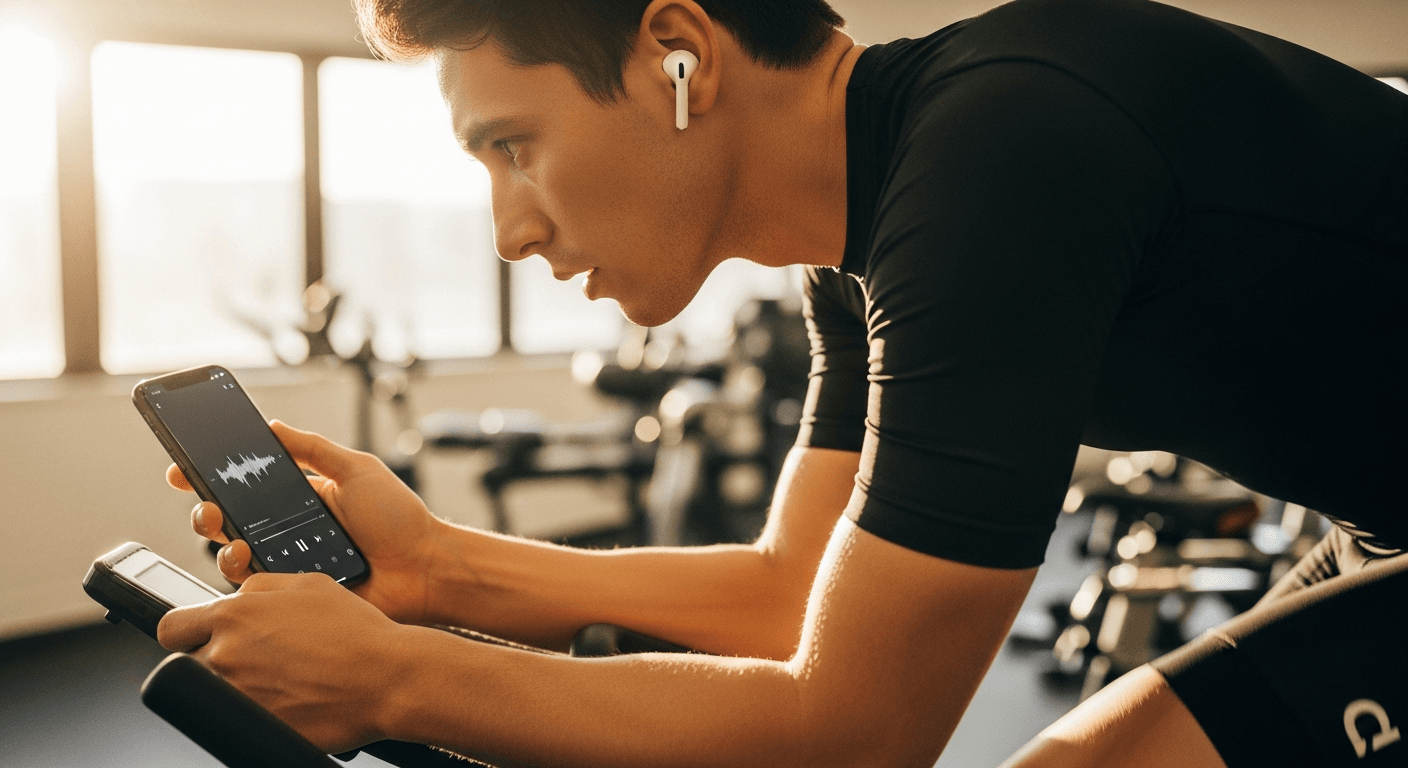
You probably already train with headphones in. But there's a good chance you're not getting as much out of your playlist as you could. A recent study on cyclists revealed something straightforward and immediately useful: listening to self-selected favorite music during exercise extended endurance performance by nearly 20%, with no increase in how hard the effort felt. That's a meaningful edge, and it costs nothing.
The difference between a good training session and a great one often comes down to variables you can control. Music turns out to be one of the most underestimated of them.
What the Research Actually Found
The study followed cyclists performing sustained aerobic efforts under three conditions: self-selected favorite music, researcher-assigned music, and silence. The group that trained with their own chosen tracks lasted significantly longer before reaching exhaustion, with the endurance gap landing close to 20% compared to the silence group.
What made the result striking wasn't just the duration increase. It was the fact that participants reported no higher perceived exertion during those longer efforts. In other words, riding nearly 20% longer felt no harder than stopping earlier. The body was working more, but the brain wasn't registering additional strain.
That gap between objective output and subjective effort is where music does its real work.
Why Self-Selected Music Is the Key Variable
Not all music produced the same effect. The cyclists who listened to tracks chosen for them by researchers didn't see the same performance gains. The endurance boost was tied specifically to music the participants had identified as their personal favorites, not just tracks with a strong beat or a fast tempo.
This distinction matters a lot practically. Generic workout playlists, algorithmically generated mixes, and curated "gym hits" compilations might provide some benefit, but they appear to fall short of what personally meaningful music delivers. The emotional connection you have to specific songs seems to be a core part of the mechanism.
Researchers have proposed several explanations. Familiar, loved music appears to reduce the brain's focus on bodily discomfort, increase motivation through emotional arousal, and create positive associations that override fatigue signals. When you hear a track that genuinely moves you, your brain interprets the physical challenge differently.
This is consistent with broader findings in exercise psychology, where attentional dissociation plays a central role. Music shifts your focus away from internal cues like burning muscles or labored breathing, and that shift translates directly into sustained output.
This Isn't Just About Cycling
The study used cycling as its testing ground because it offers a controlled, measurable format. But the underlying mechanism applies across virtually any sustained physical effort.
If you're running, rowing, doing a long set of accessory lifts, or pushing through a demanding cardio circuit, your perceived exertion is shaped in part by what your brain is processing in the moment. Music, specifically music you care about, consistently redirects that processing in your favor.
The effect is most pronounced during moderate to high-intensity steady-state efforts, where the mental component of endurance becomes as limiting as the physical one. High-intensity interval work with very short bursts may show less benefit simply because the efforts are brief enough that mental attrition isn't the limiting factor. But for any session lasting more than a few minutes of sustained output, the music variable is relevant.
If you've been rethinking how you structure your training after reading about why training to failure is more overrated than you think, adding a proper playlist to your session is one of the lowest-effort, highest-return adjustments you can pair with a smarter programming approach.
The Playlist Problem Most People Have
Here's the issue: most people don't actually train with their real favorites. They train with whatever playlist Spotify surfaced last week, or a mix a friend shared, or a genre-based station that's fine but not genuinely meaningful to them.
"Energetic" and "personally significant" are not the same thing. A track can have a hard-hitting drop and still do almost nothing for you emotionally. A slower song you've loved for years might push you harder than any algorithmically optimized BPM playlist ever could.
The research points clearly toward personal resonance as the active ingredient. That means building your training playlist requires a small amount of honest self-reflection, not just whatever's trending.
It's also worth noting that the effect compounds over time in a different way than most performance tools do. Because the benefit is tied to emotional connection rather than novelty, songs that have meant something to you for years may continue to deliver, unlike pre-workout supplements that often require cycling or carry diminishing returns. Speaking of supplements, the cost of performance aids is rising in ways that make free tools more relevant. Supplement supply chains are under pressure, and that's pushing prices up across the board.
How to Build a Playlist That Actually Works
This doesn't need to be complicated. The goal is a collection of tracks you genuinely love, not tracks you think you should be training to.
- Start with recall, not browsing. Before opening any streaming app, spend two minutes writing down songs that have genuinely moved you, energized you, or stuck with you over the years. Those are your anchors.
- Don't filter by genre or tempo first. Let emotional resonance guide the initial selection. You can refine the order later to match effort curves in your session.
- Build for your session length. If you're doing a 45-minute training block, you need at least 45 minutes of real favorites, not filler tracks padded around three songs you actually like.
- Sequence intentionally. Put tracks that tend to spark motivation near the start of hard segments. Save songs with the strongest emotional pull for when you'd typically fade.
- Revisit and refresh periodically. Emotional connections to music shift. A song that carried you through training six months ago might not land the same way now. Audit your playlist every few weeks.
- Avoid shuffle during key efforts. Predictability matters. Knowing a favorite is coming in 90 seconds can sustain effort through a tough interval in a way that random shuffle doesn't.
Pairing Music With Everything Else That Matters
A strong playlist extends what your body can do, but it doesn't replace the other foundations. What you eat before training shapes how much energy you have to extend in the first place. Getting your pre-training nutrition right ensures the fuel is there when the music helps you push further than you'd otherwise go.
Sleep is equally non-negotiable. If you're chronically under-recovered, even the most emotionally resonant playlist won't compensate for the deficit. Poor sleep quietly degrades performance in ways that are often mistaken for plateaus in fitness progress. The music trick works best when the biological baseline is solid.
Recovery between sessions also interacts with how far you can push each training block. What you do on rest days directly affects how much capacity you bring to the days when you're trying to extend your limits.
The Bigger Picture on Free Performance Tools
There's a pattern worth recognizing here. Some of the most reliable performance variables available to everyday gym-goers and athletes don't require a subscription, a supplement stack, or access to specialized equipment. Music is one of them.
At a moment when gym costs are under pressure across every segment of the market, from budget chains navigating financial turbulence to boutique studios managing revenue challenges, the most accessible tools deserve more credit than they typically get. Free and effective is a combination worth paying attention to.
The research on self-selected music isn't telling you to throw out your training program or rethink your exercise selection. It's telling you to take seriously a tool you already have, and to use it more deliberately than you probably do right now.
Your next session is probably within the next day or two. Before it starts, spend ten minutes building a playlist that reflects what you actually love, not what the algorithm decided was appropriate for your workout. The data suggests you'll go further, and it won't even feel like it.