
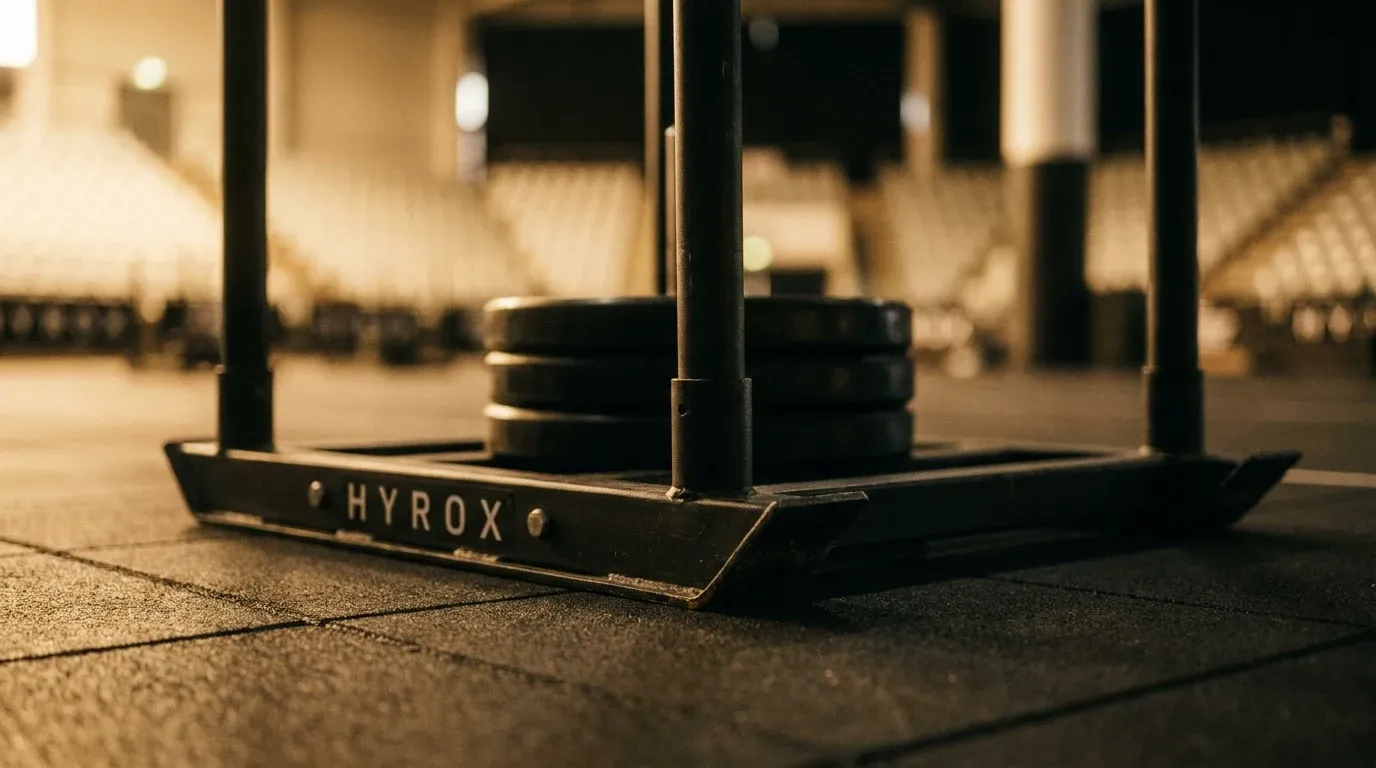
If you're building toward a HYROX race in the 2026/27 season, vague prep isn't going to cut it. The weights at every station are now confirmed, and knowing exactly what you're pushing, dragging, and carrying changes how you should be training from this point forward. This guide gives you every number, in both kilograms and pounds, across every division.
The Four Divisions and Their Total Sled Loads
Before getting into the station-by-station breakdown, it helps to anchor yourself to the headline sled numbers. These are the totals that tend to shock first-timers and remind experienced athletes why sled training deserves more than a casual mention in their weekly sessions.
- Open Women: 102 kg / 225 lb total sled weight
- Open Men: 152 kg / 335 lb total sled weight
- Pro Women: 152 kg / 335 lb total sled weight
- Pro Men: 202 kg / 445 lb total sled weight
Those totals cover both the sled push and sled pull combined. The sled itself weighs approximately 32 kg / 71 lb for the push and 32 kg / 71 lb for the pull, with plates added on top. Keep that in mind as you read the station details below. The loaded number is what your legs and lungs will argue with on race day.
Station-by-Station Weight Breakdown: All Divisions
Here's every weighted station across the 2026/27 season format, with loads listed for each division. Use this as your quick reference in the weeks leading up to your race.
Sled Push
- Open Women: 102 kg / 225 lb
- Open Men: 152 kg / 335 lb
- Pro Women: 152 kg / 335 lb
- Pro Men: 202 kg / 445 lb
Sled Pull
- Open Women: 78 kg / 172 lb
- Open Men: 103 kg / 227 lb
- Pro Women: 103 kg / 227 lb
- Pro Men: 153 kg / 337 lb
Burpee Broad Jump
No external load. Bodyweight only across all divisions. Don't let that fool you. Arriving at this station with pre-fatigued legs from the sled push and pull is where a lot of athletes start to unravel.
Rowing (1000m)
No external load. Damper setting is athlete choice. Most competitive athletes in the Pro divisions target a damper setting between 4 and 6, prioritizing stroke efficiency over raw power output.
Farmers Carry
- Open Women: 2 x 16 kg / 2 x 35 lb (total 32 kg / 70 lb)
- Open Men: 2 x 24 kg / 2 x 53 lb (total 48 kg / 106 lb)
- Pro Women: 2 x 24 kg / 2 x 53 lb (total 48 kg / 106 lb)
- Pro Men: 2 x 32 kg / 2 x 71 lb (total 64 kg / 141 lb)
Sandbag Lunges
- Open Women: 10 kg / 22 lb
- Open Men: 20 kg / 44 lb
- Pro Women: 20 kg / 44 lb
- Pro Men: 30 kg / 66 lb
Wall Balls
- Open Women: 4 kg / 9 lb to a 9 ft target
- Open Men: 6 kg / 13 lb to a 10 ft target
- Pro Women: 6 kg / 13 lb to a 10 ft target
- Pro Men: 9 kg / 20 lb to a 10 ft target
Wall balls are completed for 100 reps. At the Pro Men standard, 100 reps with a 9 kg ball at height represents a meaningful muscular endurance challenge, particularly when you've already covered six kilometers of running and five prior stations.
SkiErg (1000m)
No external load. Like the row, this is an output-based station where pacing strategy and technique matter more than raw strength. Athletes who treat this as a sprint typically pay for it at the sled push.
Assault Bike or Echo Bike (varies by venue)
No external load. Reps or calories are set by the event format for that venue. Confirm with the specific race you're entering, as not all venues use this station.
What These Numbers Mean If You're Moving Up a Division
If you're transitioning from Open Women to Pro Women, or from Open Men to Pro Men, the weight jump is substantial. Pro Women take on the same sled loads as Open Men: 152 kg on the push, 103 kg on the pull. That's a 50 kg / 110 lb increase on the sled push alone compared to Open Women.
For athletes moving from Open Men to Pro Men, the sled push goes from 152 kg to 202 kg. That's an additional 50 kg / 110 lb loaded onto a platform you're already driving through 50 meters of track. The difference isn't just strength. It's the cumulative cost of moving more weight across a full race that tends to destroy pacing plans.
This is why understanding whether HYROX is more about running than strength matters so much before you decide to compete at a higher level. The data suggests that both components are genuinely load-bearing on your final time, and moving up a division tests both simultaneously.
How to Structure Strength Sessions Around These Weights
Knowing your exact weights transforms your final four to eight weeks of preparation from generic training into targeted rehearsal. Here's how to apply the numbers practically.
Train at race weight, not above it. A common mistake is overloading the sled in training to feel prepared. What you actually need is to move race weight fast and repeatedly, with short recoveries that simulate the run-station-run pattern. Load the sled to your exact competition weight and work on speed, not heavier plates.
Sequence your stations. Don't train sled push in isolation on fresh legs and call it race prep. Pair it after a hard rowing interval or a 1 km tempo run. The fatigue pattern matters. Your body needs to learn how to recruit force when it's already carrying aerobic debt.
Program wall balls late in sessions. Doing 100 wall ball reps fresh is a different physiological task than doing them after five stations of a HYROX race. If your weekly structure includes wall balls, move them toward the end of training sessions so you're practicing under accumulated fatigue. A structured seven-day training approach can help you distribute this kind of station-specific work without overloading any single day.
Don't neglect grip and carry work. The farmers carry at Pro Men loads (2 x 32 kg / 2 x 71 lb) over 200 meters is a grip and postural endurance challenge as much as a strength one. Build this into your training with loaded walks two to three times per week in the final month, increasing distance progressively.
Account for recovery between heavy sessions. If you're pushing 202 kg sleds mid-week, your nervous system needs adequate turnaround time before you load it again. Recovery strategies drawn from elite team sport training are increasingly applicable here. High-load, high-output athletes in other disciplines have shown that managing recovery quality is as trainable as managing output.
For athletes newer to the sport who are still building base fitness, structured periodization matters more than raw load. A 12-week beginner training plan gives you a sensible progression to get comfortable with the movement patterns before intensity and race-specific weights become the focus.
The Easy Running You Shouldn't Skip
Between heavy strength sessions and station rehearsals, your easy running volume is doing critical work. HYROX athletes tend to undervalue this and end up aerobically undertrained for an event where you'll run eight kilometers across the course of a race.
Research consistently supports the role of low-intensity aerobic work in building the oxidative base that lets higher-intensity efforts feel more manageable. The case for running at a genuinely easy pace is stronger than most strength-focused athletes want to accept. If your easy runs feel almost too slow, you're probably in the right zone.
A Final Word on Race-Day Application
Print this breakdown and put it somewhere you'll see it during training. Not because memorizing weights is the point, but because training blind, without a precise target, is the fastest way to under-prepare for what's actually waiting at the venue.
Your division's weights are the contract you're signing with race day. Build toward them with intention, use the final weeks to rehearse rather than accumulate new fitness, and arrive knowing exactly what each station demands of you.