
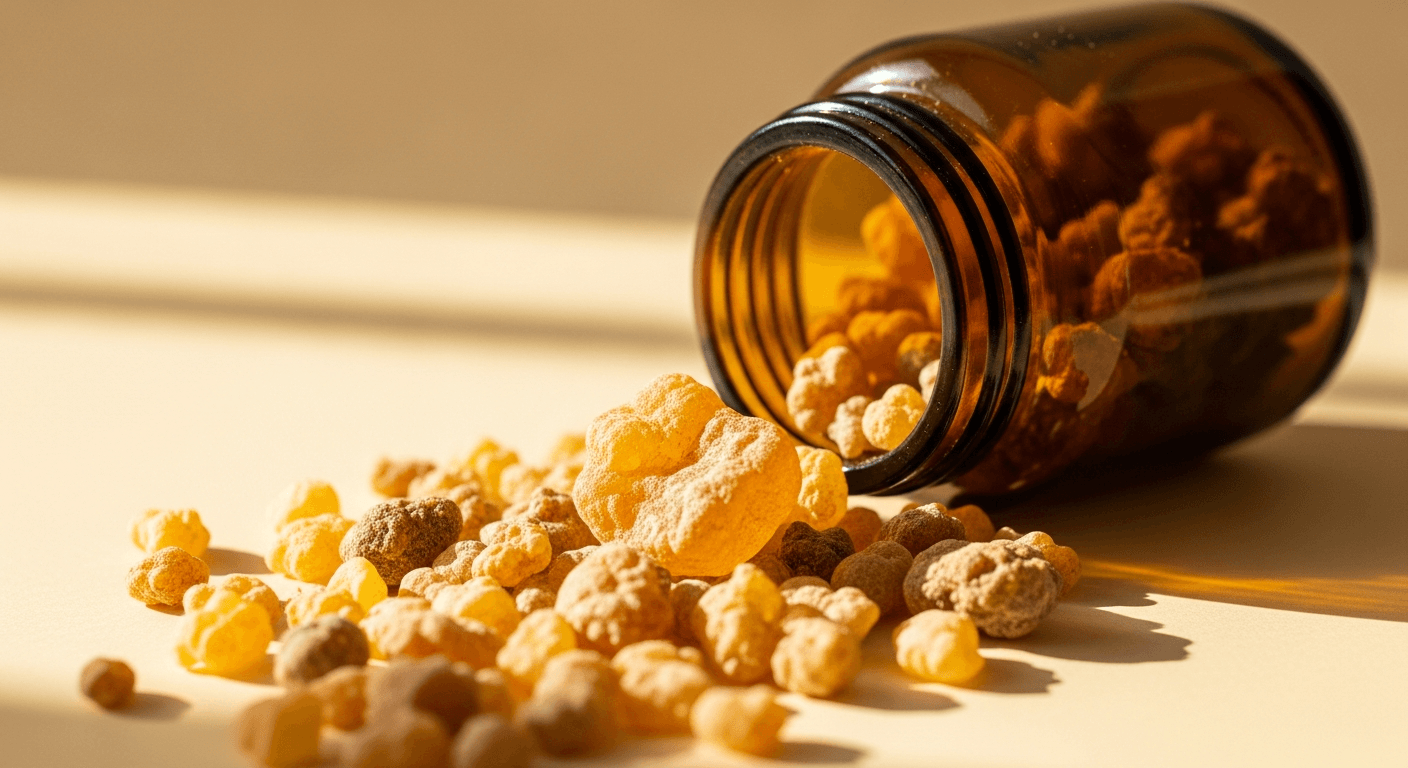
If you've spent any time researching natural anti-inflammatories, you've probably come across Boswellia serrata. It's been used in traditional Ayurvedic medicine for centuries, mostly for joint pain and inflammation. But a newer generation of standardized extracts is starting to attract serious attention from sports scientists, and for reasons that go beyond the usual herbal supplement hype.
The question worth asking right now isn't whether Boswellia has anti-inflammatory properties. That's reasonably well established. The real question is whether the evidence is strong enough to justify adding it to your recovery protocol, and whether the specific form you choose actually matters.
What Dynagenix Showed in Research
Dynagenix is a proprietary Boswellia serrata extract that has been studied specifically in the context of exercise recovery. In research involving subjects undergoing intense physical exercise, Dynagenix produced measurable reductions in muscle soreness, joint soreness, and overall stiffness compared to a placebo group.
Those are subjective outcomes, and subjective outcomes in supplement research warrant some skepticism. But the data gets more interesting when you look at the biomarker results. At 48 and 72 hours post-exercise, subjects taking Dynagenix showed significantly lower levels of C-reactive protein (CRP) and interleukin-6 (IL-6) compared to placebo. Both are well-established markers of systemic inflammation, and both are routinely elevated after intense training sessions.
The 72-hour window is particularly relevant. That's the timeframe when delayed-onset muscle soreness (DOMS) typically peaks, and when many athletes find their training quality suffers most. A supplement that meaningfully blunts inflammation at that point, rather than just in the immediate aftermath of exercise, has more practical value for anyone training on a frequent schedule.
How Boswellia Actually Works
The active compound behind Boswellia's anti-inflammatory effects is AKBA, short for acetyl-11-keto-beta-boswellic acid. AKBA works by inhibiting 5-lipoxygenase (5-LOX), an enzyme that drives the production of leukotrienes. Leukotrienes are inflammatory mediators that play a significant role in exercise-induced tissue stress and the cascade that follows hard training.
This is a meaningfully different mechanism from how NSAIDs like ibuprofen work. NSAIDs block COX enzymes and reduce prostaglandin synthesis, which is effective but comes with well-documented gastrointestinal risks, including stomach lining irritation and, with regular use, more serious GI complications. AKBA's 5-LOX inhibition targets a different branch of the inflammatory pathway, which is why Boswellia doesn't carry the same GI risk profile.
That distinction matters if you're considering using an anti-inflammatory regularly as part of your training cycle. Chronic NSAID use is genuinely problematic for athletes who already stress their GI tract through training and nutrition demands. Research on gut health and athletic performance consistently shows that intestinal integrity is a meaningful performance variable, not just a comfort issue. Anything that avoids adding pressure to that system is worth considering.
Why the Extract Form Matters More Than You Think
Here's where a lot of people get caught out with Boswellia. Not all extracts are created equal, and the difference isn't trivial. AKBA is present in raw Boswellia resin, but typically at low concentrations, often under 5% in standard extracts. For meaningful 5-LOX inhibition, you need a product standardized to a higher AKBA percentage.
The supplement market is full of Boswellia products that list impressive-sounding milligram doses but offer no standardization data on AKBA content. You could take 500mg of a low-AKBA extract and deliver a fraction of the active compound found in a smaller dose of a properly standardized product.
Dynagenix addresses this by using a process that concentrates AKBA to levels significantly higher than conventional extracts. That's not a minor formulation detail. It's the difference between a product that has theoretical plausibility and one that can produce the biomarker changes seen in clinical testing. When you're evaluating any Boswellia supplement, standardized AKBA content is the first spec you should look for on the label.
Where Boswellia Fits in Your Recovery Stack
It would be a mistake to treat Boswellia as a standalone recovery solution. The evidence supports it as a useful complement to a well-structured recovery protocol, not as a replacement for the fundamentals.
Protein intake remains the non-negotiable foundation of muscle repair. Recent updated guidelines targeting 1.2 to 1.6 grams of protein per kilogram of body weight reflect a growing consensus that most active people are under-eating protein relative to their training demands. No anti-inflammatory supplement compensates for insufficient amino acid availability during the recovery window.
Sleep is similarly irreplaceable. The bulk of muscle protein synthesis, growth hormone release, and tissue repair occurs during deep sleep, not in the hour after your workout. Active recovery modalities, including movement, mobility work, and soft tissue work, also contribute meaningfully. Research on massage therapy for recovery shows real benefits for reducing perceived soreness and improving tissue quality over time.
Where Boswellia earns its place is in filling a specific gap: managing the inflammatory load between training sessions, particularly during high-volume blocks or competition phases where you're training through residual soreness. It's also worth considering for athletes who train multiple times per day or back-to-back days, where systemic inflammation can accumulate faster than the body can naturally clear it.
A well-built recovery routine layers these inputs logically. Boswellia sits alongside other targeted supplements, not above protein, sleep, and structured rest.
What the Evidence Does and Doesn't Support
Let's be direct about the limitations. Most of the research on Dynagenix specifically involves relatively short trial durations. Longer-term data on whether the anti-inflammatory benefits persist, plateau, or diminish over months of continuous use is still limited. The research populations studied are also not always directly comparable to elite athletes or specific training modalities.
There's also the question of timing and dosing optimization. The research points to consistent daily dosing rather than acute pre-workout or post-workout supplementation. Boswellia doesn't appear to work as a one-time intervention the way something like caffeine does. The biomarker reductions seen at 48 and 72 hours reflect a systemic effect built through regular use, not a single dose response.
It's also worth noting that inflammation is not purely the enemy in training. Acute inflammation is part of the adaptive signaling that drives strength and hypertrophy gains. Suppressing it entirely would be counterproductive, which is one reason why high-dose NSAID use around training is actually associated with blunted muscle adaptation in some research. Boswellia's more targeted mechanism and moderate effect size may actually make it better suited to the recovery context than a blunt pharmacological intervention.
Practical Considerations Before You Buy
If you decide Boswellia is worth testing in your own protocol, a few things are worth keeping in mind.
- Check for AKBA standardization. Look for products that explicitly state AKBA percentage. Anything below 10% is unlikely to match the efficacy seen in clinical research on enhanced extracts.
- Expect a ramp-up period. The evidence suggests consistent daily use over several weeks before full benefits are apparent. Don't evaluate it after three days.
- Stack it thoughtfully. If you're also using strategic protein timing and other evidence-based recovery tools, Boswellia adds an additional layer. It doesn't simplify a poorly structured protocol.
- Talk to a healthcare provider if you're on medication. Boswellia has a favorable safety profile in general healthy adults, but it has potential interactions with anticoagulants and some anti-inflammatory medications.
- Price check realistically. Quality standardized Boswellia extracts typically run $30 to $60 per month in the US market. Products at the lower end of that range are worth scrutinizing more carefully for standardization claims.
The Bigger Picture on Recovery Nutrition
Recovery nutrition is evolving quickly. The idea that you just need protein and rest is being supplemented by a more nuanced understanding of how inflammatory signaling, gut integrity, sleep quality, and targeted bioactives interact. As recent thinking in applied sports nutrition has made clear, the marginal gains available through smart supplementation are real, but they only show up when the foundational work is already in place.
Boswellia, particularly in a standardized, high-AKBA form like Dynagenix, represents a credible option for athletes who want a non-NSAID approach to managing exercise-induced inflammation. The biomarker data is meaningful, the mechanism is well understood, and the safety profile is strong relative to pharmaceutical alternatives.
It won't transform your recovery on its own. But for athletes training at high frequency or high intensity, reducing the inflammatory burden between sessions by a meaningful margin isn't nothing. That's exactly the kind of incremental edge that compounds over a training season.