
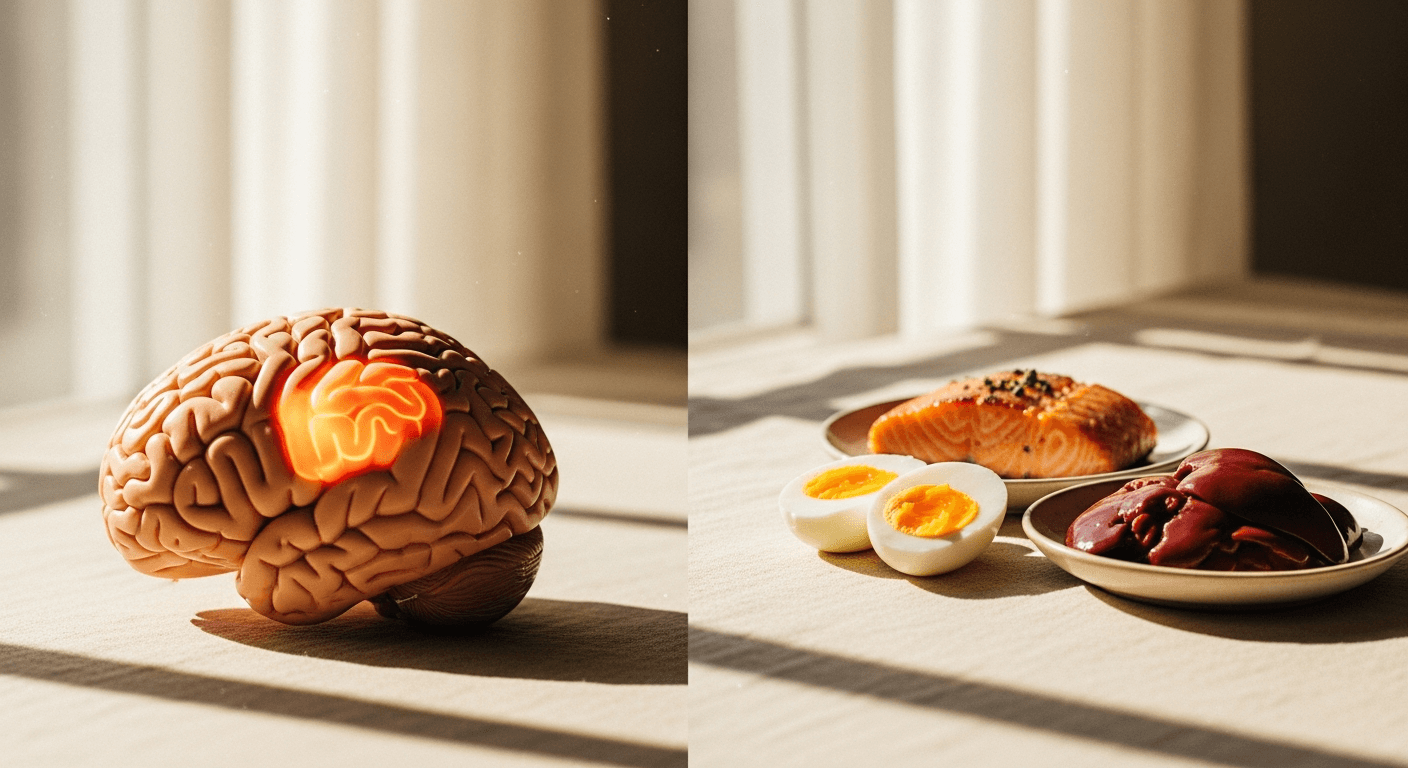
Most conversations about anxiety circle back to the usual suspects: sleep, stress, therapy, maybe medication. Nutrition rarely gets a seat at the table. That may be about to change, at least where one underappreciated nutrient is concerned.
A large-scale brain scan analysis has found that people with anxiety disorders show significantly lower levels of choline in the prefrontal cortex compared to people without anxiety. It's a finding that opens a serious question: could what you eat be shaping how anxious your brain becomes?
What the Brain Scans Actually Found
The research used magnetic resonance spectroscopy, a neuroimaging technique that measures the concentration of specific metabolites inside the brain, without any injection or invasive procedure. Across a substantial sample of participants diagnosed with anxiety disorders, choline-containing compounds in the prefrontal cortex were measurably and consistently lower than in healthy controls.
That's not a minor regional quirk. The prefrontal cortex is the brain's executive center. It governs emotional regulation, decision-making, threat assessment, and the ability to put the brakes on fear responses. When this region is functioning well, you can recognize that a worry is disproportionate and dial it back. When it's impaired, that capacity weakens.
Lower choline in this region therefore isn't just a chemical footnote. It points to a potential structural and functional gap in one of the brain areas most critical to managing anxiety. Researchers describe it as a meaningful deficit, not background noise.
Why Choline Matters in the Brain
Choline is an essential nutrient, meaning the body can synthesize some of it, but not nearly enough to meet its own needs. You have to get most of it from food. It plays several roles simultaneously: it's a precursor to acetylcholine, one of the brain's primary neurotransmitters, involved in memory, muscle control, and mood regulation. It's also a critical component of cell membrane structure throughout the nervous system.
In the prefrontal cortex specifically, choline availability appears to influence how neurons communicate and how efficiently the region can modulate emotional responses. Low choline doesn't shut the region off. But it may reduce its operational efficiency in ways that are clinically relevant.
This connects to broader emerging work on how nutritional status affects brain chemistry. Similar mechanisms have been explored with B vitamins and neurotransmitter production. If you're curious about related research in this area, the recent findings around Vitamin B3 and immunity illustrate how a single micronutrient can have wide-ranging systemic effects that weren't previously anticipated.
Most People Aren't Getting Enough Choline
Here's where it gets practically relevant. The adequate intake for choline is 425 mg per day for adult women and 550 mg per day for adult men, according to the National Institutes of Health. Studies consistently show that the majority of adults in the US, UK, Canada, and Australia fall short of these targets. Estimates suggest fewer than 10% of Americans meet the recommended intake on a daily basis.
That gap matters more now given the new brain data. It's one thing to be deficient in a nutrient that affects energy or skin health. It's another to be deficient in one that may be connected to your brain's capacity to regulate fear and stress.
Choline deficiency is also easy to miss because it doesn't announce itself with dramatic symptoms. Fatigue, muscle aches, and cognitive fog are all associated with low choline, but these are nonspecific enough that they rarely prompt anyone to investigate their choline intake.
The Best Dietary Sources of Choline
The good news is that choline is found in concentrated amounts in a handful of widely available foods. The challenge is that many modern dietary patterns deprioritize exactly these foods.
- Eggs: One of the richest sources available. A single large egg contains roughly 147 mg of choline, almost entirely in the yolk. Two eggs at breakfast gets you more than halfway to the daily target for women.
- Beef liver: The most concentrated single source. A 3-ounce serving contains around 356 mg. It's not a staple for most people, but even occasional consumption makes a significant difference.
- Salmon: A 3-ounce serving provides approximately 187 mg of choline, alongside omega-3 fatty acids that independently support brain health.
- Soybeans: The strongest plant-based source. A half-cup of roasted soybeans delivers around 107 mg. Edamame and soy milk also contribute, though in smaller amounts.
- Chicken breast: A 3-ounce serving offers about 72 mg, making it a useful contributor even if it's not as dense as eggs or liver.
- Cruciferous vegetables: Brussels sprouts, broccoli, and cauliflower contain modest amounts of choline and are worth including, especially for those eating less meat.
If you follow a plant-based diet, hitting adequate choline intake requires deliberate planning. Eggs and liver are absent by default, and the plant sources, while valuable, require larger volumes to reach the same totals. This doesn't make a vegan or vegetarian diet incompatible with good choline status, but it does mean you have to pay attention to it.
What the Research Doesn't Say
This is where it's worth being direct, because this kind of research is frequently misread in ways that lead people toward unnecessary or ineffective choices.
The brain scan data shows an association between lower prefrontal choline levels and anxiety disorders. It does not prove that low choline causes anxiety. It does not prove that raising choline levels through diet or supplements will reduce anxiety. These are related but distinct claims, and the research hasn't established the latter two yet.
Anxiety is a complex condition shaped by genetics, life experience, neurological factors, hormonal patterns, and social environment. No single nutrient fixes it. If you're managing anxiety disorder, the evidence-based interventions remain cognitive behavioral therapy, appropriate medication when indicated, regular physical activity, sleep hygiene, and in some cases structured stress management practices. Nutrition can support that framework. It doesn't replace it.
On that note, approaches like training your stress response like a muscle have a growing body of support behind them, and they work alongside, not instead of, good nutritional habits.
Should You Take a Choline Supplement?
The supplement market will almost certainly move faster than the science here. Choline supplements, including choline bitartrate, CDP-choline, and alpha-GPC, are already widely sold and marketed toward cognitive performance and mood support.
The current evidence does not support taking a choline supplement specifically to treat or prevent anxiety. There are no large randomized controlled trials demonstrating that supplemental choline reduces anxiety symptoms in people with anxiety disorders. The brain scan data is compelling enough to warrant further research. It's not compelling enough yet to justify a clinical recommendation for supplementation.
If your diet is genuinely low in choline-rich foods and you're eating a highly restrictive dietary pattern, discussing supplementation with a registered dietitian makes sense as a general nutritional precaution. But buying a choline supplement because you read about this study and hoping it calms your nervous system is getting well ahead of what the data actually supports.
It's also worth remembering that excess choline isn't harmless. Very high intakes, typically above 3,500 mg per day, are associated with a fishy body odor, low blood pressure, and potential cardiovascular effects. Staying within the adequate intake range from food is the sensible target for most people.
Where This Research Points Next
Researchers are cautiously optimistic that nutritional psychiatry, the field examining how diet influences mental health outcomes, is approaching a more rigorous phase. The choline findings add to a growing body of work suggesting that brain chemistry is more sensitive to nutritional status than clinical practice has historically acknowledged.
Anxiety rates remain high across the US, UK, Canada, and Australia, with no signs of meaningful population-level decline. If nutritional interventions can eventually be shown to reduce risk or severity, even modestly, the public health implications are significant given how accessible food-based changes are compared to pharmaceutical interventions.
The next steps will involve intervention trials: giving people with anxiety and documented low choline a structured dietary protocol or supplement regimen, then measuring whether prefrontal choline levels rise and whether symptoms improve. That work is underway in several research centers, but results are years away.
For now, the most reasonable takeaway is this: choline is an essential nutrient that most people aren't getting enough of, it appears to matter for prefrontal brain function, and eating more eggs, salmon, or soy is a low-risk, evidence-adjacent step that supports overall brain health regardless of where the anxiety research lands.
That's not a cure. It's a starting point, and an honest one. If you're looking at your broader health picture, nutritional adequacy in areas like choline, electrolyte balance, and key micronutrients all feed into how your body and brain perform under pressure. The full picture matters. Looking at how other nutrients affect performance and recovery, as covered in the research on daily creatine use, is a good reminder of how nuanced these conversations always end up being.