
Walk into any supplement store in 2026 and you'll find creatine in a dozen forms. Creatine HCl. Buffered creatine. Peptide-creatine combos promising faster absorption and better pumps. The shelves have never looked more complicated. The science, however, has barely changed. And that's actually a good thing.
Key Takeaways
- Creatine monohydrate remains the most effective form despite marketing around 'next-gen' versions
- Claims about creatine HCL, buffered, or liquid forms lack solid scientific evidence
- 3-5 g of creatine monohydrate per day is the only protocol validated by the literature
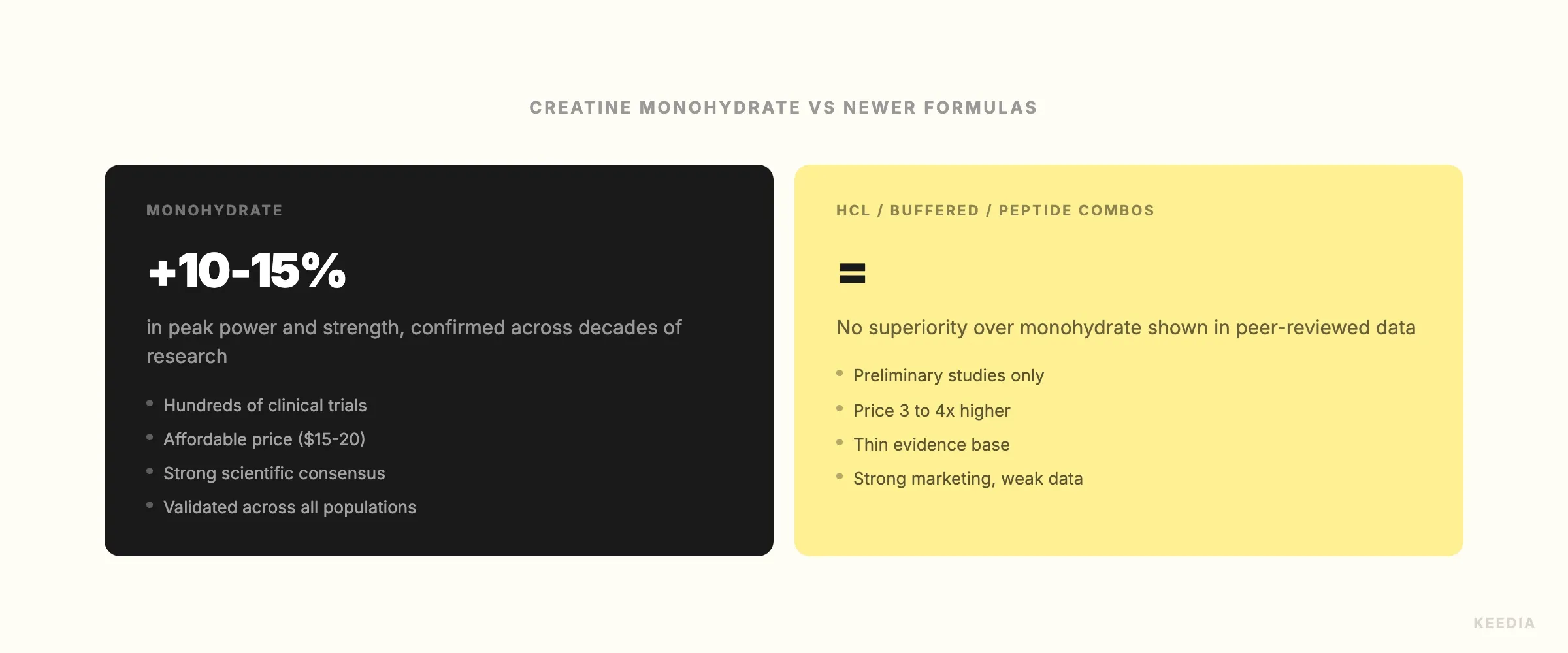
Creatine monohydrate remains the most studied performance supplement in history. Decades of peer-reviewed research consistently show 10 to 15% improvements in maximal power and strength output. No other supplement comes close to that evidence base. So before you pay a premium for the latest formulation, here's what the research actually supports.
How Creatine Works (and Where It Actually Helps)
Creatine works by replenishing phosphocreatine stores in your muscles, which your body uses to regenerate ATP. ATP is the immediate energy currency for short, explosive efforts. This is the key detail most marketing skips over: creatine doesn't benefit all types of exercise equally.
The performance benefit is most consistent in repeated short bursts of high-intensity effort. Think sprint intervals, heavy strength sets, HIIT circuits. If your training is primarily steady-state cardio, long-distance running, or low-intensity movement, the performance upside is minimal. Knowing this helps you decide whether creatine is actually relevant to how you train, rather than buying it because everyone else does.
This is also why creatine pairs so well with structured strength work. If you're following a program built around progressive overload, as outlined in Strength Training: The Minimum Effective Dose for Real Progress, creatine supports exactly the type of repeated high-intensity efforts that drive adaptation.
The Benefits Most Fitness Marketing Ignores
Younger male athletes dominate the creatine advertising. That demographic reflects old marketing logic, not the current research. The science in recent years has been expanding in ways that matter far beyond the average gym-goer in their twenties.
Older adults may have the most to gain. Research consistently links creatine supplementation in people over 55 with improvements in muscle preservation, functional strength, and bone density markers. Sarcopenia, the progressive loss of muscle mass with age, is one of the most significant health risks in aging populations. Creatine doesn't reverse it, but the data supporting its role as part of a resistance training protocol is solid enough to take seriously.
Women are also underrepresented in the marketing despite being well-represented in the research. Studies show women respond to creatine similarly to men in terms of strength and power output, and the muscle preservation data during caloric restriction is particularly relevant given how many women cycle through deficit phases. If you're managing body composition while training hard, creatine helps protect lean mass during that process.
Cognitive function is a newer area of interest. Several studies have found that creatine supplementation supports cognitive performance under conditions of stress, particularly sleep deprivation. The effect size isn't dramatic, but it's consistent. Given that sleep debt and training load often coincide, this is worth noting. The relationship between recovery, sleep, and performance is increasingly well-documented, as covered in Sleep and Athletic Performance: What the 2026 Research Actually Shows.
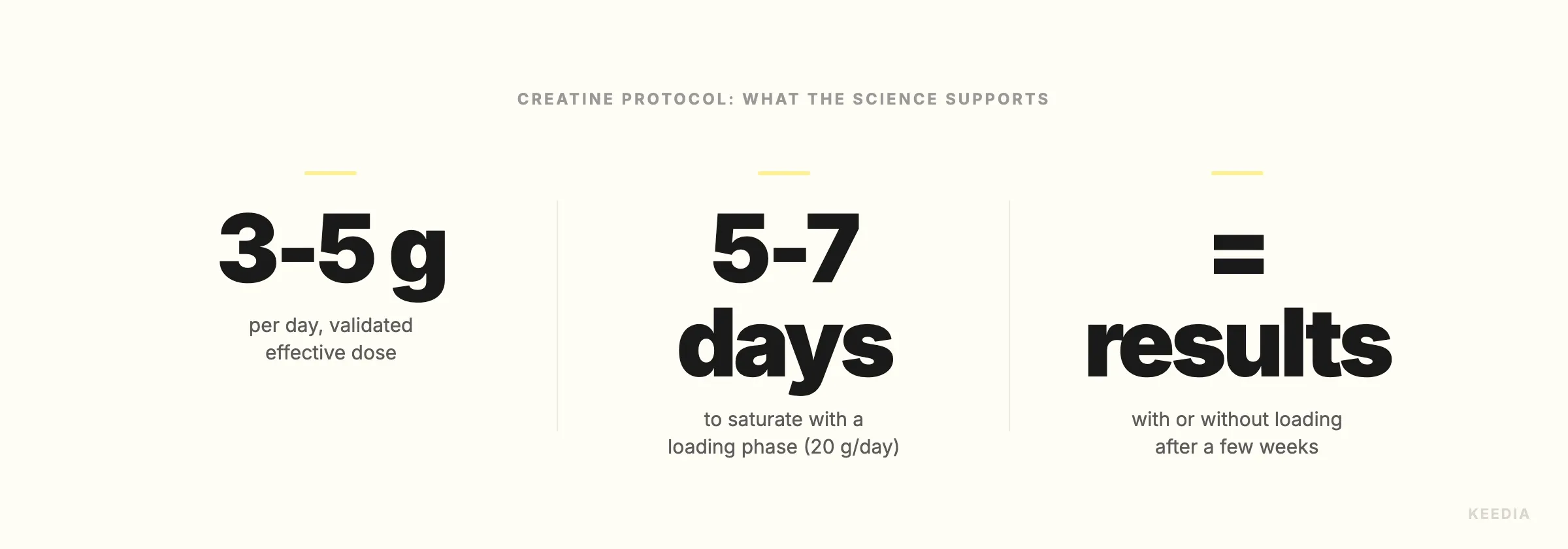
ILLUSTRATION: stat-card | Recommended dosage and muscle saturation timeline
Dosing: Simple, Consistent, Unexciting
This is the part the supplement industry doesn't want to lead with: the dosing protocol for creatine is straightforward and cheap.
- Standard dose: 3 to 5 grams per day, taken consistently
- Loading phase: 20 grams per day split across 4 doses for 5 to 7 days, followed by 3 to 5g maintenance. This saturates muscle stores faster but produces the same long-term results as simply taking 5g daily from the start
- Timing: Doesn't meaningfully matter. Pre-workout, post-workout, with food. The research shows that consistency over weeks is what produces the benefit, not the timing of any single dose
- Form: Creatine monohydrate. Plain, unflavored, inexpensive. A monthly supply costs roughly $15 to $20. No other form has outperformed it in peer-reviewed data
If you're on a GLP-1 medication and managing muscle loss during caloric restriction, creatine monohydrate is one of the more evidence-supported tools available alongside resistance training. The muscle preservation angle is covered in more depth in GLP-1 Drugs and Muscle Loss: What the 2026 Research Actually Shows.
What About the New Peptide-Creatine Combinations?
In 2026, a growing number of premium products are pairing creatine with peptide compounds, most notably PeptiStrong-based formulations. The pitch is synergistic effects on power output and recovery. The reality is more cautious.
PeptiStrong, a fava bean-derived peptide, does have early data suggesting improvements in muscle protein synthesis and power output. Some studies show promising signals. But "promising signals" from a handful of recent trials is a fundamentally different category of evidence than what creatine monohydrate has behind it. We're talking about decades of replicated research across thousands of subjects versus early-stage data that hasn't yet been independently verified at scale.
The price difference reflects the marketing premium, not the performance premium. A peptide-creatine combo product can run $60 to $80 per month. Plain monohydrate runs $15 to $20. Until the evidence base catches up, that gap is hard to justify unless you've already optimized everything else in your nutrition and training.
Worth noting: no currently available creatine formulation, including HCl, buffered versions, or ethyl ester, has demonstrated superior outcomes to monohydrate in well-controlled studies. The main selling point for HCl and buffered versions is reduced GI discomfort for sensitive users. That's legitimate for that specific use case. It's not a performance advantage.
What the Research Doesn't Support
ILLUSTRATION: comparison-table | Creatine monohydrate vs other forms: efficacy and price
Creatine doesn't directly burn fat. It doesn't directly build muscle without training stimulus. It doesn't improve endurance performance in any meaningful way. And it doesn't replace the basics: adequate protein intake, consistent training, quality sleep, and recovery.
The best supplement stack is still built on fundamentals first. Creatine is an effective addition to a solid training and nutrition foundation. It's not a substitute for one. The same principle applies whether you're tracking client outcomes as a coach or managing your own program, and it's worth applying the kind of honest performance measurement discussed in How to Actually Measure Client Progress (Beyond Weight and Performance Numbers).
The Bottom Line
Creatine monohydrate is one of the rare supplements where the evidence is clear, the cost is low, and the risk profile is well understood. Long-term use at standard doses has no documented kidney or liver risk in healthy individuals, a concern that still circulates despite being repeatedly addressed in the literature.
If your training involves high-intensity, short-duration efforts and you're not currently supplementing with creatine, the cost-benefit case is straightforward. If you're an older adult doing resistance training, the case is arguably even stronger. If you're being marketed a peptide-creatine blend for three times the price, ask for the peer-reviewed data. You'll be waiting a while.