
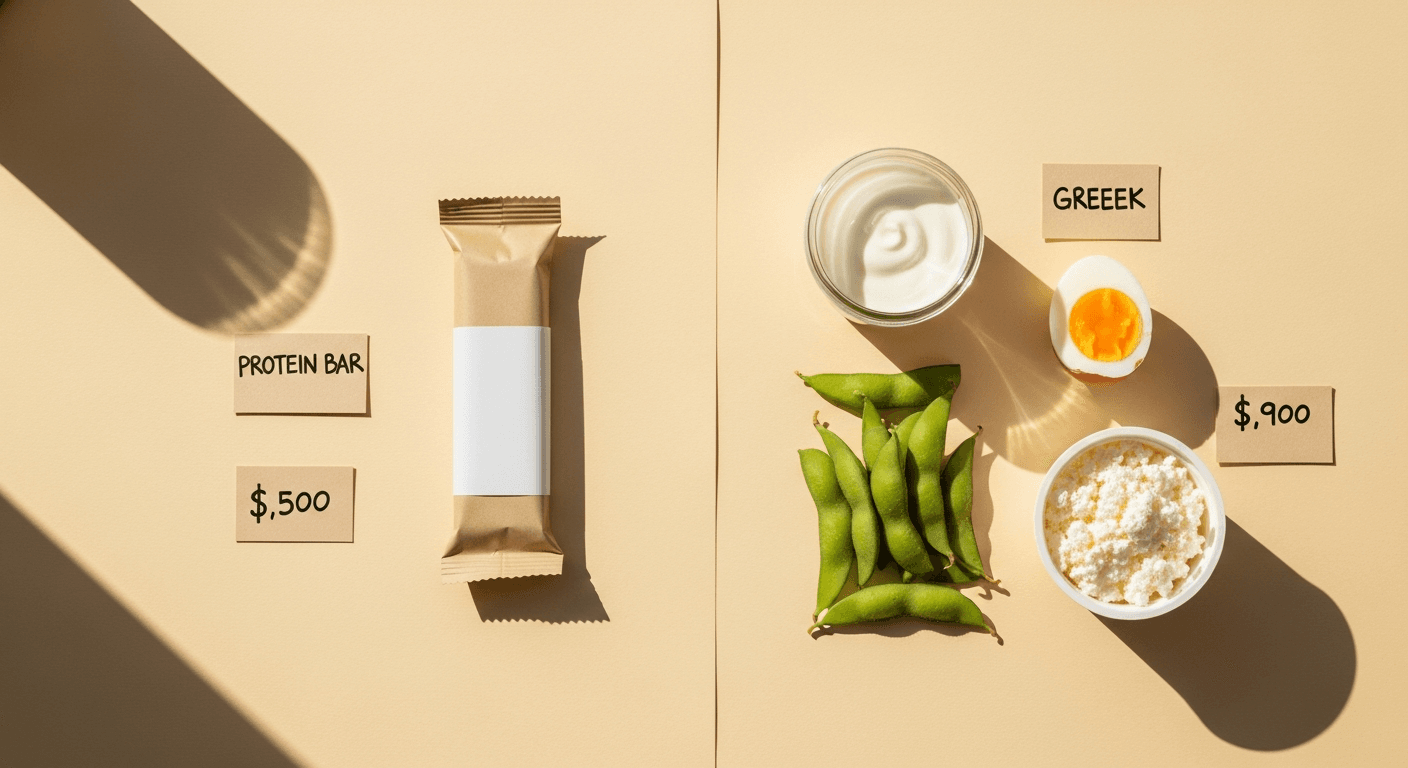
Walk into any gym, airport, or convenience store and you'll find a wall of protein bars priced between $2.75 and $4.50 each. The packaging promises lean muscle, fast recovery, and optimized macros. What it doesn't show you is the cost-per-gram-of-protein breakdown. When you run that math, the picture changes quickly.
Smart athletes in 2026 are doing exactly that math, and they're walking past the bar display. Whole-food and minimally processed alternatives deliver equivalent protein and satiety at roughly half the price. This isn't about being cheap. It's about being precise with your nutrition budget.
What You're Actually Paying For in a Protein Bar
The average commercial protein bar in 2026 contains between 18 and 22 grams of protein. Most are built around whey protein concentrate, soy isolate, or pea protein, bound together with sugar alcohols, palm oil, and a handful of stabilizers. The macros are real. But so is the markup.
A standard $3.50 bar with 20 grams of protein costs you roughly $0.175 per gram of protein. That's your benchmark. Everything below it is a win. Most whole-food alternatives land between $0.05 and $0.10 per gram of protein, which means you're paying two to three times more per gram for the convenience of a wrapper.
Some of that premium is justified. Bars are shelf-stable, portable, and require zero preparation. But if you're eating one or two per day as a regular nutrition habit, the cost stacks up fast. At $3.50 per bar and two bars a day, that's $210 per month on a single snack category. That's before your actual meals.
The Cost-Per-Gram Analysis: Real Numbers
Here's how common protein bar alternatives perform when you break them down by cost per gram of protein, using average 2026 US retail prices.
- Cottage cheese (2% fat, 200g pack): Approximately $1.20 for 24 grams of protein. That's $0.05 per gram. It refrigerates well, travels in an insulated bag, and has a higher satiety index than most bars because of its casein content.
- Greek yogurt pouches (150g, single-serve): Around $1.50 for 15 to 17 grams of protein, roughly $0.09 per gram. Squeezable formats are now widely available and genuinely portable for athletes.
- Hard-boiled eggs (two-pack, pre-cooked): Around $1.00 to $1.25 for 12 to 14 grams of protein, putting you at $0.08 to $0.09 per gram. Pre-cooked, peeled, and packaged versions are available at most US grocery chains.
- Edamame (frozen, shelled, 150g pack): Roughly $1.00 for 11 grams of protein at $0.09 per gram. Lightly salted versions require no prep beyond defrosting overnight.
- Homemade oat-and-nut clusters (batch of 10): A batch using rolled oats, peanut butter, protein powder, and honey costs roughly $6 to $8 in ingredients and yields 10 clusters with 12 to 16 grams of protein each. That's $0.60 to $0.80 per serving, or $0.05 to $0.06 per gram.
- Canned tuna or salmon (single-serve 90g can): Around $1.50 for 20 grams of protein. $0.075 per gram, with no refrigeration needed until opened. Peel-top cans with a fork included are standard in US grocery stores now.
- Roasted chickpeas (30g snack bag): Around $1.00 to $1.25 for 6 to 7 grams of protein. Less protein-dense, but the combination of protein and fiber makes them more filling per calorie than most bars, and they're fully shelf-stable.
The pattern is consistent. Every alternative above costs between 50% and 70% less per gram of protein than a standard commercial bar.
Convenience Is Real, But It's Solvable
The honest objection to whole-food alternatives is convenience. A protein bar lives in your gym bag for a week and survives a hot car. A cottage cheese pack doesn't. That's a fair point, and it's worth addressing directly rather than dismissing it.
The solution most athletes land on is a tiered approach. You keep one or two shelf-stable options (canned fish, roasted chickpeas, pre-packaged nut clusters) in your bag for genuine emergencies or travel days. For your regular post-workout or mid-afternoon protein hit, you plan ahead with a small cooler insert or an insulated lunch bag. This two-tier system eliminates the "I had no choice" purchase 80% of the time.
Batch preparation matters here. If you spend 30 minutes on Sunday making oat-and-nut clusters, you have 10 servings ready for the week. The per-unit cost is low, the protein content is controllable, and you know exactly what's in them. This also gives you flexibility around your overall protein distribution. How you spread your protein across the day matters significantly for muscle protein synthesis, and homemade snacks make it easier to hit specific protein targets at specific times rather than eating whatever's on the shelf.
Ranked: The Best Protein Bar Alternatives for Athletes on the Go
Here's a practical ranking combining cost, protein density, and real-world portability. Tier 1 options are genuinely as convenient as a bar. Tier 2 requires minor planning.
Tier 1: Drop-in replacements (no planning required)
- Canned tuna or salmon (single-serve, peel-top): best protein-to-cost ratio of any shelf-stable food
- Hard-boiled egg two-packs (pre-peeled, sold at most grocery and convenience stores): low cost, complete protein, no prep
- Roasted chickpeas or edamame pouches: lower protein density but excellent fiber-to-protein ratio for satiety
Tier 2: Mild planning, major payoff
- Greek yogurt squeeze pouches with a small ice pack: 15 to 17g protein per serving, probiotic benefit included
- Cottage cheese single-serve packs: highest casein content of any option, which supports slower protein absorption and longer-lasting fullness
- Homemade oat-and-nut clusters: fully customizable macros, lowest cost per serving, best for high-volume athletes who need more calories alongside protein
The Satiety Question: Do These Options Actually Keep You Full?
Protein bar marketing leans heavily on satiety. The argument is that a 20g protein bar holds you over until your next meal. In practice, many athletes report hunger returning within 90 minutes, partly because most commercial bars are low in fiber and digest quickly.
Whole-food alternatives tend to outperform bars on satiety per gram of protein. Cottage cheese and Greek yogurt contain casein, which digests more slowly than whey. Eggs trigger stronger satiety hormone responses than equivalent calories from processed sources. Legume-based options like edamame and chickpeas deliver fiber alongside protein, which compounds the fullness signal.
This connects directly to gut health. The fiber content in whole-food alternatives supports microbiome diversity in a way that most bars, which rely on sugar alcohols for sweetness, don't. The evidence linking gut health to athletic performance is growing significantly, and what you're snacking on between meals is part of that picture.
What About Protein Quality?
One common counterargument is that whole-food protein sources have different amino acid profiles than the engineered protein in commercial bars. It's a legitimate point for about five minutes, and then it falls apart in practice.
Eggs, dairy-based options (Greek yogurt, cottage cheese), and fish all contain complete amino acid profiles with high leucine content, which is the key trigger for muscle protein synthesis. The advantage of isolated whey protein in a bar is real at the margins, but for athletes eating a varied diet, it's negligible. The research consistently shows that overall daily protein intake and distribution matter far more than the specific source once you're above a basic quality threshold.
If you're concerned about optimizing further, most of these whole-food alternatives can be combined easily. A Greek yogurt pouch with a small handful of almonds pushes you past 20 grams of protein with a complete amino acid profile, for under $2.50 total.
The Math Over a Month
If you're currently spending $3.50 per bar and eating one per day as a regular snack, that's roughly $105 per month. Switching to a mix of pre-cooked eggs, cottage cheese packs, and a weekly batch of homemade clusters brings that number to approximately $45 to $55 per month for equivalent protein. That's a saving of $50 to $60 monthly, or $600 to $720 per year, with no reduction in protein intake and likely an improvement in satiety and fiber consumption.
That's real money. Redirected toward quality whole meals, it compounds your nutrition quality rather than subsidizing a brand's packaging budget.
One Practical Starting Point
You don't need to overhaul everything at once. Start with one substitution. Swap your post-workout bar for a cottage cheese pack or a two-egg pre-cooked pouch for two weeks. Track how your hunger levels hold up and what you spend. The data you collect from your own body and your own wallet is more useful than any marketing claim on a wrapper.
From there, add a Sunday batch-prep habit for homemade clusters, and keep one shelf-stable backup option in your bag for travel days. That's the full system. It takes about 30 minutes to set up weekly and cuts your snack costs significantly without touching your training outcomes.
For athletes who are already optimizing their training stimulus. whether that's through slow eccentric loading for muscle growth or structured cardio periodization. the next performance variable worth auditing is often right there in the snack aisle. The bar you've been paying a premium for is, nutritionally, not the best option. It's just the most visible one.