
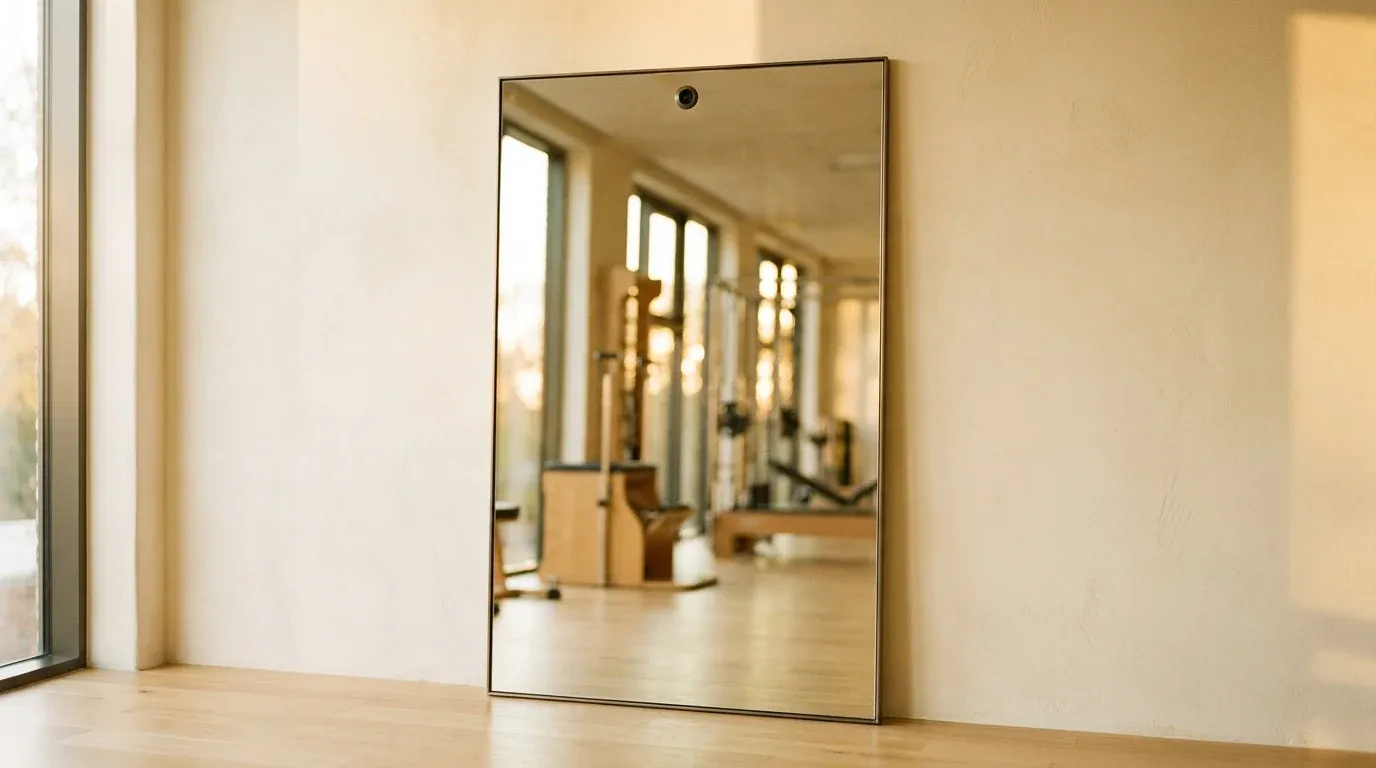
Fitness mirror hardware has a credibility problem in the US. Lululemon paid $500M for Mirror in 2020, watched it collapse, and quietly sold it off three years later. Tempo, Tonal, and a handful of other connected fitness devices all promised to reshape the home gym. Most struggled to hold consumer attention past the first renewal cycle. Now Magic AI is stepping into that same arena with $11M in fresh capital and a strategy that looks deliberately different from everything that came before.
The question isn't whether the technology is impressive. It is. The question is whether Magic AI has found the distribution model that turns a beautiful piece of hardware into a sustainable business.
What the Funding Round Actually Tells You
Magic AI closed an $11M Series B co-led by Beringea and IW Capital, bringing the company's total funding since 2023 to approximately $20M. For a hardware company operating in a segment where burn rates are historically brutal, that's a meaningful but not lavish war chest. It signals investor confidence in the thesis without suggesting anyone is betting the house on a direct-to-consumer push.
The more revealing detail is who else is in the cap table. Soho House, the global members club and hospitality brand, backed the round. That's not a passive financial play. When a brand with 40-plus locations across North America, Europe, and Asia writes a check into a fitness hardware company, it's almost certainly looking at deployment across its own estate. That's a distribution relationship dressed up as an investment.
For context on how wearable and connected fitness brands are thinking about investor signaling and brand positioning, Oura's $16B IPO illustrates the wearable brand playbook in granular detail. The pattern is consistent: the companies that scale aren't just selling hardware. They're selling access to an ecosystem, and they're building distribution through strategic partners rather than relying on paid acquisition alone.
The Technology Stack
Magic AI's mirror uses computer vision to deliver real-time form correction, rep counting, and holographic trainer projection. The pitch is straightforward: you get a significant portion of what a personal trainer provides, at a fraction of the cost, without needing to coordinate schedules.
In the US, one-on-one personal training sessions typically run $60 to $150 per hour in major metropolitan areas, with premium trainers in cities like New York or Los Angeles commanding $200 or more. A connected fitness device that credibly replicates feedback and accountability at a fixed monthly cost has a clear value proposition, at least on paper.
The form correction piece is where the technology differentiates itself from earlier mirrors, which were essentially screens on stands. Real-time computer vision that catches a caving knee during a squat or flags excessive forward lean in a deadlift addresses one of the most common failure modes in self-directed training. Research consistently shows that technique degradation under fatigue is a primary injury driver for recreational lifters. If the mirror catches those breakdowns before they become problems, that's a genuinely useful function.
That said, more volume and more technology don't automatically produce better results. The hardware is only as effective as the programming behind it and the consistency of the person using it. That's a behavioral problem, not a technical one, and it's one that sank Mirror as much as any business model failure.
The Graveyard of Fitness Mirrors
It's worth being direct about the competitive history here. Lululemon's Mirror acquisition is the most visible cautionary tale, but it's not the only one. The connected fitness hardware category as a whole saw a brutal correction after the pandemic-era boom ended. Consumer behavior snapped back toward in-person training and group fitness as lockdowns lifted. Hardware companies that had built their models around sustained at-home engagement found themselves holding expensive inventory and chasing subscribers who had already canceled.
The structural problem for direct-to-consumer fitness hardware is retention. Gyms struggle with it too. The psychology behind quitting fitness routines is well-documented: motivation spikes at the point of purchase and erodes rapidly without social accountability, environmental cues, and progress visibility. A mirror in a home gym doesn't provide the environmental separation that makes a gym feel like a dedicated space for training. It's easy to walk past.
Peloton survived partly because of its community layer. Mirror never built an equivalent. Magic AI is entering a market that has seen those failures up close, which is either a massive obstacle or a map of what not to do.
The Hospitality Channel as a Viable Path to Scale
Here's where Magic AI's strategy diverges most sharply from its predecessors. Rather than pushing direct-to-consumer at scale, the Soho House backing points toward a luxury hospitality and members-club distribution model. That changes almost everything about the unit economics.
In a hospitality deployment, the mirror sits in a hotel gym, a spa, or a members club fitness suite. The operator pays for the hardware and potentially a software license. Utilization is spread across dozens or hundreds of guests rather than a single household. The device doesn't need to compete with a couch for attention, because the environment is already purpose-built for wellness.
Soho House's member demographic skews toward exactly the consumer profile Magic AI is targeting: high-income, wellness-oriented, globally mobile, and willing to pay for premium experiences. If a member encounters the mirror at a Soho House in London, uses it in Chicago, and gets the same holographic trainer experience in New York, that repetition builds familiarity. Familiarity drives aspiration. Aspiration eventually converts to residential purchase.
This mirrors the strategy that luxury fitness equipment brands like Technogym have used for decades. Getting equipment into five-star hotels and high-end residential buildings isn't just a B2B revenue stream. It's a $0 marketing channel that puts hardware in front of exactly the right buyers. The gym model winning in 2026 is built around environment, community, and experience. Magic AI's hospitality play is an attempt to borrow that infrastructure rather than build it from scratch.
Market Tailwinds Are Real, but Uneven
The broader market context is favorable. The global athleisure market was valued at $368.61B in 2025 and is projected to reach $844.77B by 2034, growing at a 9.7% CAGR. Consumer spending on premium fitness categories is expanding, not contracting. The appetite for connected fitness tools hasn't disappeared; it's become more selective.
Post-pandemic, consumers are better at evaluating fitness products. They've lived through the hype cycle. They know that a $2,000 piece of hardware doesn't automatically produce results. What they're responding to now is evidence of efficacy, ease of integration into existing routines, and social proof from people they trust. The hospitality channel helps with the last two. Soho House membership is itself a signal of belonging to a community that values wellness.
The longevity angle also matters here. Data from an 88,000-person study shows that exercise benefits compound with age, which is driving older, higher-income demographics toward sustained investment in quality fitness tools. That's the Magic AI buyer. Not the 24-year-old chasing aesthetics, but the 45-year-old who understands that consistent, well-coached movement is a long-term health investment.
What Magic AI Needs to Get Right
Funding and a smart distribution partner are necessary but not sufficient. There are several execution risks that will determine whether the $11M Series B leads to a healthy Series C or a quiet acqui-hire.
- Content depth and trainer quality. The holographic trainer experience is only compelling if the trainers are excellent and the programming is genuinely periodized. Generic workout content will fail to retain users who have access to real coaches.
- Hospitality contract terms. B2B hardware deals in hospitality can be slow to close, expensive to service, and painful to renegotiate. Magic AI needs airtight SLA frameworks and scalable remote support.
- Residential conversion infrastructure. If the hospitality channel is the awareness play, there needs to be a clear and frictionless path from "I used this at Soho House" to "I want this at home." That requires CRM sophistication and a compelling direct offer.
- US regulatory and liability clarity. Real-time form correction that prevents injury is a feature. Advice that causes one is a lawsuit. The line between fitness guidance and medical advice is one Magic AI's legal team needs to have drawn very precisely before US launch.
The connected fitness hardware category isn't dead. It's clarifying. The companies that survive will be the ones that chose distribution channels aligned with their actual buyer, built retention through environment and community rather than novelty, and protected their margins by avoiding the direct-to-consumer death spiral of paid acquisition and high churn.
Magic AI's $11M and its Soho House partnership suggest it understands the lesson. Whether it can execute is the only remaining question that matters.