
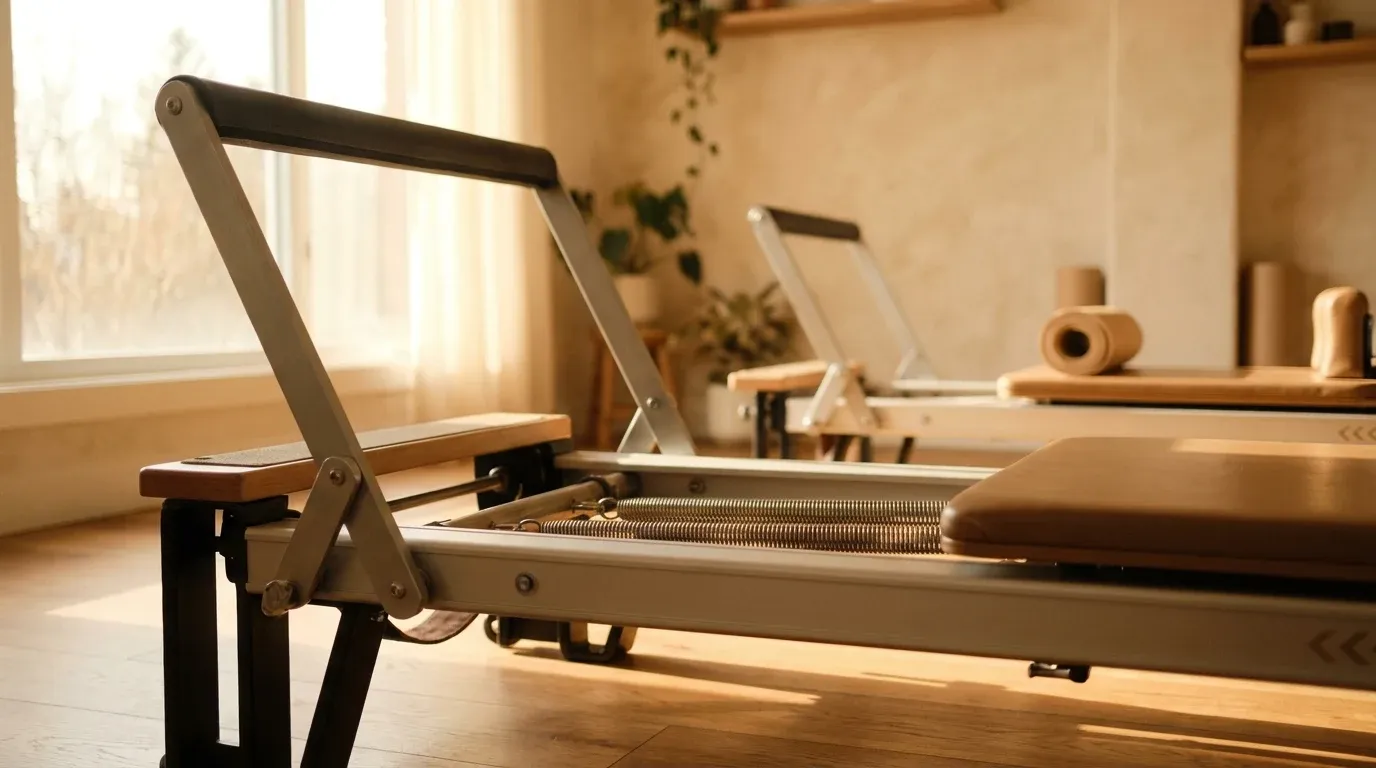
A new market report projects the global Pilates equipment and gear sector growing at a 6.83% CAGR from 2025 to 2035. That rate places it comfortably among the faster-growing niches inside commercial fitness. But the headline number isn't where the real strategic story lives. The story is in what's splitting beneath the surface, and whether operators and brands are positioned to capture it or simply watch margin evaporate.
If you're running a studio, managing a gym's equipment procurement, or supplying into the commercial fitness channel, this divergence is already reshaping your floor plan, your price points, and your supplier relationships. Most operators haven't caught up yet.
Two Segments, Two Very Different Trajectories
The Pilates market isn't moving as one block. The Reformer segment continues to dominate by revenue. That's not surprising. A single commercial Reformer can run $4,000 to over $10,000 per unit, and premium connected models push higher. Studio operators who built their entire identity around Reformer classes aren't walking away from that model.
But the Mat segment is recording faster unit growth. Gym operators are layering accessible, lower-capex Pilates offerings alongside their premium Reformer programs. A mat-based Pilates area requires a fraction of the upfront investment, fits into existing floor space, and can be monetized immediately through group classes. For larger multi-site operators, that's a meaningful financial argument.
This bifurcation matters for pricing strategy on both sides. If you're a supplier treating the Pilates category as a single revenue pool, you're misreading the market. Operators building out both segments simultaneously have very different procurement budgets, decision timelines, and quality thresholds for each. Serving both well requires a differentiated product line and differentiated sales conversations.
Tech Integration Is Now a Procurement Filter, Not a Feature
Two demand drivers are doing the most work in this growth cycle: technological integration and sustainability requirements. Both have moved from nice-to-have positioning into hard criteria on supplier shortlists.
Connected Reformers with sensor-enabled feedback, real-time resistance tracking, and platform integrations are no longer a premium curiosity. They're what serious studio operators expect when they're spending at the top of the market. The logic is straightforward: if you're charging $40 to $60 per class and competing against boutique studios that already offer biometric feedback and session history, a dumb machine is a liability.
This mirrors the broader shift playing out across wearables and connected fitness. The brands that have understood data as a retention and differentiation tool. as detailed in Oura's $16B IPO and the wearable brand playbook. are setting expectations that flow downstream into category decisions including Pilates hardware.
Sustainability requirements are hitting procurement in a parallel way. Operators sourcing new equipment now field questions from landlords, franchise partners, and members about material sourcing, product longevity, and end-of-life options. Suppliers who can't answer those questions clearly are getting screened out earlier in the sales cycle than they were two years ago.
The Technogym Effect and the Two-Tier Market
Technogym's move into US Pilates Reformers has recalibrated what premium means in this category. When a brand with that level of engineering credibility, retail presence, and software infrastructure enters your segment, it doesn't just compete. It resets the specification benchmark for every operator evaluating the field.
The result is a two-tier market that's becoming harder to ignore. On one side, you have premium connected hardware with verifiable quality controls, software roadmaps, and service infrastructure. On the other, commodity units sourced through shorter supply chains, often with inconsistent tolerances, limited warranty support, and no software layer.
The gap between those two tiers is widening, not narrowing. Operators who buy on price alone are discovering the true cost of unreliable equipment through downtime, member complaints, and accelerated replacement cycles. That's a recurring pattern in commercial fitness procurement that plays out across categories, but it's particularly acute in Pilates because class experience is so tightly tied to equipment feel and resistance consistency.
If you're sourcing for a studio where member retention is the primary business metric, the math on the cheaper unit often doesn't hold. A Reformer that's out of service for two weeks during a busy season can cost more in lost bookings than the price differential between tiers.
The Competitive Context Operators Can't Ignore
This Pilates growth isn't happening in isolation. It's unfolding inside a 2026 commercial gym equipment market defined by fierce low-price competition and significant regional divergence across North America, Europe, and Asia.
North American operators are dealing with compressed margins, rising real estate costs, and a member base that's increasingly fitness-literate and harder to retain. European markets show stronger regulatory pressure around sustainability and product certification. Asian markets are accelerating adoption of connected equipment, often skipping the analog generation entirely.
That regional divergence means supplier selection and contract terms are more consequential now than in previous cycles. A supplier relationship that works well in one geography can create real problems in another if their logistics, service network, or regulatory compliance isn't consistent across markets. Operators expanding across regions need to stress-test this before signing multi-year deals.
The broader gym business environment is also in flux. Private equity valuation resets are forcing operators to demonstrate stronger unit economics, as covered in depth in how PE is resetting gym valuations for independent operators. Equipment decisions that look like capital expenditure line items are increasingly being scrutinized as drivers of member experience, retention rates, and ultimately EBITDA. That changes the conversation around what counts as a smart Pilates investment.
What Floor Plan Strategy Actually Looks Like Now
The operators getting this right aren't treating Pilates as a single product category. They're building layered Pilates ecosystems within their facilities. Here's what that typically looks like in practice:
- A dedicated Reformer studio with 8 to 14 units, premium connected hardware, and a class schedule that justifies a per-session or membership surcharge above the base gym rate.
- A mat Pilates zone integrated into the main floor or a secondary studio, serving members who want the movement benefits without the surcharge, and acting as a pipeline into Reformer classes.
- A pricing architecture that monetizes both tiers without cannibalizing either. Mat classes can be included in standard membership. Reformer access becomes an upsell or premium membership tier.
This model works because it meets members where they are in their Pilates journey. Research consistently shows that accessible entry points increase long-term retention. Members who start with mat classes convert to Reformer programs at meaningful rates when the studio environment is well-designed and the instruction quality is high. The gym models that are thriving in 2026, as analyzed in the structured, social, competitive gym model, share this common thread: they create progression pathways, not just access points.
The Member Retention Dimension
There's a demand-side story here that operators underweight when they're focused on capex decisions. Pilates isn't just growing because equipment brands are pushing it. It's growing because the member base is pulling for it.
Pilates appeals strongly to members who are prioritizing longevity, joint health, and functional movement quality over raw intensity. That's a substantial and growing segment, particularly among members over 40. The evidence that exercise compounds in value as people age is well-documented, and data from a study of 88,000 adults confirms that exercise benefits increase with age. Pilates sits directly in the path of that demand curve.
Studios that understand this aren't marketing Pilates as a trend. They're positioning it as a long-term practice, which changes the retention dynamic entirely. Members who see Pilates as part of a multi-year movement health strategy churn at lower rates than members chasing short-term fitness goals. That's a retention argument that should be in every operator's business case for Pilates investment.
What Brands and Operators Should Do Now
The 6.83% CAGR projection through 2035 gives you a decade-long runway. But the strategic decisions that will determine who captures that growth are being made now, in procurement cycles, supplier negotiations, and floor plan redesigns happening across the next 12 to 18 months.
For equipment brands: if your product line doesn't address both the premium connected Reformer tier and the accessible mat segment, you're leaving volume on the table. Operators want to consolidate supplier relationships where they can. A brand that can serve both segments with consistent quality and service infrastructure has a structural advantage in the sales cycle.
For operators: the cheapest Reformer on the market isn't the lowest-risk option. Model the full cost of ownership including downtime, service contracts, replacement timelines, and the member experience impact of equipment that underperforms. Then compare tiers honestly. You'll often find the gap between premium and commodity isn't what the purchase price suggests.
The Pilates equipment market is growing fast enough to reward serious investment. It's also complex enough that underprepared operators and undifferentiated brands will give that reward away. The operators pricing this right are the ones treating Pilates not as a line item, but as a core pillar of their member value proposition.