
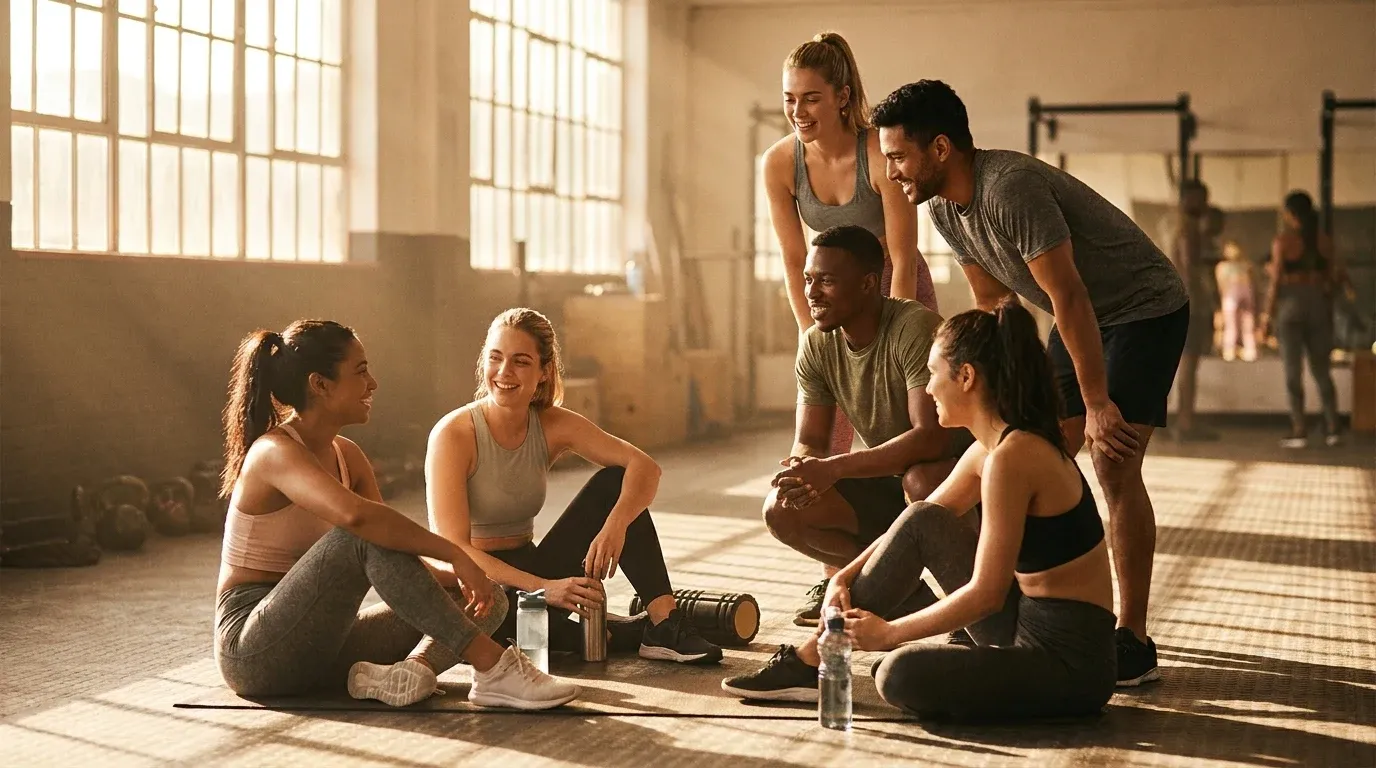
The bar is losing ground. Not financially. Socially. New research from ClassPass, published in August 2026, finds that 53% of adults aged 18 to 34 now prioritize fitness activities over nightlife when it comes to building social connection. That's not a lifestyle quirk. That's a structural shift in how an entire generation is spending its discretionary time.
For gym operators, this is one of the most significant behavioral signals in recent memory. Gen Z isn't just showing up to work out. It's showing up to belong.
The Third Place Has a New Address
Sociologists have long used the term "third place" to describe the spaces outside home and work where people gather, connect, and form community. For decades, that meant bars, cafes, and houses of worship. The ClassPass data suggests fitness studios are now competing directly for that role.
This isn't entirely surprising. Gen Z came of age during a period of social fragmentation, accelerated by pandemic lockdowns, the collapse of casual social infrastructure, and a growing cultural awareness around alcohol consumption. A generation that's more likely to identify as sober-curious, more likely to track its sleep, and more likely to scroll through fitness content than nightlife content was always going to redirect its social energy somewhere.
The gym was waiting. And the numbers confirm it's delivering. US gym traffic is already beating record 2025 levels at the midyear point of 2026, driven in significant part by younger cohorts who are visiting more frequently and spending more per visit.
Gen Z and the Lifetime Value Opportunity Operators Can't Afford to Miss
Industry analysts tracking the fitness club market have already flagged Gen Z and seniors as the two cohorts with the highest growth contribution in 2026. That makes intuitive sense. Seniors are returning to gyms for functional health reasons. Gen Z is entering gyms for the first time as independent adults with disposable income and strong brand preferences.
The difference between those two cohorts, from a business standpoint, is the length of the runway. A 23-year-old who finds her gym community in 2026 has four to five decades of membership potential ahead of her. If operators build the right environment now, they're not just acquiring a member. They're anchoring a community participant whose lifetime value dwarfs that of any casual drop-in.
This is the strategic context behind projections placing the global fitness club market at $298 billion by 2034. The brands capturing Gen Z's loyalty today are positioning themselves to claim a disproportionate share of that figure.
What "Social Hub" Actually Means for Studio Design
Saying your gym is a community doesn't make it one. The operators making real progress on this front are thinking about space and programming in deliberately social terms, not fitness-delivery terms.
Here's what that looks like in practice:
- Post-workout zones designed for lingering. Not a bench near the exit. A dedicated area with seating, good lighting, and sometimes a coffee or smoothie station. The signal to members is that staying is welcome, even expected.
- Group classes structured for interaction. Instructors who learn names, formats that create shared struggle, and consistent scheduling so the same people show up together week after week. Ritual repetition is what builds community, not one-off events.
- Run clubs and outdoor programming. These have exploded in urban markets across the US and UK because they combine fitness with the kind of casual, low-stakes social interaction that bars used to provide. They're cheap to operate and extraordinarily effective at building attachment.
- Member-facing communication that reinforces identity. Gen Z responds to brands that reflect their values back at them. Community-oriented messaging, member spotlights, and shared goal tracking all contribute to a sense that the gym knows who you are.
Strong Pilates, which recently expanded its footprint into Central Europe, has built much of its brand identity around exactly this formula. The studio format creates repeated cohort experiences that members describe in explicitly social terms. Its franchise expansion signals that the community-first studio model is viable at scale, not just in flagship urban locations.
Retention Is the Proof Point
The connection between community programming and retention isn't anecdotal. Research on gym attendance patterns consistently shows that members who visit twice a week or more are dramatically less likely to cancel than those who visit once a week or less. Two visits per week is the threshold that changes the retention equation for operators. Community programming is one of the most reliable mechanisms for pushing members across that line.
When the gym is where your friends are, attendance stops being a discipline question. It becomes a social appointment. That's a fundamentally different relationship between the member and the facility, and it's nearly impossible to replicate through pricing alone.
This also reframes how operators should think about group fitness investments. A Thursday evening bootcamp class that generates $15 in incremental revenue per head isn't just a revenue line. It's a retention mechanism for 20 members whose monthly dues far exceed the cost of running the class. Accounting for it narrowly misses the point entirely.
Community Is Now the Baseline, Not the Differentiator
For most of the last decade, community programming was a premium add-on. The flagship boutique studios offered it. Big-box gyms treated it as optional. That calculus no longer holds.
When 53% of your fastest-growing demographic segment says social connection is the primary reason they choose fitness over alternatives, community infrastructure becomes a product requirement. Not a feature. Not a selling point. A requirement.
Operators who haven't invested in this are already behind. Not because they're failing to capitalize on an opportunity, but because they're failing to meet a baseline expectation that their target member already holds.
This applies whether you're running a single boutique studio in Austin or managing a multi-location franchise in suburban Canada. The demographic pressure is consistent across English-speaking markets. Gen Z expects its gym to be a place where it belongs, not just a place where it trains.
What Operators Should Actually Do Right Now
If you're an operator reading this and thinking your current programming already addresses this, it's worth pressure-testing that assumption. Here are the questions that matter:
- Do your members know each other by name? Do your instructors?
- Is there a physical space in your facility where staying after a class feels natural?
- Do you offer at least one recurring community format, a run club, a challenge series, a recurring class cohort, that creates the same group of people interacting repeatedly?
- Does your marketing speak to belonging, or just to results?
If the honest answer to most of those is no, that's where the work starts. And it doesn't require a full facility redesign or a massive programming budget. A weekly run club costs almost nothing to launch. A post-class social corner can be created with a few chairs and a coffee machine. The signal you're sending to members matters more than the scale of the investment.
It's also worth making sure the experience inside the gym matches the brand promise outside it. Intimidation remains a documented barrier to gym attendance, particularly for younger women who represent a significant share of the Gen Z demographic operators are trying to reach. A community-first environment has to feel genuinely welcoming from the first visit, not just for members who've already been around for six months.
The Long Game
Gen Z's preference for fitness over nightlife isn't a passing trend. It reflects durable values around health, authenticity, and in-person connection that this cohort has held consistently even as other behaviors have shifted. The operators who recognize this early and build accordingly are making a long-term bet that the data strongly supports.
The fitness industry is heading toward a $298 billion global market over the next decade. The members who will define that market are already in their twenties, already choosing studios over bars, and already looking for a place that feels like theirs. The question for every operator right now isn't whether to build for community. It's whether you're building fast enough.