
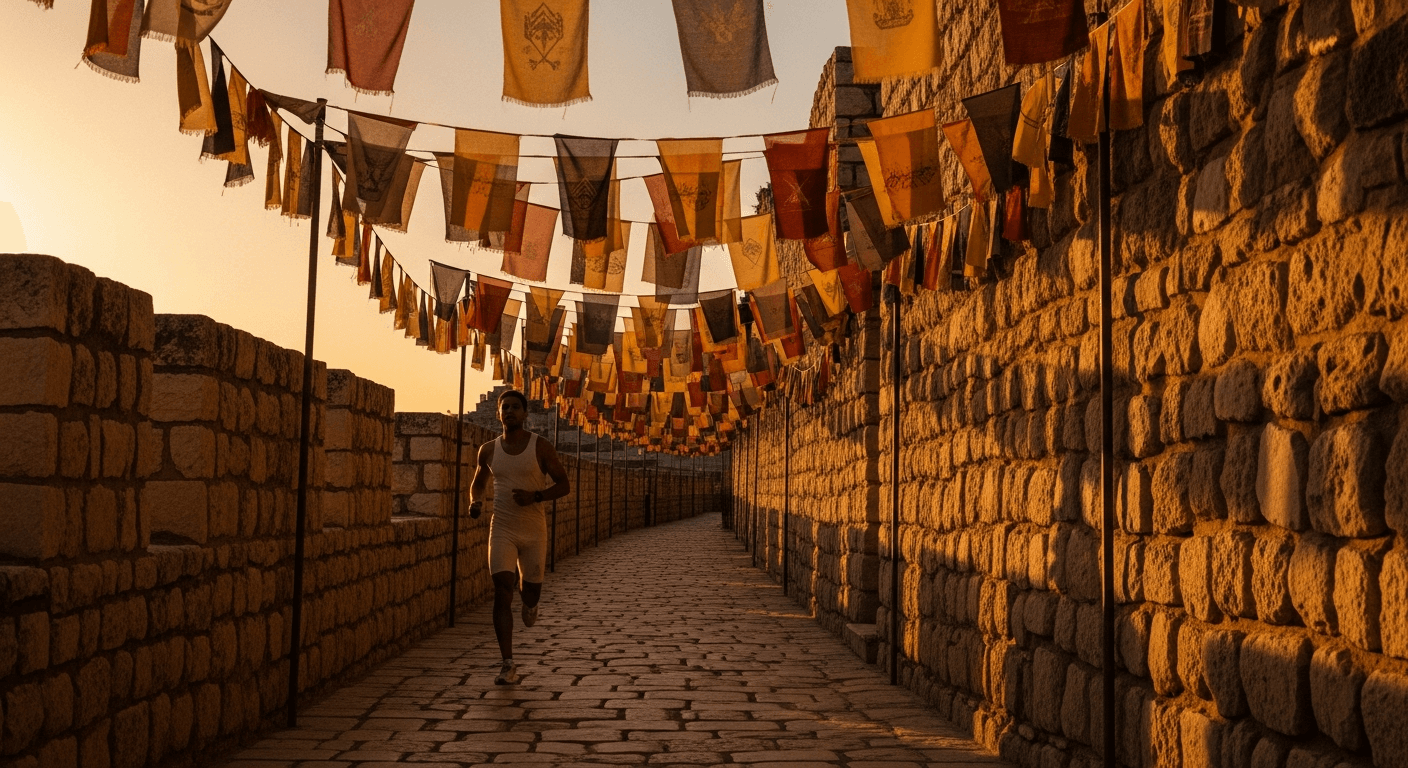
There are road races, and then there are acts of witness. The Palestine Marathon belongs firmly in the second category. Held in Bethlehem in the spring of 2026, the event drew thousands of runners from more than 60 countries onto streets that wind through checkpoints, past separation barriers, and across a landscape that carries the weight of decades of conflict. With Gaza under continued siege, finishing a 42.2-kilometer loop through the West Bank became something far larger than a personal athletic achievement.
If you think running is purely about pace and podiums, Bethlehem will recalibrate that assumption fast.
A Race That the World Can't Ignore
The Palestine Marathon was first organized in 2013 by Right To Movement, a Palestinian-led initiative that uses sport as a platform for political visibility. The premise was straightforward and radical at the same time: if Palestinians can't run freely across their own land because of checkpoints and movement restrictions, then the race course will be two loops of the same route. The geography of occupation becomes the course design.
In 2026, the backdrop is grimmer than ever. The ongoing military campaign in Gaza has killed tens of thousands of civilians, displaced millions, and triggered a global debate about international law, humanitarian access, and accountability. Against that context, Bethlehem filling with runners from the United States, the United Kingdom, Canada, Australia, Germany, Brazil, and beyond carries a meaning that no press release could fully articulate.
Participation numbers in 2026 were the highest the event has recorded, with organizers confirming more than 7,000 registered runners across full marathon, half marathon, and 10K distances. Around 40 percent of entrants traveled from outside Palestine. That's not a coincidence. It's a coordinated response.
What It Actually Takes to Get to the Start Line
Getting to Bethlehem is not like booking a flight to Berlin or Chicago for a major city marathon. Runners traveling from Western countries typically enter through Tel Aviv's Ben Gurion Airport and then navigate Israeli military checkpoints to cross into the West Bank. Some participants report hours of delays at the border. Others describe being questioned extensively about their reasons for attending. A small number are turned back entirely.
The logistical friction is part of what makes showing up politically significant. You don't accidentally end up at the Palestine Marathon. Every runner who crosses the start line has made a deliberate decision to be there, absorbing real inconvenience and, in some cases, real risk to their professional or personal reputation depending on their home country's political climate.
Preparation for the race itself also demands serious attention. The course is hilly, the spring heat in the West Bank can be intense, and the emotional weight of the surroundings doesn't make it easier to manage your effort through mile 20. Dialing in your fueling before and during the race is non-negotiable. Understanding the evolving approach to high-carbohydrate marathon fueling and training your gut in advance could make the difference between finishing strong and hitting a wall in the middle of a deeply charged moment.
The Political Architecture of the Course
The route itself is a political document. Runners pass the Israeli separation barrier, a concrete structure that cuts through Palestinian communities and stretches more than 700 kilometers in total. They run through Manger Square, past the Church of the Nativity, and through narrow streets in the old city. Local Palestinian families line the route, cheering, handing out water and fruit, treating the presence of international runners as something between celebration and proof of life.
Organizers from Right To Movement have consistently framed the event around a single core argument: that freedom of movement is a human right, and that denying Palestinians the ability to move freely across their own territory is a form of collective punishment. The marathon makes that argument visceral rather than abstract. When you run a double-loop course because a straight point-to-point route would cross militarized territory you're not permitted to enter, the politics stop being theoretical.
International athletes who have participated in events that prioritize performance metrics and technical excellence. think of the kind of infrastructure you'd see in a major HYROX competition like the races held in Hong Kong and Helsinki in 2026. often describe the Palestine Marathon as a reset in values. It strips away the performance apparatus and asks a simpler question: why do you run, and for whom?
Solidarity as a Finishing Strategy
Runners who have completed the Palestine Marathon describe the experience in terms that you don't hear at most races. The word "witness" comes up repeatedly. So does "responsibility." Several participants in 2026 ran in memory of specific Gazan athletes who were killed during the conflict, carrying their names on their race bibs or tattooed onto temporary paper strips worn on the wrist.
Palestinian runners, many of them training under conditions that would be considered unworkable anywhere else in the world, train on roads shared with military vehicles, in areas subject to curfews and electricity cuts, often without access to the nutrition and recovery tools that athletes in other countries take for granted. Something as straightforward as understanding which foods actually support muscle recovery becomes a different kind of problem when consistent access to fresh food is not guaranteed.
Despite those conditions, local runners participate in large numbers. Their presence alongside international runners creates something that a purely tourist-heavy event could never manufacture: a genuine exchange of witness. The international runners see what life under occupation looks like. The local runners see that the outside world has not forgotten them.
The Debate Inside the Running Community
Not everyone in the global running community agrees on how to engage with politically charged events. Some runners argue that sport should remain apolitical, that a marathon is a marathon regardless of where it's held. Others contend that choosing where you race is itself a political act, whether or not you acknowledge it as such. Running a corporate-sponsored mega-marathon in a major financial hub carries its own set of implicit endorsements.
The Palestine Marathon forces that debate into the open. It's not subtle about its intentions. The tagline "Right To Movement" is a direct play on the language of human rights, and the event's communications have never pretended to be neutral. For runners accustomed to measuring progress through splits and volume data and training consistency, the pivot to running as political statement can feel disorienting. That disorientation might be the point.
What the race demonstrates, regardless of where you sit politically, is that the act of running in a particular place at a particular moment can carry meaning that transcends the sport itself. You don't have to agree with every aspect of the race's framing to recognize that 7,000 people showing up in Bethlehem while Gaza burns sends a signal that is impossible to misread.
What 2026 Changes
The 2026 edition of the Palestine Marathon is likely to be remembered as a turning point in the event's history. Attendance was up. International media coverage was wider than in previous years, with outlets across North America, Europe, and the Middle East covering the race as a news event rather than just a sports feature. Several high-profile athletes, including ultrarunners and former Olympic competitors, participated publicly and spoke about their motivations on social media and in post-race interviews.
The race is also drawing scrutiny from governments. Some countries have informally discouraged their athletes from attending. Others have made the opposite signal. That kind of governmental attention is itself a measure of how seriously the event is now taken as a platform rather than simply a race.
For the running world specifically, the Palestine Marathon raises questions that will keep surfacing. How do you build a training block for a race where the course is defined by military geography? How do you prepare emotionally for a finishing line that carries collective grief? And how do you, as a runner who has spent months optimizing splits and evaluating footwear for performance and injury risk, reckon with a race where none of that is really the point?
Running as an Act of Presence
The Palestine Marathon doesn't offer a finish line medal as its primary reward. What it offers is the experience of having been present, physically and publicly, in a place that the world is watching. That's a different kind of achievement, and it doesn't fit neatly into any training app or race result database.
For runners who are searching for something more than personal bests, the event represents a model of what community running can be at its most expansive. Not a wellness ritual. Not a bucket-list race. A deliberate act of showing up, in the most literal sense, for people who are not free to show up for themselves.
The roads of Bethlehem will be there again in 2027. The question is who will be on them.