
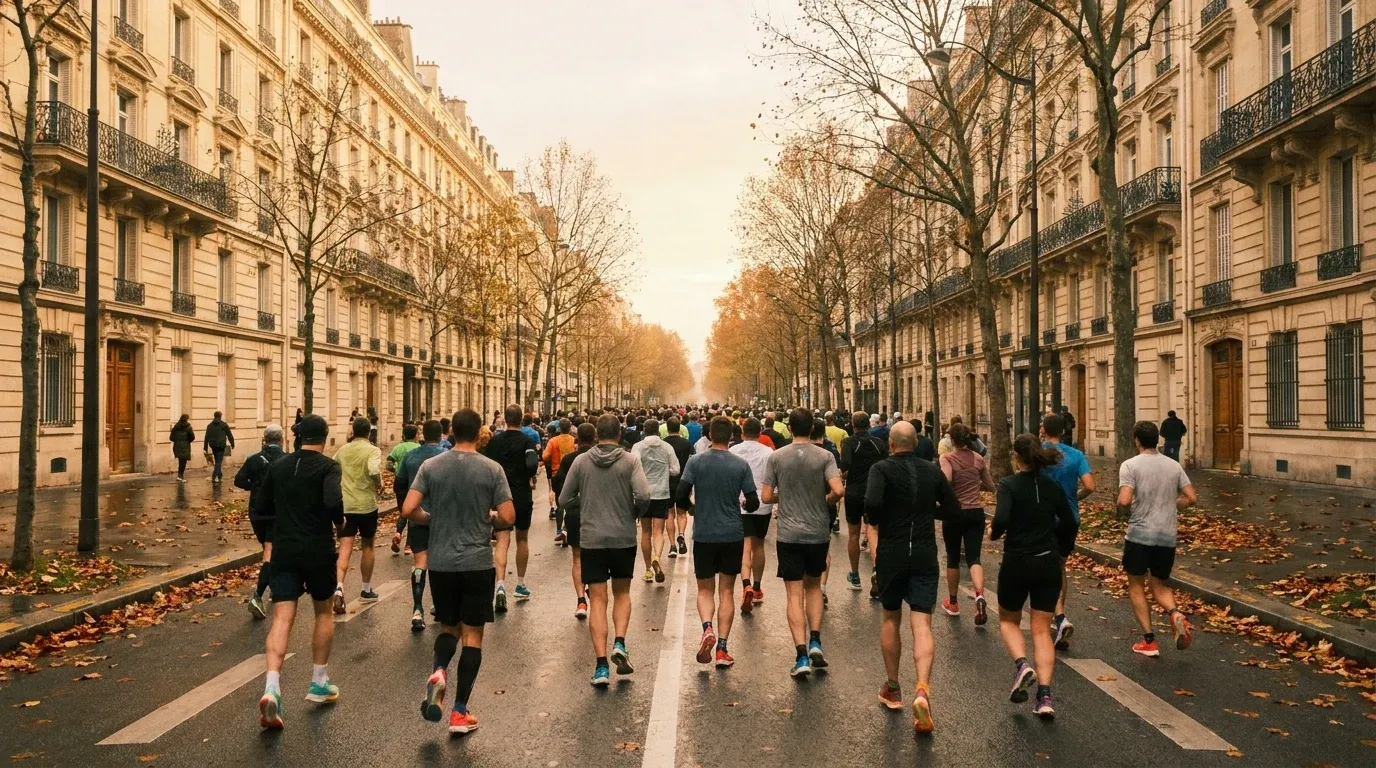
Every fall, tens of thousands of runners line up in central Paris and finish nearly 17 kilometers later in the shadow of the Palace of Versailles. It's one of the most compelling point-to-point road races on the global calendar, and the 2026 edition delivered exactly what the event has always promised: a fast course, a massive community field, and finishes that mean something to everyone from elite runners to first-timers.
The 2026 results were published on September 27, 2026, with full rankings available across all categories. Whether you ran it, tracked someone who did, or you're already planning for next year, here's what you need to know.
Paris-Versailles 2026: The Results
The 2026 edition saw strong participation numbers consistent with recent years, with the field drawing runners from dozens of countries. The course, which traces a largely downhill trajectory from the Place de la Concorde area toward the royal grounds of Versailles, remains one of the more forgiving mass-participation courses in Europe for runners chasing a personal record.
Full rankings by age category, gender, and overall finish time were published through the official race platform on September 27, 2026. Results are searchable by name and bib number, allowing finishers to access split times and official chip-timed results. The top finishers in the elite fields posted times consistent with the course's reputation for fast running, particularly in favorable weather conditions that have characterized recent September editions.
Recreational runners dominated the bulk of the field, as they always do, with finish times spread across a wide range. That distribution is part of what makes Paris-Versailles one of France's most genuinely inclusive autumn running events. You don't need to be chasing a podium to feel the pull of that finish line.
Why Point-to-Point Courses Hit Differently
Most road races you'll enter are either looped circuits or out-and-back routes. Loops are logistically tidy. Out-and-backs offer symmetry. But point-to-point courses like Paris-Versailles create a fundamentally different psychological experience, and that difference is worth understanding before you train for one.
The core of it is simple: you're always moving toward something new. There's no retracing your steps, no passing the same landmark twice, no mental shortcut that lets your brain estimate distance based on what you've already covered. The finish line is somewhere you've never been during the race. That uncertainty, combined with the knowledge that every step is a step you'll never run again on that course, tends to sharpen focus in a way that looped races don't always produce.
Research on pacing behavior in road races consistently shows that runners on point-to-point courses are more likely to execute negative splits, partly because the gradient often favors it and partly because the psychological novelty of the route keeps engagement high. On a loop, familiarity can work against you. Seeing the same mile marker a second time can trigger premature fatigue signals in the brain. Point-to-point removes that trigger entirely.
For runners who struggle with the mental grind of long efforts, a one-way course can be a genuine advantage. It's not a coincidence that some of the world's fastest road race times have been set on point-to-point courses. The format rewards runners who can stay present and manage effort across new terrain.
If you're building toward a PR attempt on a course like this, your training strategy matters. Recovery after hard efforts is one of the most underrated variables in race preparation. The 4R Recovery Rule Every Trail Runner Needs outlines a post-effort nutrition framework that applies just as well to road race training blocks, particularly during the high-volume weeks leading into a fall race.
What Makes Paris-Versailles Uniquely Accessible
Mass-participation events vary enormously in how welcoming they actually feel to recreational runners. Some races are structured around elite performance, with the community field almost an afterthought. Paris-Versailles is different. The event's identity has always been built around its breadth of participation rather than its depth of elite talent.
The course profile is a significant factor. The net elevation drop from start to finish means that runners who aren't accustomed to flat or fast terrain can still target a strong time. It's a course that rewards training but doesn't punish recreational runners who aren't at peak fitness. That accessibility has made it a fixture in the autumn running calendar for tens of thousands of participants who return year after year.
The broader running participation trend matters here too. Why So Many People Are Running in 2026: The Real Drivers looks at the forces pushing global running participation to record levels. Paris-Versailles sits squarely in that current. It's a race that benefits from the expanding community of recreational runners who want a meaningful event experience without the pressure or expense of a major marathon. Registration costs for races of this type typically fall well below the $150 to $200+ entry fees common for major city marathons, making accessibility a financial reality as much as a physical one.
The start in Paris and finish at Versailles also gives the race a built-in narrative that few events can match. You're running from one of the world's most recognizable urban landmarks to a UNESCO World Heritage site. The journey has meaning independent of your finish time, which is part of why the event retains runners who've completed it many times.
Training for a Point-to-Point PR
If Paris-Versailles is on your radar for 2027, or if you're eyeing any point-to-point race on the fall calendar, your preparation should account for the specific demands of the format.
First, train downhill running deliberately. Many runners log all their miles on flat or varied terrain and arrive at a net-downhill course underprepared for the eccentric muscle load that sustained descent creates. Quad fatigue in the final kilometers of a downhill course is a very specific discomfort that targeted training can reduce significantly. Include controlled downhill repeats in your weekly sessions starting eight to ten weeks out.
Second, practice running on unfamiliar routes. This sounds simple, but it has a real impact on your ability to manage effort on a point-to-point course. Regularly running new routes during training keeps you sharp at reading effort by feel rather than by landmark recognition. That skill translates directly to race day performance.
Third, treat your strength work as race preparation, not an optional extra. Runners who include consistent lower-body strength training are more resilient across the final third of any race. The eccentric demands of downhill running in particular are better managed by runners with stronger glutes and quads. If you're newer to integrating strength into a running program, the landscape of options can feel overwhelming. Running a Marathon at 70: What Science Actually Says touches on how endurance training and strength work interact across different stages of an athlete's life, with findings that apply broadly regardless of your current age or fitness level.
Nutrition strategy for a sub-two-hour race like Paris-Versailles is often underestimated. Many runners treat anything under 90 minutes as not requiring fueling. But pre-race carbohydrate loading and post-race recovery nutrition affect how you feel at kilometer 14 as much as they affect marathon performance. Protein quality in your overall diet also plays a meaningful role in how well you recover between training sessions. Not All Protein Sources Are Equal: Here's Why It Matters breaks down why the type of protein you eat affects muscle repair, which matters every time you're running high weekly mileage.
Looking Ahead: Fall Racing Season 2026
Paris-Versailles sits in a fall racing calendar that's increasingly crowded and increasingly global. Runners who complete this event often use it as a tune-up for a late-season marathon or as a standalone goal race in its own right. Either way, it fits neatly into the rhythm of the autumn running season.
The broader fall race landscape is shifting in interesting ways. Trail Running This Fall: What's Shifting for Runners captures some of those changes, including the growing appetite for destination races that offer an experience alongside the competition. Paris-Versailles has always delivered both.
If you finished the 2026 edition, your results are live. Search your name, find your splits, and use that data to inform what comes next. If you're targeting the race for the first time, the draw is straightforward: a historic course, a welcoming field, and a finish line that earns its place on anyone's running bucket list.