
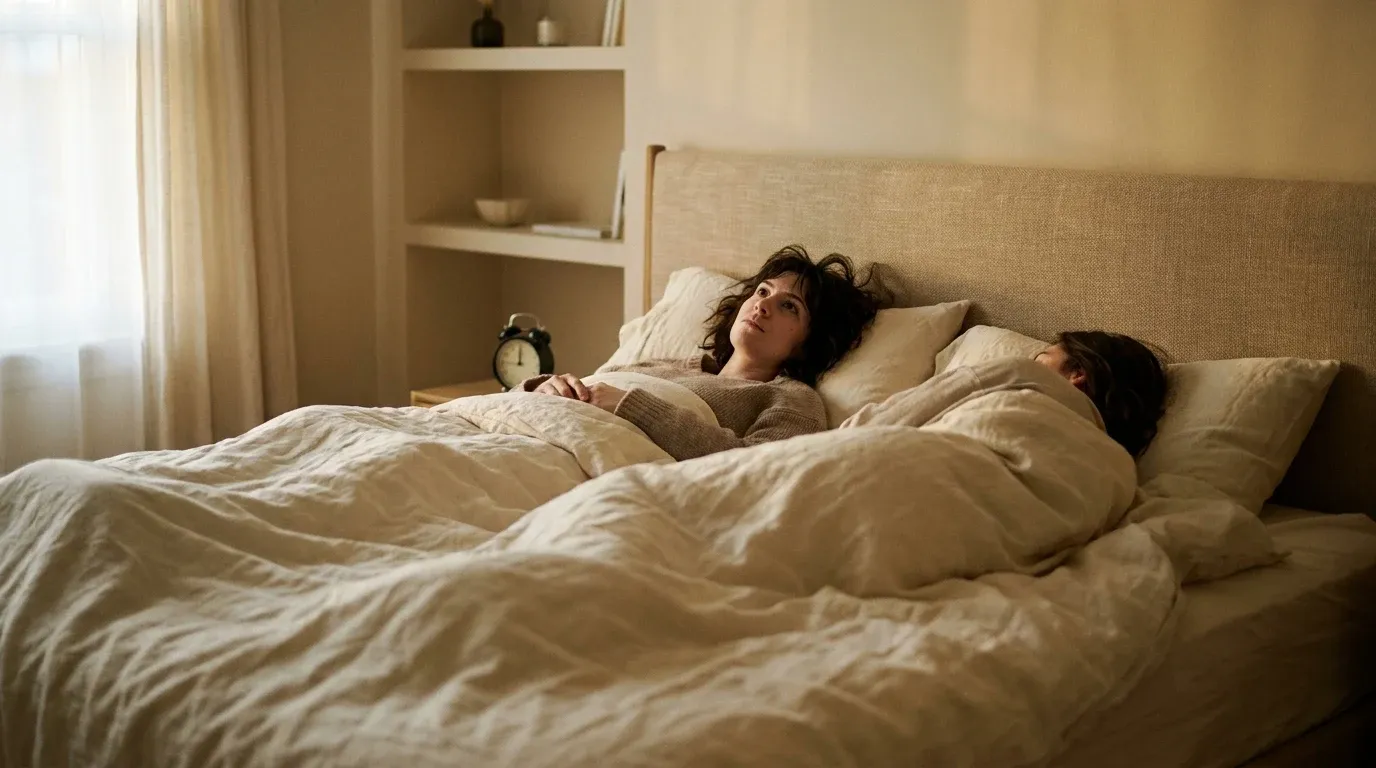
You already know that a rough night leaves you reaching for whatever's easiest at breakfast. But a study published September 15, 2026 in Annals of Behavioural Medicine adds a harder-to-ignore layer: your poor sleep doesn't just wreck your own eating habits. It quietly undermines your partner's too.
That reframes sleep hygiene as something far more shared than most people treat it. It's not just your problem to solve on your own schedule. It's a household variable with measurable consequences for two people's nutrition, mood, and long-term health.
What the Study Actually Found
Researchers tracked couples over multiple weeks, measuring nightly sleep quality alongside daily dietary choices for both partners. The finding was direct: when one person slept poorly, both partners were more likely to make lower-quality food choices the following day. That pattern held even when the second partner had slept adequately.
The effect wasn't explained entirely by shared meals or synchronized schedules. Even accounting for those variables, there was an independent ripple. One person's sleep deprivation appeared to alter the shared food environment in ways the other partner absorbed.
This is consistent with what sleep science already tells us about individual behavior. Poor sleep suppresses activity in the prefrontal cortex, the part of the brain responsible for impulse control and forward planning. When that capacity is reduced, people default to high-calorie, high-convenience options. The new contribution here is showing that this effect doesn't stay contained to the sleep-deprived individual.
Why One Person's Fatigue Becomes a Shared Problem
Think about how most couples actually navigate food decisions. Someone has to decide what's for dinner. Someone does the grocery run. Someone has the energy to prep vegetables on a Tuesday night or not. When one partner is exhausted, those decisions don't disappear. They get made differently.
The study points to three overlapping mechanisms. First, decision fatigue: a sleep-deprived partner is less able to engage in the cognitive work that planning nutritious meals requires. Second, mood contagion: irritability and low motivation transfer between partners through normal interaction, dampening the other person's willingness to invest effort in food choices. Third, environmental shift: when one person orders takeout, picks up chips instead of cooking, or skips the farmers market, the household food supply changes for everyone.
None of these require malicious intent or even awareness. They're the quiet arithmetic of shared domestic life. And over weeks and months, they compound. This connects to a broader body of research on how sleep and stress together shape your metabolic health, often in ways that dietary intervention alone can't fully correct.
The Diet Consequences Are More Specific Than "Eating Junk"
The dietary disruptions the study identified weren't limited to late-night snacking or extra dessert. Researchers tracked patterns across three distinct areas.
- Grocery and shopping behavior: Couples where one partner reported poor sleep were more likely to rely on processed, ready-to-eat food purchases compared to their baseline weeks.
- Meal preparation frequency: Home cooking dropped significantly on the days following a poor sleep night for either partner, suggesting that kitchen motivation is genuinely shared and fragile.
- Dietary variety: Both partners consumed fewer distinct food categories, narrowing the range of nutrients they took in. Over time, that kind of narrowing can affect gut microbiome diversity and broader metabolic function.
That last point deserves attention. Dietary diversity isn't just about getting your vitamins. It's the foundation of a resilient gut environment. When you consistently collapse your food variety under stress and fatigue, you're eroding something that's harder to rebuild than people assume. The relationship between food variety, microbial health, and performance is increasingly well-documented, particularly in the context of why fermented foods and microbiome diversity matter for active people.
This Changes How Couples Should Think About Sleep Hygiene
Most sleep advice is framed as a solo project. Fix your screen time. Try magnesium. Set a consistent bedtime. That advice isn't wrong, but the study suggests it's incomplete. If your partner's sleep quality affects your diet, then improving sleep hygiene at the household level carries a return that neither partner can achieve alone.
Researchers noted that couples who reported more synchronized sleep schedules, meaning similar bedtimes, similar wake times, and compatible sleep environments, showed smaller diet disruptions overall. The benefit wasn't dramatic in any single night, but across the study period it produced a measurable difference in dietary quality for both partners.
What does "synchronized" mean in practice? It doesn't require going to bed at exactly the same moment or eliminating all individual sleep variation. It means bringing the sleep environment and routine into shared conversation rather than treating it as purely personal territory.
What You Can Actually Do With This Information
Here's where the research becomes actionable. If you and your partner want to protect your collective nutrition, the lever isn't just meal planning or food tracking. It's sleep alignment.
Start with the sleep environment. Room temperature, light exposure, and noise are the variables with the strongest evidence base. A room that's too warm disrupts sleep architecture for both of you, even if only one person notices. Blackout curtains and a consistent cool temperature, typically between 65 and 68 degrees Fahrenheit, benefit both partners simultaneously. That's a structural fix that costs less than most supplements.
Name the problem when it's happening. When one partner is sleep-deprived, acknowledging that explicitly lets both people make more conscious food decisions. "I didn't sleep well, I know I want to default to easy food" is information the other person can work with. It turns a passive influence into a shared decision point.
Build a low-effort food buffer. On weeks when sleep is fragile, having prepped, nutritious food that requires no motivation to eat removes the decision entirely. This doesn't mean elaborate meal prep. It means a stocked fridge with foods that are ready without effort. When fatigue hits, your environment makes the choice, not your willpower.
Treat your stress load as a shared metric. Sleep disruption rarely travels alone. It tends to show up with elevated stress, which further impairs food decision-making and compounds the nutritional impact. Couples who address stress as a joint concern rather than an individual failing tend to manage both sleep and diet better. A structured, science-backed stress reduction approach that both partners engage with can reduce the sleep disruption that starts this whole chain in the first place.
Be cautious with supplement shortcuts. Poor sleep drives people toward quick dietary fixes, including appetite-suppressing supplements. It's worth knowing what the evidence actually supports before adding anything to your routine. The science around natural GLP-1 supplements, for instance, is more nuanced than most marketing suggests, and fatigue-driven cravings are a distinct mechanism that supplements rarely address at the root.
Why This Matters Beyond Couples
The study focused on romantic partnerships, but the underlying dynamics apply wherever sleep quality and food decisions are shared. Housemates, family members living together, and anyone whose domestic life overlaps with another person's schedule can find themselves inside this feedback loop.
The broader point is that health behavior rarely happens in isolation. You're not making your food choices in a vacuum. You're making them inside a social environment that has its own rhythms, moods, and energy levels. Treating sleep as a collective household variable rather than a personal quirk is a shift that the evidence now supports.
If you've been frustrated that your diet keeps slipping despite genuine effort on the nutrition side, it's worth asking whether the disruption is coming from upstream. Inadequate sleep, particularly when it's chronic and shared across a household, doesn't just make you tired. It systematically degrades the conditions under which good food choices get made.
That's the finding that makes this study worth taking seriously. The solution isn't more willpower. It's a better-designed sleep environment, for both of you.