
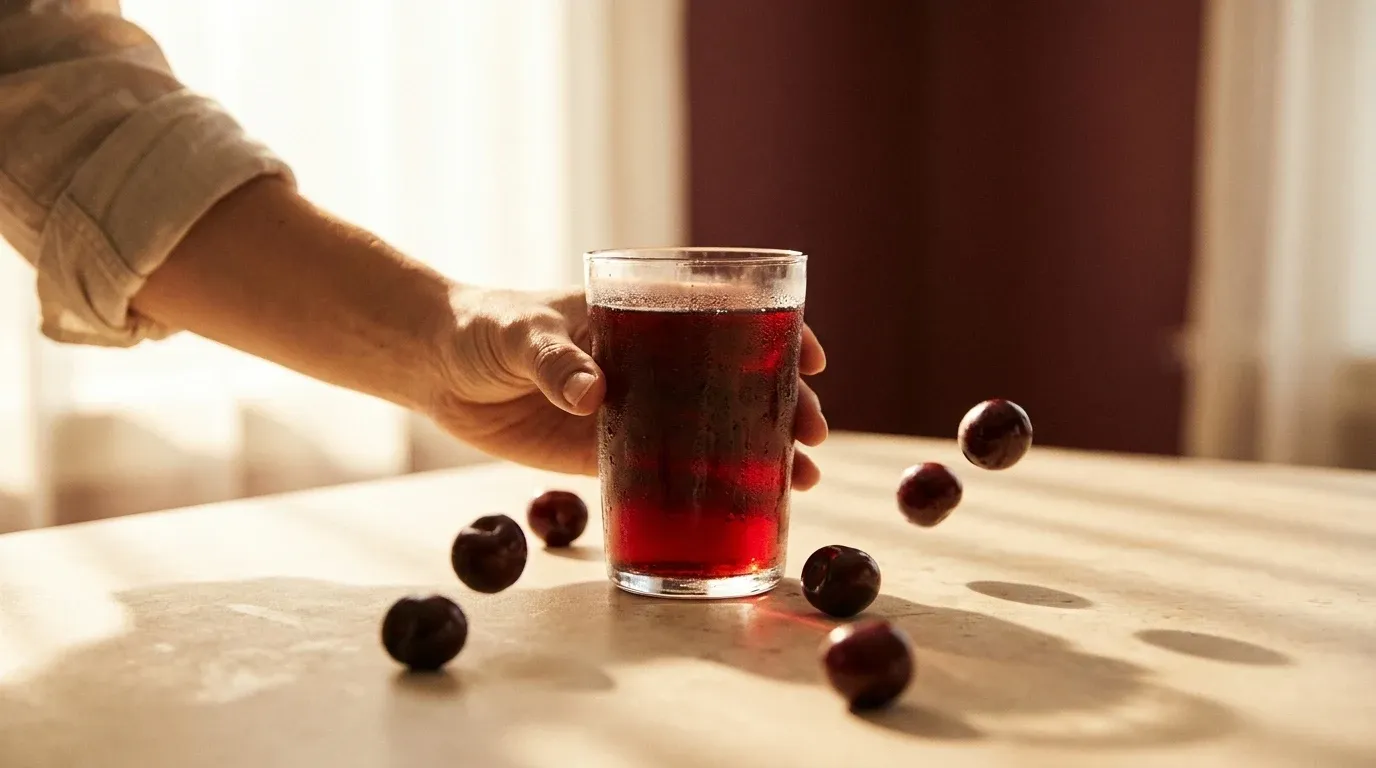
Tart cherry juice has circulated in wellness and endurance communities for well over a decade. Athletes swear by it. Coaches recommend it. But the actual science has lagged behind the enthusiasm. That's starting to change. A growing body of controlled research now gives tart cherry juice its most precise characterization yet: a recovery aid with small-to-moderate effects on soreness and a genuine, measurable ability to help restore strength and power output after hard training.
That's not a miracle claim. It's also not nothing. Here's what the evidence actually shows, and how to use it practically.
What the Latest Research Found
The most comprehensive recent review of tart cherry juice and exercise recovery pooled data from multiple randomized controlled trials covering both endurance and resistance training populations. The findings were specific enough to be useful.
On muscle soreness, the effect was characterized as small-to-moderate. That means tart cherry juice consistently reduces delayed onset muscle soreness (DOMS), but it's not eliminating it. You'll still feel yesterday's hard session. You'll just feel it less, and that reduction appears reliably across study designs.
The stronger finding was around functional recovery. Tart cherry juice showed a measurable ability to accelerate the restoration of muscular strength and power output in the 24 to 72 hours after intense exercise. For athletes training on consecutive days, or anyone managing a demanding weekly schedule, that's the number that matters most. Soreness is uncomfortable. Strength loss is a performance problem.
Why Tart Cherries Work at All
The mechanism isn't mysterious. Tart cherries, particularly the Montmorency variety, are exceptionally high in anthocyanins. These are the same class of polyphenols found in blueberries and blackcurrants, but tart cherries contain them in unusually high concentrations. Anthocyanins have well-documented antioxidant and anti-inflammatory properties.
Hard exercise creates oxidative stress and localized inflammation in muscle tissue. That's normal. It's also what drives soreness and temporary strength loss. Tart cherry's polyphenols appear to blunt the magnitude of that inflammatory response without fully suppressing it. The distinction matters.
Research measuring biomarkers like creatine kinase and C-reactive protein after exercise consistently shows lower levels in subjects consuming tart cherry compared to placebo. Lower creatine kinase levels indicate less muscle membrane disruption. Lower inflammatory markers suggest the repair process is running more efficiently rather than running hotter than necessary.
The Cold Immersion Comparison That Changes the Calculus
One of the more consequential findings in recent recovery science concerns the difference between tart cherry juice and cold water immersion. Both reduce soreness. Both accelerate perceived recovery. But they don't work the same way, and the downstream effects differ in ways that matter if you're actually trying to build fitness over time.
Cold immersion, particularly ice baths used frequently, has been shown to blunt anabolic signaling. The same inflammation that drives soreness is also part of the adaptive cascade that triggers muscle protein synthesis and long-term strength gains. Suppress inflammation too aggressively, too consistently, and you may be limiting the adaptation you trained for. If you want to understand that tradeoff in detail, Ice Baths Feel Good. They May Cost You Muscle. covers the research directly.
Tart cherry juice doesn't appear to carry this cost. Current evidence suggests it modulates rather than suppresses the inflammatory response. The anabolic signaling pathways associated with muscle growth don't show the same blunting effect seen with regular cold immersion. For athletes trying to get both the recovery benefit and the training adaptation, that's a meaningful distinction.
Dose, Timing, and Format: The Practical Details
The research that shows benefits isn't using whatever tart cherry product happens to be on sale at a grocery store. Protocol specifics matter, and they vary across studies, but some patterns are consistent enough to guide real-world use.
Concentrate versus juice. Most of the stronger study outcomes use tart cherry concentrate rather than bottled juice. Concentrate delivers a much higher polyphenol load per volume, typically around 60 to 90 milliliters of concentrate compared to 300 to 500 milliliters of juice. If you're using the bottled juice format, you need to check polyphenol content on the label, because dilution varies widely by brand. Many commercial products marketed as tart cherry juice contain a fraction of the anthocyanins used in controlled trials.
Timing. The most replicated protocol in the literature involves consuming tart cherry twice daily for several days before a hard effort, continuing through 48 to 72 hours after. The pre-loading component seems important. Waiting until after you're already sore to start dosing appears to produce weaker results. If you have a hard race, long training block, or intense competition weekend coming up, starting 4 to 5 days before is the approach most supported by current evidence.
Dose. Effective doses across studies cluster around 30 to 60 milliliters of concentrate twice daily, or roughly 500 milliliters of natural juice twice daily. Capsule and powder formats exist, but the evidence base for those is thinner. The liquid forms have more consistent research behind them.
Calories. This is worth flagging. Tart cherry juice in the quantities used in research adds meaningful calories and sugar. For athletes with high training loads, that's often fine and may even be useful. For someone managing body composition carefully, it's a factor worth accounting for rather than ignoring.
Who Benefits Most
The research population matters when you're trying to apply findings to your own situation. Studies showing the clearest benefits tend to involve endurance athletes (marathon runners, cyclists, triathletes) and resistance-trained individuals performing high-volume or high-intensity sessions. The more demanding the training stimulus, the more pronounced the recovery deficit, and the more room there is for an intervention to show measurable effects.
For recreational athletes training three or four times per week at moderate intensity, the benefit signal is real but smaller. You're producing less muscle damage to begin with, so there's less to modulate. That doesn't mean it won't help. It means your expectations should be calibrated to the research population, not extrapolated from elite endurance contexts.
Age is a relevant factor here as well. Recovery slows measurably with age, driven by changes in hormonal environment, reduced satellite cell activity, and lower baseline antioxidant capacity. Older athletes may have more to gain from recovery-targeted nutrition strategies. Why Recovery Takes Longer After 40 (And What to Do) covers those mechanisms in full.
Where Tart Cherry Fits in the Bigger Picture
Tart cherry juice is a useful tool. It's not a recovery system. The research is consistent enough that dismissing it as wellness noise would be inaccurate. But no single intervention substitutes for the fundamentals, and those fundamentals have a far larger evidence base.
Sleep is the most powerful recovery stimulus available to any athlete, and it costs nothing. Protein intake timed around training directly drives muscle repair. Hydration status affects every downstream process from nutrient delivery to inflammation resolution. If those three aren't in order, tart cherry juice is filling in gaps around a structure that's already cracked. The evidence on this hierarchy is clear, and Sleep and Food Still Beat Every Recovery Gadget lays it out without ambiguity.
The same applies to training structure. Recovery quality is downstream of training load. If you're accumulating more stress than your current programming can support, no supplement closes that gap. The Weekly Lifting Sweet Spot Coaches Should Know addresses how training frequency and volume interact with recovery capacity in practical terms.
On the nutrition side, whole food sources of polyphenols produce compounding effects that isolated supplements don't replicate in the same way. Whole Foods vs. Supplements: What 2026 Science Actually Prioritizes addresses that distinction directly if you're thinking about where tart cherry fits in your broader dietary strategy.
The Bottom Line
Tart cherry juice has earned its place in the evidence-based recovery toolkit. The effects are real, they're specific, and they're meaningfully different from cold immersion in ways that favor athletes who are also trying to build strength and fitness over time.
Use concentrate over juice where possible. Pre-load for several days before hard efforts. Don't expect it to rescue a recovery process that's broken at the foundation. And treat it as one well-supported layer in a recovery approach that still starts with sleep, protein, and honest training load management. That's what the research actually supports.