
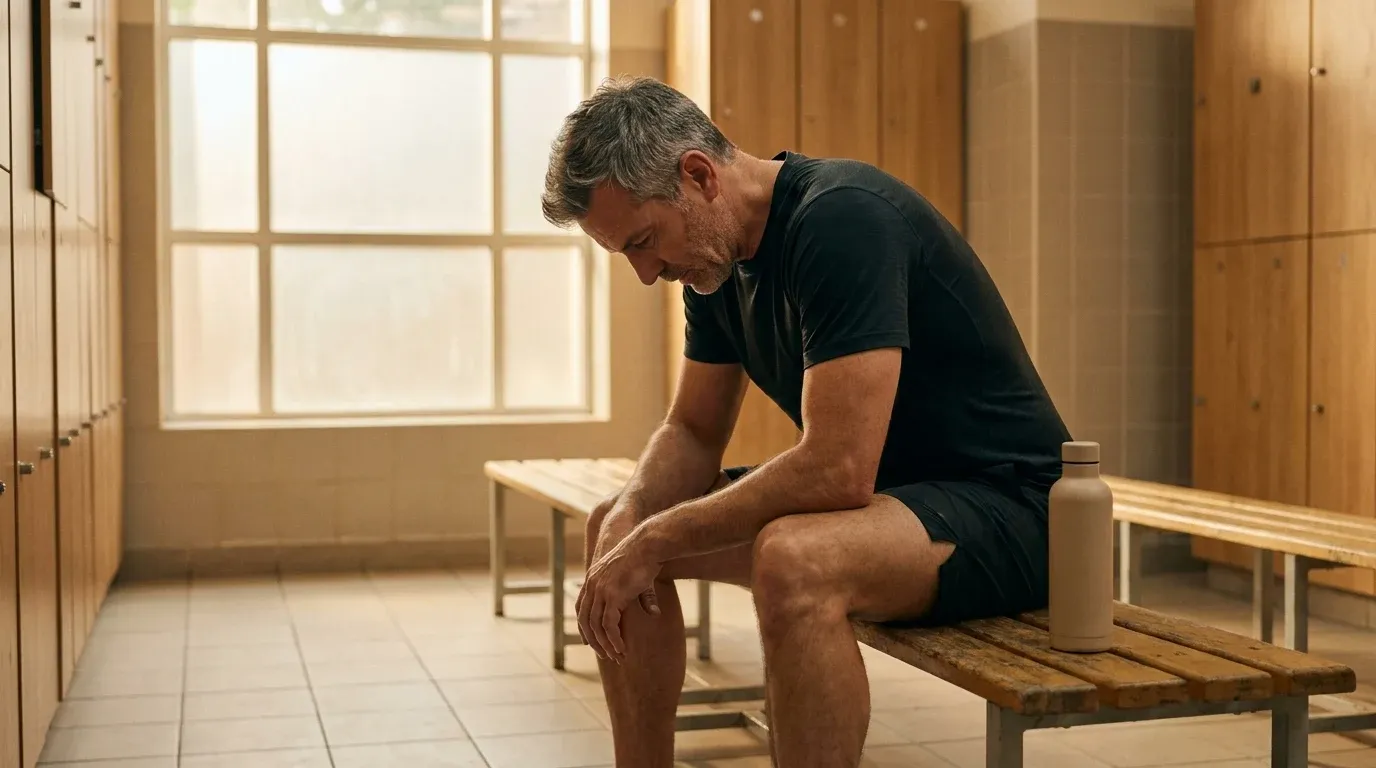
You trained hard on Monday. By Wednesday, you're still sore. Five years ago, you'd have been fine by Tuesday morning. Nothing about your effort changed. So what did?
The answer isn't that you're out of shape. It's that your biology has shifted in ways that most fitness content doesn't bother to explain clearly. Recovery after 40 slows for specific, measurable reasons. And once you understand those reasons, you can actually do something about them.
The Biology Behind Slower Recovery
Three interconnected changes drive most of what you experience as "slower recovery" after 40. They're not about fitness level. They're about physiology.
Muscle fiber composition shifts. As you age, you gradually lose fast-twitch muscle fibers, the ones that generate force quickly and also take the longest to repair. By your mid-40s, your muscle tissue has a higher proportion of slow-twitch fibers, but the fast-twitch fibers you still have are more vulnerable to damage and slower to rebuild after intense training. This isn't reversible through effort alone.
Anabolic hormones decline. Testosterone, growth hormone, and IGF-1 (insulin-like growth factor) all drop meaningfully after 40, particularly in men, and the hormonal landscape shifts significantly for women around perimenopause. These hormones regulate the speed and efficiency of muscle protein synthesis. Lower levels don't make recovery impossible. They make it slower and more dependent on external inputs like nutrition, sleep, and training structure.
Inflammation lingers longer. Exercise causes controlled inflammation as part of the repair process. In younger adults, this inflammatory response resolves quickly. Research consistently shows that older adults experience a prolonged inflammatory response to the same training stimulus, which is sometimes called "inflammaging." This isn't dangerous on its own, but it does mean your system stays in a repair state longer after each session.
The Anabolic Window Gets Narrower With Age
Younger trainees have some flexibility around post-workout nutrition. The window for maximizing muscle protein synthesis after exercise is relatively forgiving when you're 25. After 40, that window tightens considerably.
Studies comparing muscle protein synthesis rates across age groups show that older adults have what researchers call "anabolic resistance," meaning it takes more protein, more precisely timed, to trigger the same rebuilding response. The practical implication is that eating enough protein generally isn't sufficient. When you eat it matters too.
Getting 30 to 40 grams of high-quality protein within 60 to 90 minutes after a training session becomes meaningfully more important as you age. The leucine content of that protein matters as well. Leucine is the amino acid most directly responsible for signaling muscle protein synthesis. Whey, eggs, and animal proteins are leucine-dense. If you're leaning on plant-based sources, you'll likely need to consume more volume to hit the same threshold. Not All Protein Sources Are Equal: Here's Why It Matters goes deeper on how protein quality affects that rebuilding response.
Total daily protein also needs to be higher than most people assume. A common guideline for adults over 40 who train regularly is 1.6 to 2.2 grams of protein per kilogram of bodyweight per day. Most people are still operating at half that.
Training Less Isn't Usually the Answer
Here's where a lot of well-meaning advice goes wrong. When people notice they're recovering more slowly, the default suggestion is to train less. Cut your sessions. Take it easier. But frequency reduction isn't always the right lever to pull, and in many cases it accelerates the very muscle loss you're trying to prevent.
What tends to matter more is how you distribute intensity across your training week. High-intensity sessions, whether that means heavy strength work, intervals, or sport-specific training, are the ones that create the most systemic stress. If you're doing three of those per week and recovering poorly, the solution isn't necessarily to cut to two. It might be to keep two hard sessions and restructure the third as genuine low-intensity work, not moderate effort dressed up as recovery.
This distinction between truly easy and moderately hard is one most recreational athletes get wrong. Moderate-intensity training doesn't give you the adaptation benefits of hard training, but it does cost you recovery resources. It's often the worst option.
For practical guidance on structuring sessions around your recovery capacity, Compound vs. Isolation: How to Actually Structure Your Program covers how exercise selection affects cumulative fatigue across a week.
Sleep Is the Recovery Tool You're Probably Underusing
Growth hormone is released primarily during slow-wave (deep) sleep. After 40, deep sleep duration declines naturally, which creates a compounding problem. You already produce less growth hormone due to age-related hormonal shifts. Then reduced sleep quality cuts the window during which that hormone gets released even further.
Poor sleep also elevates cortisol, the primary catabolic hormone. Chronically elevated cortisol accelerates muscle breakdown and impairs the protein synthesis that recovery depends on. It's a two-sided problem: less building, more breaking down.
Research on recovery interventions consistently finds that sleep quality and quantity outperform most supplementation strategies, most compression gear, and most recovery technology when it comes to actual tissue repair. Sleep and Food Still Beat Every Recovery Gadget breaks down the evidence in detail.
Practical steps that meaningfully improve deep sleep include keeping a consistent sleep and wake time (even on weekends), keeping your room cool (around 65 to 68°F), avoiding alcohol within three hours of sleep, and limiting screens in the hour before bed. These aren't novel suggestions. They work because the underlying physiology is well-established.
Structuring Your Week After 40
The framework that tends to work best for adults over 40 isn't complicated, but it does require more intentionality than the training plans most people use.
- Allow 48 to 72 hours between sessions that stress the same muscle groups. This isn't excessive. It reflects the actual timeline of repair in older muscle tissue.
- Treat easy days as genuinely easy. Walking, light mobility work, or low-intensity cardio at a conversational pace. Not a moderate-effort gym session framed as "active recovery."
- Prioritize protein timing around training. 30 to 40 grams of high-quality protein within 90 minutes post-session, and distribute protein evenly across meals rather than loading it all at dinner.
- Sleep seven to nine hours consistently. Not occasionally. The cumulative effect of short sleep nights shows up directly in recovery markers.
- Consider creatine supplementation. The evidence base here is strong for adults over 40. Creatine supports phosphocreatine resynthesis, reduces exercise-induced muscle damage, and has shown benefits for muscle maintenance even at rest. Creatine Builds Strength Even Without Exercise, Study Finds covers the latest research.
When to Work With a Professional
If you've adjusted your training structure, improved your sleep, and cleaned up your nutrition, but you're still feeling consistently beaten up after sessions, that's a signal worth taking seriously. It might mean your program design needs a more thorough overhaul, or that something physiological warrants a conversation with a doctor.
Working with a coach who understands the specific demands of training after 40 can also make a significant difference. A good coach won't just prescribe more sets. They'll assess your recovery capacity alongside your training output and help you calibrate the two. How to Choose a Trainer for Building Muscle After 40 outlines what to look for when making that decision.
For women specifically, the intersection of perimenopause and training load is an area where generic programs often fall short. Hormonal fluctuations can dramatically affect recovery week to week, and a coach experienced with this population can help you adapt in real time rather than guessing.
The Bigger Picture
Slower recovery after 40 is real. It's biological, it's measurable, and dismissing it as a mindset problem doesn't help anyone. But it's also not a reason to train less, lower your expectations, or accept a steady decline.
The athletes who continue to make meaningful progress past 40 aren't the ones who simply push harder or accept less. They're the ones who get precise. They train with enough intensity to drive adaptation, recover with enough seriousness to actually absorb it, and adjust the inputs (nutrition, sleep, structure) to match what their physiology actually needs right now.
That's a more demanding approach in some ways. But it's also a more sustainable one. And it tends to produce better results than whatever you were doing at 30, simply because you're finally paying attention to all of it.