

Most runners who get injured don't fall. They don't twist an ankle or collide with anything. They simply repeat the same mechanical pattern thousands of times until something gives out. A new systematic review published in Cureus suggests that one of the most modifiable variables in that pattern is step rate, and that many recreational runners are operating in a range that quietly increases their injury risk with every mile they log.
Here's what the research found, why it matters, and how to actually use it.
The 170 Threshold: Where Injury Risk Rises
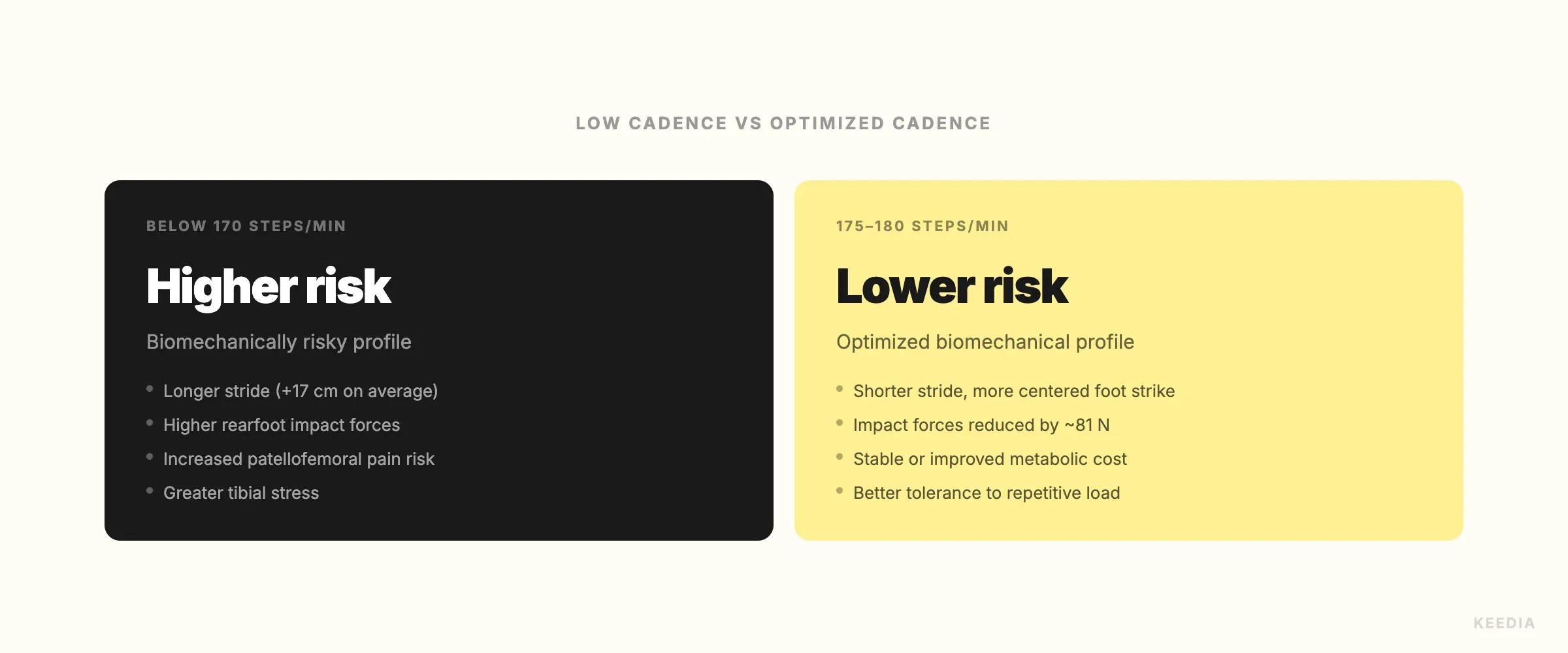
The review identified a clear pattern: runners with a cadence below 170 steps per minute show significantly higher rates of patellofemoral pain syndrome and tibial stress fractures. These aren't rare or exotic injuries. They're two of the most common reasons runners end up sidelined, and both are directly tied to how much load reaches the knee and shin with each stride.
The mechanism isn't complicated. At lower cadences, runners tend to overstride. The foot lands further in front of the body's center of mass, the knee straightens excessively at contact, and the tibia absorbs a disproportionate share of the impact. Repeat that 8,000 times per hour and the cumulative stress is substantial.
Increasing cadence shifts the foot landing closer to the body, reduces that peak load, and redistributes stress across more muscle tissue rather than concentrating it in joints and bone.
What the Numbers Actually Look Like
The review didn't just identify a threshold. It quantified what happens when cadence goes up. A step rate increase of roughly 10% was associated with an average reduction in rearfoot impact force of 81 Newtons and a stride length reduction of 17 centimeters.
To put 81 Newtons in context: that's approximately 18 pounds of force removed from each heel strike. Over a 30-minute run, you're talking about millions of accumulated Newtons no longer hammering the same tissues. The stride length reduction is equally meaningful. Shorter strides mechanically limit how far the foot can get ahead of the hips, which is the exact geometry that drives overstriding-related injuries.
These aren't marginal adjustments. They represent a genuine shift in the mechanical environment your musculoskeletal system is operating in.

Does Running Faster Cost More Energy?
This is the concern most experienced runners raise immediately. If you increase your step rate, you're doing more work per minute, so your metabolic cost must go up, right?
Not necessarily. The review found that a 5 to 10% cadence increase does not raise metabolic cost, and in some subjects actually improved running economy. The explanation lies in elastic energy return. When the foot contacts the ground closer to the center of mass and the stride is shorter, tendons and muscles can operate more efficiently in their elastic range. You're bouncing slightly rather than braking and reaccelerating with each step.
This mirrors findings across the broader biomechanics literature. Overstriding wastes energy by creating a braking force every time the heel strikes ahead of the hips. Correcting it doesn't just reduce injury risk. It can also make you faster at the same effort level, which connects directly to the kind of adaptations you'd track through research-backed VO2max protocols.
The caveat is that increases beyond 10% do begin to raise oxygen consumption. That's outside the therapeutic range the review examined, and it's not something most runners need to target.
Why Telling Yourself to Step Faster Doesn't Work
Here's a consistent finding that coaches should pay close attention to: verbal cues without real-time feedback produce minimal lasting change in cadence. Telling a runner to "step quicker" or "shorten your stride" in a coaching session has a short shelf life. Once attention shifts away, the old pattern returns within minutes.
The most effective implementation strategy identified in the review is auditory cueing, specifically metronome-based feedback during runs. Free and low-cost metronome apps allow you to set a target beats-per-minute, and the rhythmic pulse gives your nervous system something to synchronize with. This is motor learning in a form the brain actually responds to.
The practical protocol is straightforward. Measure your current cadence on a flat section of an easy run by counting steps for 30 seconds and doubling it. Multiply that number by 1.05 to get your initial target. Set a metronome app to that BPM and run to it for 10 to 15 minutes per session, two or three times per week. Hold that cadence for two to three weeks before increasing further.
This incremental approach matters. Jumping directly to a target cadence causes discomfort and neuromuscular fatigue because it's a genuinely new motor pattern, not just running harder.
There Isn't One Universal Number
The 170 steps per minute threshold is useful as a risk floor. But the research is clear that optimal cadence isn't a fixed target that applies equally to every runner. It interacts with three main variables.
- Running speed. Cadence naturally increases as pace increases. A runner at a 10-minute mile and the same runner at a 7-minute mile will have different optimal step rates. The 170 floor applies more reliably at moderate training paces than at slow recovery jogs or all-out efforts.
- Leg length. Taller runners with longer legs have naturally longer optimal strides. Applying a cadence number designed for shorter athletes can produce its own mechanical inefficiencies. The percentage-based approach (increase by 5 to 10% from your current baseline) is more individually appropriate than chasing a fixed absolute number.
- Fitness level and training age. Newer runners often land with poor mechanics for reasons beyond cadence. Elite runners tend to self-organize toward efficient cadences naturally over time. Where on that spectrum you sit affects how much immediate benefit cadence modification will produce.
If you're using a GPS watch, most current models display cadence in real time. Garmin, Polar, and Apple Watch all provide step rate data. That makes self-monitoring more accessible than it's ever been, without needing lab equipment or a coach present for every session.
What the Research Still Doesn't Prove
The Cureus review is valuable, but it's honest about its own limitations. The majority of studies included are short-term and biomechanical in nature. They measure forces, stride lengths, joint angles, and oxygen consumption in controlled settings. They don't yet demonstrate, across large populations followed over months or years, that increasing cadence translates directly into fewer actual injuries.
This is not a reason to dismiss the findings. Biomechanical plausibility combined with consistent measurement of reduced load is a reasonable basis for intervention. But it does mean that cadence modification should be understood as one tool among several rather than a complete injury prevention strategy.
Other recovery variables matter in parallel. How well you're sleeping affects tissue repair rates, and if you're not optimizing that side of the equation, the benefits of cleaner biomechanics will be partially offset. The evidence on magnesium supplementation for athlete sleep quality is worth reviewing if recovery is an active concern.
Similarly, the load you accumulate across your full training week, not just your running form, determines injury risk. Appropriate deload protocols reduce cumulative fatigue that makes tissues more vulnerable regardless of how optimal your mechanics are.
How to Apply This Starting This Week
You don't need to overhaul your training to use what this review found. The intervention is targeted and time-efficient.
- Check your cadence on your next easy run. Most watches display this live. If you don't have a watch, count steps for 30 seconds on a flat road and multiply by two.
- If you're consistently below 170 steps per minute at your standard training pace, that's a meaningful data point worth acting on.
- Set a metronome app to 5% above your current average. Use it during the middle 15 minutes of two runs per week. Don't force it for the full session initially.
- After two to three weeks, reassess. If the new cadence feels natural during those segments, extend the duration before increasing the target further.
- Don't change cadence and volume simultaneously. If you're already increasing weekly mileage, hold cadence constant until mileage stabilizes.
Zone 2 training runs are a practical place to work on cadence because the low intensity gives you cognitive bandwidth to focus on the new motor pattern. If you haven't yet established your actual Zone 2 range, finding your Zone 2 accurately without lab equipment is a logical starting point before layering in cadence work.
The Honest Summary
Running cadence below 170 steps per minute is associated with higher injury risk at typical training paces. A 5 to 10% increase reduces peak impact forces meaningfully, doesn't raise your metabolic cost, and can be trained effectively using a metronome app. The clinical evidence for long-term injury reduction is still building, but the biomechanical logic is solid and the intervention costs nothing.
If you're running and you haven't checked your cadence recently, that's worth doing before your next session. It takes 30 seconds and might tell you something genuinely useful about why certain injuries keep returning.