
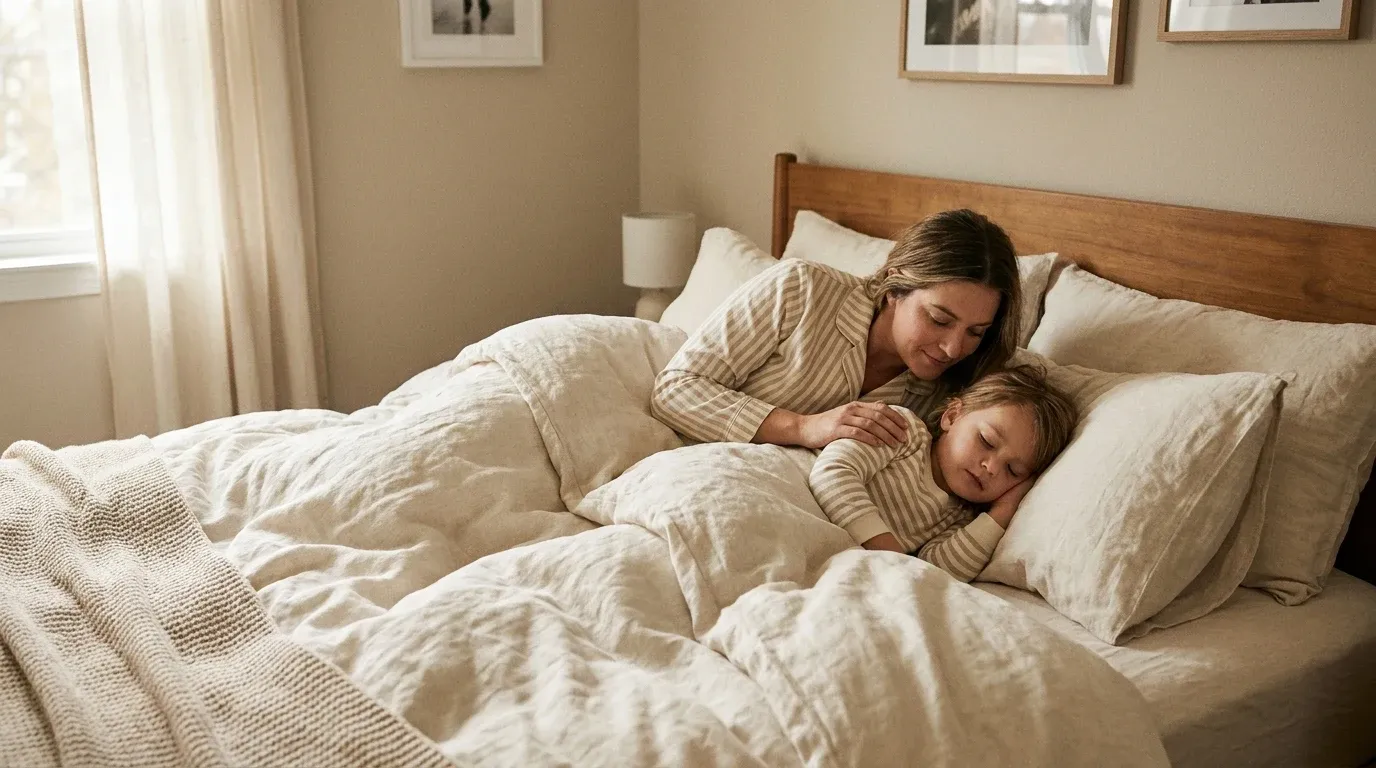
If your child is struggling to get enough sleep, the answer probably isn't a better mattress or a white noise machine. New research from the Japanese Society of Sleep Research points to something closer to home: you. Specifically, the bedtime habits parents model and enforce have a measurable, lasting effect on how much sleep elementary-age children actually get.
The findings arrive at a moment when pediatric sleep is drawing serious attention from clinicians. Screen time is up, school absenteeism is rising in several countries, and researchers are increasingly connecting those dots back to what happens in the household after dinner.
What the Research Actually Found
The study examined sleep patterns across elementary and junior high school students, tracking the relationship between parent-set bedtimes and actual sleep duration. The headline finding: when parents establish and communicate a clear bedtime, children sleep significantly longer, even when those children don't follow the schedule perfectly.
That last part matters. You don't need a household that runs like a military operation. Kids who stayed up a bit past their set bedtime still slept more overall than children with no structured bedtime at all. The act of setting an expectation, and consistently reinforcing it, changes the baseline.
Researchers also found a meaningful link between poor family sleep communication and two specific outcomes: higher rates of screen addiction and increased school avoidance. These weren't fringe cases. The associations were strong enough to suggest that bedtime structure functions as a kind of protective buffer against behaviors that compound over time.
For parents already managing screen time battles, this reframes the problem. It's not just about limiting devices. It's about whether the family has a shared understanding of when the day ends.
The Developmental Window You Shouldn't Miss
One of the more striking aspects of the research is what happens in junior high. The effect of parental bedtime-setting weakens substantially once children hit adolescence. That shift isn't surprising to sleep researchers. Puberty triggers genuine biological changes in circadian rhythm, pushing teenagers toward later sleep onset. Fighting that biology is hard, and the data reflects it.
But the flip side is important: the elementary years represent a clear window where parental influence on sleep is both strong and actionable. If you have a child between roughly ages six and eleven, the habits you establish now are doing real work. Waiting until sleep problems become visible, or until your child starts avoiding school, is waiting too long.
This is consistent with what broader sleep science has documented. What a Sleep Study Reveals About Your Heart and Lungs underscores how sleep architecture during critical growth periods affects long-term physiological development, not just daily alertness. The stakes aren't only behavioral.
Screen Addiction and School Avoidance: The Sleep Connection
The link between poor sleep structure and screen addiction deserves more than a passing mention. Research consistently shows that sleep deprivation reduces executive function, including the ability to regulate impulse control. A tired child is neurologically less equipped to pull themselves away from a screen. The screen then delays sleep further. The cycle reinforces itself quickly.
School avoidance follows a similar pattern. Chronic sleep insufficiency leads to fatigue, difficulty concentrating, and heightened emotional sensitivity. For some children, school becomes associated with a state of feeling consistently overwhelmed. Avoidance is a coping response to that state, not the root cause.
What the Japanese Society of Sleep Research data suggests is that bedtime structure disrupts these cycles before they start. It's not a cure for clinical anxiety or screen addiction disorder. But it's a meaningful upstream intervention that costs nothing.
Routine Over Hours: The Key Lever
Parents often focus on total sleep hours, and those numbers do matter. The American Academy of Sleep Medicine recommends nine to twelve hours for children aged six to twelve. But the research points to something more controllable and arguably more impactful: consistency of routine.
A child who sleeps nine hours but goes to bed at a wildly different time each night doesn't get the same cognitive and emotional benefit as a child on a consistent schedule. The body's internal clock responds to regularity. When bedtime shifts by ninety minutes or more across the week, which is common in households where weekends follow completely different rules, that variability creates a kind of chronic mild jet lag.
The practical implication is that you don't need to be rigid about an exact hour every single night. What you need is a narrow window and a set of pre-sleep rituals that signal to the child's nervous system that the day is winding down. That might include dimming lights, stopping screens, a bath, reading, or some version of each. The specific activities matter less than the consistency with which they happen.
If stress in the household is making it hard to stick to routines, that's worth addressing directly. Dance Beats Yoga and the Gym for Stress Relief, Science Says covers approaches to adult stress reduction that don't require much time or equipment, which is relevant when you're also managing children's schedules.
What Parents Can Do Starting Tonight
The research doesn't prescribe a specific protocol, but the findings point toward a few concrete actions that families can implement without waiting for a pediatrician appointment.
- Set a verbal bedtime expectation. Tell your child specifically what time you expect them to be in bed, not just heading upstairs. The communication itself has measurable impact, according to the data.
- Keep it consistent across weekdays and weekends. A ninety-minute swing on Saturdays is enough to disrupt the body clock. Try to hold within thirty to forty-five minutes of your target time across all seven days.
- Create a wind-down sequence, not just a cutoff. Abrupt transitions from high stimulation to expected sleep don't work well physiologically. Give the child a thirty to forty-five minute transition period before the actual target sleep time.
- Remove screens from the bedroom. This is the intervention with the most consistent support in sleep research. Not just at bedtime. Overnight. A phone that buzzes with notifications at 2 a.m. is incompatible with restorative sleep, even if the child doesn't consciously wake fully.
- Model the behavior yourself. Children in elementary school are highly attuned to what adults do. If parents are visibly scrolling on devices at 11 p.m. with no apparent wind-down routine, that signal registers.
That last point connects to something the research implies but doesn't state outright. The quality of family sleep communication isn't just about rules handed down to children. It's about the overall culture of sleep in the home. Families where adults treat sleep as a priority, rather than something that happens when everything else is done, raise children with better sleep outcomes.
The Bigger Picture for Family Wellness
Sleep research in children has historically focused on individual clinical interventions: sleep studies, melatonin protocols, cognitive behavioral therapy for insomnia. Those tools have their place. But this research is a reminder that population-level change in children's sleep health will more likely come from household behavior than from clinical programs.
That framing also opens up how parents think about their own sleep. The habits you build for your child's benefit have a reasonable chance of improving your own sleep too. A household with a consistent wind-down routine and screen-free bedrooms is a better sleep environment for everyone in it, including adults.
If you're looking at the broader landscape of recovery and wellness, sleep sits at the center of nearly every outcome. Tart Cherry Juice and Recovery: What the Evidence Shows explores one evidence-backed tool for improving sleep quality in adults, which may be worth considering alongside structural changes at home.
The research doesn't ask families to be perfect. It asks them to be consistent, to communicate expectations clearly, and to take the evening seriously as a time that shapes the next day's health. For elementary-age children, that window is open right now. The evidence suggests it won't stay open indefinitely.
If your family is navigating a broader wellness reset and sleep is just one piece of the puzzle, The Fall Recovery Reset: How to Actually Bounce Back Now offers a practical framework for rebuilding healthy habits across multiple areas at once.