
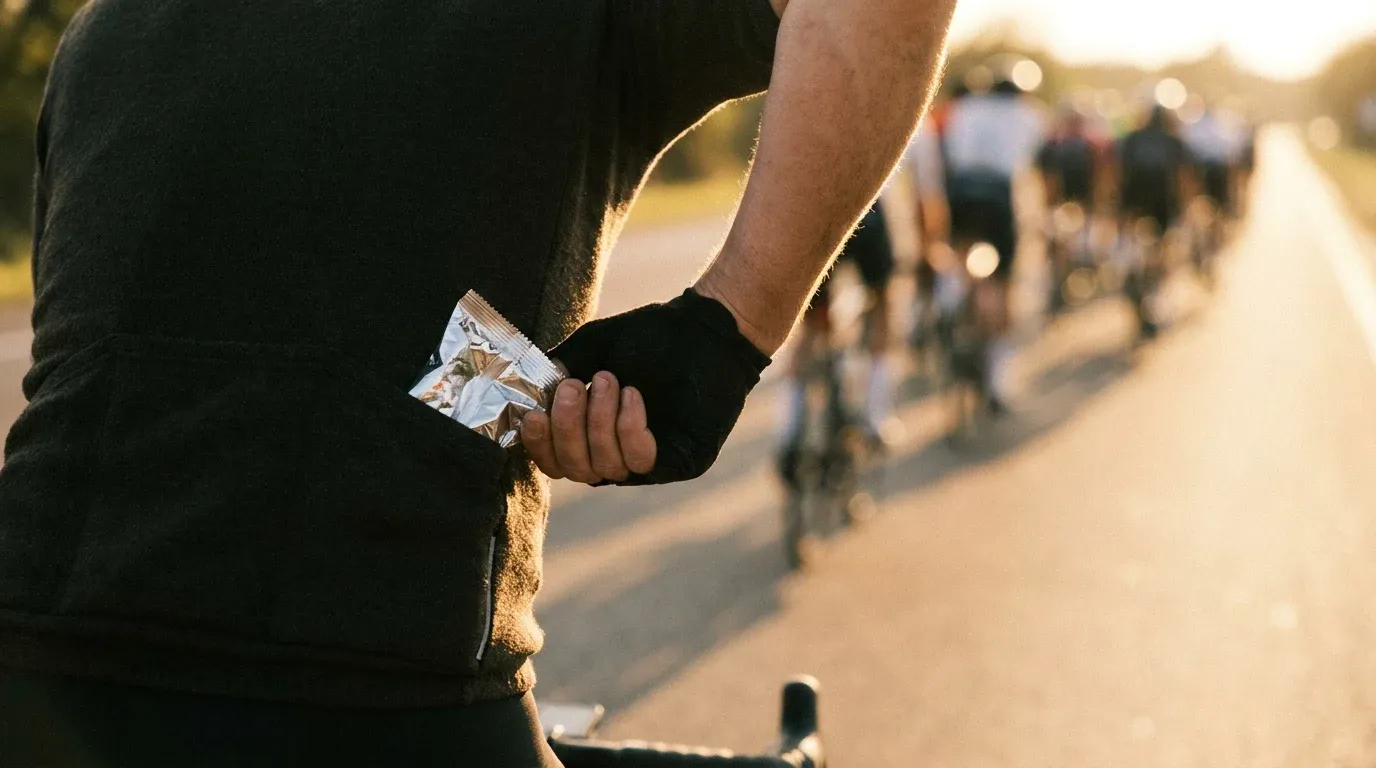
Somewhere in the middle of a mountain stage in the early twentieth century, a professional cyclist pulled a piece of bread from his jersey pocket, washed it down with wine, and kept pedaling. That wasn't an exception. That was the protocol. For decades, endurance athletes fueled on instinct, tradition, and whatever happened to be available at roadside feed zones. The science simply didn't exist yet.
It does now. And the transformation that happened between that wine-soaked bread and today's precisely dosed carbohydrate blends tells you almost everything you need to know about modern sports nutrition. Not just for cyclists. For anyone who trains hard and wants their body to perform.
What Early Cyclists Actually Ate Mid-Race
The early Tour de France was an endurance ordeal that made today's racing look almost comfortable. Stages routinely exceeded 400 kilometers. Riders set off before dawn and finished in darkness. And they fueled accordingly, which is to say, poorly by any modern measure.
Steak was common. So was bread, cheese, and coffee. Alcohol appeared regularly, partly for perceived energy, partly for pain management on roads that barely qualified as roads. Riders also smoked cigarettes, which were believed to open the airways. Nobody was tracking macros. Nobody understood what glycogen was, let alone that depleting it was the primary reason athletes hit the wall.
The concept of "bonking," that sudden, catastrophic energy crash that turns strong legs into concrete, was known to every rider. The cause was not. It was attributed to weakness, poor pacing, bad luck. The real mechanism, glycogen depletion in working muscles and the liver, wouldn't be properly understood for decades.
The Science Catches Up: The 1980s and 1990s Shift
Glycogen research had been accumulating since the 1960s, but it took another twenty years for the findings to reach applied sports nutrition in any meaningful way. By the 1980s, researchers had established clearly that endurance performance was tightly coupled to glycogen availability, and that carbohydrate consumption during exercise could sustain output when internal stores ran low.
This reframing was significant. It moved fueling from a comfort strategy to a performance variable. Sports drinks emerged. Gels followed. The idea that you could eat and drink strategically during a race, not just reactively when you felt terrible, began to take hold.
Professional cycling was an early adopter, partly because the sport's structure created natural experimentation. Long races, controlled team environments, and obsessive attention to marginal gains meant that nutritional innovation got tested quickly. By the mid-1990s, elite riders were consuming carbohydrates at rates of 60 to 90 grams per hour during major events. Steak was gone. Rice cakes and maltodextrin drinks were in.
The 120g/hr Threshold: Where We Are Now
Current elite cycling nutrition has moved well beyond that 1990s baseline. The cutting edge today operates around 120 grams of carbohydrate per hour during high-intensity stages. That number would have been dismissed as physiologically impossible two decades ago. The gut, the thinking went, simply couldn't absorb carbohydrates that fast.
What changed the equation was understanding multiple-transporter carbohydrate blends. Glucose and fructose are absorbed through different intestinal transporters. Glucose uses SGLT1. Fructose primarily uses GLUT5. When you consume only glucose, SGLT1 saturates at roughly 60 grams per hour, and absorption stalls. But when you combine glucose (or maltodextrin, which breaks down to glucose) with fructose at roughly a 2:1 ratio, you engage both pathways simultaneously and push total absorption significantly higher.
Multiple studies have confirmed that trained athletes consuming multiple-transporter blends can absorb and oxidize carbohydrates at 90 to 120 grams per hour without the gastrointestinal distress that would cripple someone using single-source glucose at the same rate. This isn't a small performance upgrade. Research has shown that moving from 60g/hr to 90g/hr of multiple-transporter carbs can improve prolonged cycling time trial performance by several percentage points.
Professional teams now work with nutritionists who design intra-race fueling down to the gram. Energy bars, gels, rice cakes, chews, and custom drink mixes are sequenced across a six-hour stage with the same precision you'd apply to a training plan. The era of improvised roadside steak is definitively over.
Your Gut Is a Trainable Organ
Here's where it gets directly relevant to you, even if you've never raced a bike in your life. Absorbing 120 grams of carbohydrate per hour doesn't happen automatically. The gut has to be trained to handle it, just like your legs have to be trained to handle volume.
Gastric emptying rate, the speed at which food leaves your stomach and enters the small intestine, is one limiting factor. Intestinal transporter density and efficiency is another. Both adapt to consistent exposure. Athletes who practice high-carbohydrate fueling during training gradually develop a gut that tolerates and absorbs more without cramping, bloating, or nausea.
This matters because a lot of recreational athletes skip fueling in training, then attempt to eat aggressively during races or long events, and end up with a stomach revolt at kilometer 50. The gut isn't ready for the load because it was never trained for it. Think of gut training the same way you think of base fitness. You build it progressively, starting with modest intake and increasing over weeks.
Supporting your overall digestive health pays dividends here too. Gut Health for Athletes: Why Fermented Food Wins makes the case that a robust gut microbiome helps manage the intestinal stress that comes with high-carbohydrate fueling during intense exercise. It's worth reading if you're building a serious fueling practice.
How This Translates Across Endurance Sports
Cycling pioneered the 120g/hr approach, but the methodology has spread. Elite triathletes competing in Ironman events now follow carbohydrate protocols that would have looked extreme even five years ago. Top ultrarunners are fueling at 80 to 100 grams per hour on long technical courses. Team sport athletes in football and rugby are increasingly applying multiple-transporter logic to half-time fueling and training sessions exceeding 90 minutes.
The common thread is duration. Below 60 to 75 minutes, your glycogen stores are generally sufficient and fueling during exercise provides minimal performance benefit for most people. Beyond 90 minutes, the picture changes sharply. Glycogen depletion becomes a real performance limiter, and what you consume during the effort becomes a significant competitive variable.
What Non-Elite Athletes Should Actually Do
You don't need to reach 120 grams per hour. That ceiling is calibrated for athletes sustaining very high power outputs for many consecutive hours under professional monitoring. But the underlying principles scale down cleanly, and applying them will improve how you perform and recover.
For any endurance effort lasting more than 90 minutes, here's where the evidence points:
- Target 60 to 90 grams of carbohydrate per hour once you've built gut tolerance. Start lower (30 to 40g/hr) and increase over several weeks of practice.
- Use multiple-transporter blends, not single-source glucose. Most quality sports products now contain maltodextrin plus fructose or glucose plus fructose. Check labels for the ratio. Aim for approximately 2:1 glucose-to-fructose.
- Fuel during training, not just racing. Your gut needs practice. Long training sessions are the right place to dial in your intake and identify tolerance limits before they become problems on race day.
- Combine solid and liquid sources strategically. Gels are convenient but become unpleasant after a few hours. Real food, rice cakes, bananas, and homemade bars, can sustain palatability across longer efforts.
- Start early, not when you're already struggling. Fueling is preventive. By the time you feel low energy, you're already behind. Begin consuming carbohydrates within the first 30 minutes of an effort that will last over 90.
It's also worth noting that the broader nutritional foundation you carry into training matters. Gut function, absorption efficiency, and even baseline energy metabolism don't exist in isolation from your overall diet quality. If you're curious about how micronutrient status affects performance, Do You Actually Need a Multivitamin? A Straight Answer provides a grounded look at where supplementation does and doesn't move the needle.
The Bigger Lesson From Cycling's Evolution
What makes cycling's nutritional history compelling isn't just the technical progression. It's what that progression reveals about how sports science works. Riders were bonking in the 1920s for the exact same biochemical reasons they bonk today. The physiology didn't change. The understanding of it did.
And when that understanding improved, performance improved with it. The athletes didn't get genetically stronger between 1960 and 2000. They got better coached, better fueled, and better supported by science that finally caught up to the demands they were placing on their bodies.
That same dynamic applies to you. Your gut can absorb more than you're probably giving it credit for. Your performance in long efforts can be meaningfully supported by carbohydrate intake you're probably skipping. The limiting factor isn't your physiology. It's familiarity with a protocol that's now well established and accessible to anyone willing to train it.
Recovery is the other side of this equation. How well you absorb and process fuel during exercise connects directly to how quickly you bounce back afterward. Cold Water Immersion: When It Actually Speeds Recovery and the role of metabolic restoration after glycogen-depleting efforts are worth exploring together if recovery quality is something you're actively working on.
The rider eating steak mid-stage in 1925 wasn't doing anything wrong given what anyone knew at the time. But you don't have that excuse. The science is here. The protocols are practical. The only question is whether you're going to use them.