
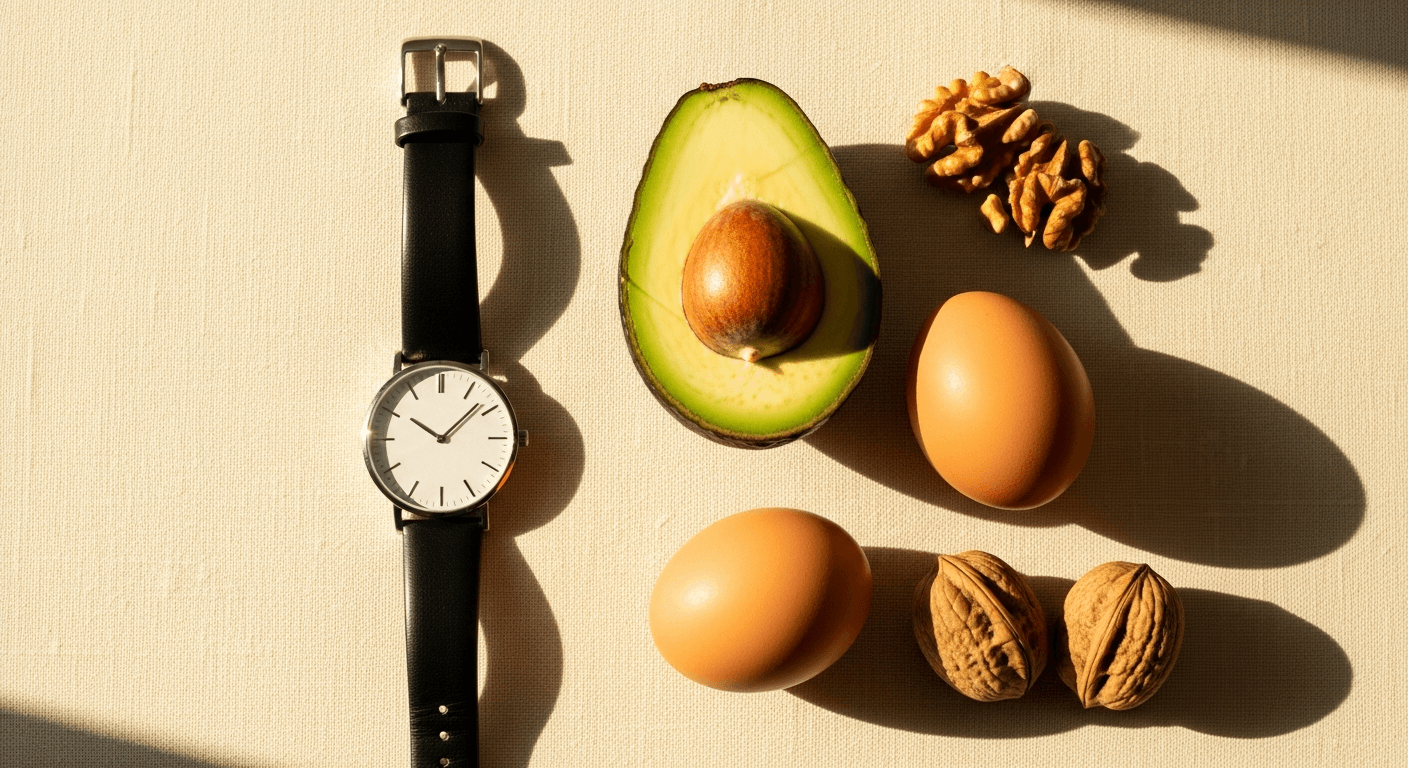
Somewhere between intermittent fasting influencers and pre-workout timing guides, a reasonable question got buried: does when you eat actually matter more than what you eat? For most people with ordinary schedules and moderate training loads, the answer is no. But the nuance matters, and getting it wrong costs you results.
Here's what the current evidence actually says, stripped of the marketing noise.
The Timing Obsession Was Always a Little Overblown
The past decade produced a flood of content around eating windows, circadian nutrition, and post-workout protocols. Much of it was built on research conducted in highly controlled lab settings, with elite athletes or very specific populations. That context rarely survived the translation to general advice.
For sedentary adults and recreationally active people, consistent data shows that total calorie intake and diet quality drive body composition outcomes far more reliably than meal timing. A 2024 meta-analysis covering over 20,000 participants found that when total protein and calorie intake were matched, time-restricted eating produced no significant advantage over standard eating patterns for fat loss or muscle retention in non-athletes.
That doesn't mean timing is irrelevant. It means you shouldn't be structuring your entire life around an eating window if your training is three sessions per week and your diet is mostly processed food. Fix the food first.
Food Quality Still Wins for Most People
If you're not training for performance, the variables that consistently predict better outcomes are: protein adequacy, fiber intake, whole food density, and overall calorie awareness. These aren't exciting. They don't have apps built around them. But they work across demographics, age groups, and activity levels.
Studies published through 2025 continue to reinforce that highly processed food consumption is independently associated with worse body composition, even when calories are controlled. The mechanism involves appetite dysregulation, lower satiety signaling, and reduced thermic effect of food compared to minimally processed alternatives.
Timing strategies layered on top of a low-quality diet don't fix these problems. An eight-hour eating window filled with ultra-processed snacks is still an eight-hour window of poor nutrition. The window doesn't do the work.
For practical guidance on building a higher-quality pre-training plate, what to eat before training matters more than when you eat it for most recreational lifters and runners.
The One Timing Variable That Actually Has Strong Evidence
Here's where timing earns its place: protein distribution across the day.
This is not the same as hitting a total daily protein target. Research increasingly shows that spreading protein intake across three to four meals, rather than loading it into one or two, meaningfully improves muscle protein synthesis. The threshold effect is relevant here. Each meal triggers a finite anabolic response. Once you exceed roughly 40 to 50 grams of high-quality protein in a single sitting, you're not getting proportionally more muscle-building stimulus from that meal.
A 2025 review in a major sports nutrition journal confirmed that distributing 1.6 to 2.2 grams of protein per kilogram of bodyweight evenly across four meals produced significantly better lean mass outcomes than the same total concentrated in one or two meals, even when total intake was identical.
This applies to both athletes and older adults. For people over 50, where anabolic resistance makes muscle maintenance harder, protein distribution may be the highest-leverage nutritional variable available outside of total intake itself.
So if you're eating 160 grams of protein per day but consuming 100 grams at dinner, you're leaving real gains on the table. Redistribute. That's a timing intervention worth making.
Post-Workout Windows: Real but Much Wider Than You Were Told
The anabolic window concept. the idea that you have a narrow 30-to-45-minute post-workout period to consume protein or lose the adaptation. drove supplement industry sales for years. It also created a lot of unnecessary anxiety around gym bags full of shakers.
Current evidence puts the effective post-exercise window at three to five hours for most training scenarios, not 30 to 45 minutes. The urgency collapses almost entirely if you ate a protein-containing meal within two hours before training. Your muscles aren't waiting with a stopwatch.
The exception is fasted training. If you've trained first thing in the morning without eating, the post-workout meal does carry more urgency. Getting 30 to 40 grams of protein within an hour of finishing makes physiological sense in that context. But this is a specific condition, not a universal rule that applies to everyone who finishes a gym session.
For athletes in heavy training blocks, recovery nutrition compounds over days, not hours. What you eat across the full 24-hour period after a hard session matters more than what you eat in the first 30 minutes. This connects to recovery-focused eating patterns covered in foods that actually speed up recovery, where the emphasis on consistent nutrition across the day holds up better than acute timing strategies.
When Timing Actually Matters: A Practical Decision Tree
Rather than applying one rule universally, use your training volume and goals to decide how much timing attention is worth your energy.
You can largely ignore meal timing if:
- You train fewer than four sessions per week at moderate intensity
- Your primary goal is general health, fat loss, or weight management
- Your diet quality is still developing (focus there first)
- You're not competing or working toward a performance deadline
In these cases, consistent protein intake spread across the day and a whole-food-dominant diet will produce better results than any timing protocol you layer on top.
Timing becomes worth your attention if:
- You train five or more sessions per week, including high-intensity work
- You're in a calorie deficit while trying to preserve muscle mass
- You train twice per day or in back-to-back sessions within 24 hours
- You compete in strength, endurance, or team sports with performance benchmarks
- You're over 50 and actively working to maintain or build lean mass
For competitive athletes, timing layered on top of quality nutrition genuinely produces compounding benefits. Carbohydrate timing around high-volume sessions, protein distribution across four meals, and targeted post-workout nutrition all contribute measurable improvements in recovery and adaptation. Tools that help personalize this are evolving quickly. AI-driven sports nutrition tools are now offering individualized timing recommendations that go beyond generic templates, though the quality of these tools varies significantly.
The Variables People Overlook Entirely
While the timing debate runs hot, two factors that demonstrably outperform both timing and content strategies get almost no attention in mainstream nutrition content.
Sleep is one. Poor sleep disrupts appetite-regulating hormones, increases calorie intake the following day by an average of 300 to 500 calories in controlled studies, and impairs muscle protein synthesis regardless of what you eat or when. the impact of poor sleep on recovery in active adults is one of the most underappreciated drivers of stalled progress in recreational athletes.
Consistency is the other. The most precisely timed meal plan abandoned after three weeks produces inferior results to an imperfect plan maintained for six months. Adherence is the real performance variable, and it's almost impossible to measure in a lab, which is why it gets less research attention than it deserves.
The same logic applies to training. Research continues to challenge the idea that optimizing every variable produces proportionally better outcomes. new global guidelines on training intensity suggest that more moderate, sustainable approaches outperform aggressive optimization for most non-elite athletes over time.
The Practical Bottom Line
If you're spending more mental energy on eating windows than on what's actually in your meals, you're working in the wrong order. For the overwhelming majority of people, diet quality and composition do the heavy lifting. Timing is a refinement layer, not a foundation.
The one timing strategy worth implementing universally is protein distribution. Spread your daily protein across three to four meals. Don't skip breakfast protein. Don't load everything into dinner. That single shift is supported by stronger evidence than almost any other timing intervention available.
For athletes in serious training, the post-workout window deserves attention but not anxiety. Eat well before you train, eat well after, and keep the full day in frame. The compounding effect of consistent, high-quality nutrition across weeks and months will outperform any acute timing optimization you can engineer around a single session.
Precision is a tool. Use it when it's warranted. For most people, most of the time, it isn't.